Showing posts with label Fire Exit. Show all posts

Friday, December 11, 2015

Burn Survivor from The Station Nightclub fire speaks-out for the NFPA

On February 20th, 2003, a fire broke out in a nightclub that killed 100 people in just minutes.  Rob Feeney was there, and was one of the lucky ones that got out before the fire and smoke became to intense to survive.  Join Rob to read more about his experience at the NFPA's Fire Sprinkler Initiative blog.

http://sprinkler.blog.nfpa.org/2015/12/burn-survivor-from-the-station-nightclub-fire-now-nfpas-newest-blogger-and-fire-sprinkler-champion.html

For other posts about nightclub fires use the Theatre Safety Blog's search for keyword 'Station Nightclub'.


Sunday, November 1, 2015

Nightclub Fire in Romania Kills 27, Injures 170

2015-10-31 - Bucharest, Romania - An late night fire in a basement nightclub claimed 39 lives, injured over 190, and was completely predictable and preventable.  A heavy metal band Goodbye to Gravity gave a free Halloween concert at the Colectiv nightclub just south east of the city center, and during the show some fireworks (pyrotechnics) were set-off which ignited a foam covered column that was adjacent to the stage.  Witnesses said the fire rapidly spread across the foam and pine wood covered ceiling causing a panic in the crowd.


Ironically, the band had just played 'This is the Day We Die' from their new CD "Mantras of War", and then as they started into the next song the fire started.  Delia Tugui, a Spanish teacher at the American International School of Bucharest who was at the concert with her husband and son, said club goers were surprised by how fast the fire spread and panicked.
Moments before the fire
"The lead singer made a quick joke: 'This wasn't part of the program.'  The next second, he realized it wasn't a joke and asked for a fire extinguisher," she wrote on her Facebook page.  "In 30 seconds . . . the fire spread all over the ceiling.  People rushed to the entrance but it was too narrow, and people panicked.  Behind me people stampeded, climbing over each other, to try and get out."
The fireworks spray towards the foam covered column
"I was two meters from the door and I barely got out," she told The Associated Press.  "People started pushing each other, stamping on each other, it was incredibly quick."
Patrons still smiling unaware of the hell that was about to break loose
"Friends were looking for each other under the pile of people," she said. "It was a nightmare."

She said she knew some would not escape.

"I realized that those on the other side of the bar would not get out alive."

Once she got outside there was a blast and her hair caught fire, Tugui said.

"I tried to put it out with my hands and got burned.  People behind me were burned from head to toe."

A  3D computer generated graphic of the nightclub fire can be seen here.

The band’s lead singer, Alex Pascu, was hospitalized and later died.  Antena 3 TV said bass guitarist Alex Telea was reported missing by his parents, who have been searching for him.  he is also confirmed dead.

Florentina Dinca, 38, who lives opposite the nightclub, told The Associated Press there was chaos as emergency workers tried to aid the badly burned clubgoers.

"They were very frightened, they screamed, ambulances didn't know what to do," she said.  "Girls had their hair burned, they had burns on their faces.  It was terror."

“There was a stampede of people running out of the club,” a man who escaped without shoes told Reuters.

A young woman who sustained minor injuries described the club bursting into flames.  “In five seconds the whole ceiling was all on fire. In the next three we rushed to a single door,” she told television station Antena 3.

The nightclub had only one entrance / exit and it was just 80cm wide (31 1/2").  Paul Angelescu, a reporter with ProTV, said the mayor told him the venue had all the necessary permits to operate as a club, however, they did not have permits for any pyrotechnic use.  Further investigation will determine if the facility was indeed compliant with current local building codes.

The club was said to have 300-400 in attendance that night, and some were minors. It was only permitted for 80 occupants.  In Romania it is permissible for adults to bring their children into nightclubs, and occasionally unaccompanied minors enter the clubs because the monitoring of age is very lax.

The nightclub is one of dozens of clubs and bars that have sprung up in the Romanian capital in recent years, a lively city of 3 million renowned for its nightlife and long hours.

Shooting candles and indoor fireworks are common in bars and restaurants in Romania and enforcement of fire regulations is poor.

Twelve hospitals were filled with burn and smoke inhalation victims, and hundreds lined-up outside to donate blood.  The death toll is expected to rise.

Update:  Thousands of protesters in Romania have been gathered in Bucharest expressing anger towards the government for the lax building code enforcement that led to this tragedy.  Prime Minister Victor Ponta and his Cabinet resigned Wednesday, November 4 in response to public demands for accountability.

If this story seems all-to-familiar, numerous nightclub fires have been initiated by the illegal use of pyrotechnics which ignite foam materials used for sound absorption.  These include The Station nightclub fire in 2003 at West Warwick, Rhode Island, which killed 100 people; and and the Kiss nightclub fire in Santa Maria, Brazil, which killed 242 people.

More coverage can be found at:  https://en.wikipedia.org/wiki/Colectiv_nightclub_fire

This blog entry updated 2015-11-07-10:15PM

Saturday, April 6, 2013

Fire and Audience Safety in Nightclubs

I went to a nightclub / restaurant tonight to get a bite to eat, and they had me seated upstairs in a balcony area that overlooked the main level of the nightclub.  Just as I was getting ready to leave, I went to go down the staircase that I had originally come-up, only to find that it was blocked with a portable sign that read:  "Stairs Closed" hand-scrawled in chalk.

There were no other instructions, signs, arrows . . . nuttin!  And the  EXIT  sign above the 'closed' stairs was still illuminated, beckoning all to "come-hither".

I look over the railing back towards the bottom of the staircase, and I see that the club has cordoned-off what was the main entrance to the club, and a band is loading-in their stuff.  The usual junk is piled every which-way: drums, speakers, guitars, mic stands, road cases . . .

Huh?  I look again, a sure enough, my eyes are not fooling me, they have removed the host stand and they are using the main entrance to the club as the stageI can see the glowing red  EXIT  signs over the doors.  I look around upstairs and I do find another exit, although it's not well-marked. So this means that 1/2 the upper balcony audience may have to go down the other stairs, and 1/2 may have to find their way out through the adjacent bar area (again - the  EXIT  sign in the adjacent bar area is NOT visible from the show room balcony seating area).
Band Set-up in front of EXITs

Next, I go downstairs to get a better look.  Once there, I see that at the bottom of the 'closed' staircase (which ended right at one of the two front doors), they had amplifiers and junk stacked in the travel path.  So I look around some more.  To the other side of the other main entrance / exit door there was a doorway that went into a souvenir shop at the time I came in to dine.  The souvenir shop had another exit door to the street, but now it was closed-off and inaccessible.  I moved away from the band's makeshift performance area and I found a passage out to anther adjacent part of the bar, it has an  EXIT  sign, but the lamps are burned-out, and the passage is circuitous and poorly illuminated.

I follow that passage into the adjacent bar chamber, and I can see two possible egress routes.  One has a vestibule with another door leading to the outside, but the  EXIT  sign for this door is only visible to about 1/2 of the room, or less.  I walk closer to this exit door and gradually the overhanging soffit that forms the vestibule area around the door reveals that there is an  EXIT  sign above the door.  Mystery solved!

Final count:  One functional exterior EXIT from upstairs (sign not visible from the balcony audience area), Two functional exterior EXITS from downstairs (one of which the sign is mostly obscured, neither of which are visible from the central audience area for the make-shift stage).

This means that a space that had SIX exits during the day (a light density crowd, mostly people dining) when the Fire Marshal visited and there was a lot of outside light filling the space through the windows; and only had THREE working exits at  night  when the patrons are highly inebriated and more densely packed.   All this on a Friday night in a college town . . .

Friday, November 23, 2012

70th Anniversary of Cocoanut Grove Nightclub Fire

QUINCY, MA -- The National Fire Protection Association (NFPA) has teamed up with a number of public and private organizations to form The Cocoanut Grove Coalition to preserve the history of the monumental nightclub fire that took the lives of 492 people 70 years ago.

The deadliest nightclub fire in U.S. history occurred in Boston on November 28, 1942. The coalition includes the Boston Fire Department, the Boston Fire Historical Society, Boston Fire Museum, City of Boston Archives, Boston Public Library, and Massachusetts General Hospital.

According to Sue Marsh, the NFPA’s librarian, time was of the essence as all agreed that it was vital not to let more time pass before gathering additional resources, especially personal accounts from those impacted by the fire, “knowing that if we didn’t, things would be lost.”

Three videos in which Cocoanut Grove fire victims tell their stories exemplify the rich content that has come from these collections and this project.

All of the organizations represented in the coalition have material related to the fire. The intent of the project, according to Marsh, is to provide a single way to access all of the information as well as attract additional information that is out there but has not surfaced.

The NFPA library receives more requests related to Cocoanut Grove than any other incident.

“Unlike some earlier landmark fires, like the Triangle Shirtwaist Co. fire in New York in 1911, the Cocoanut Grove fire did not result in significant changes to NFPA codes,” writes Fred Durso, Jr. in the November / December 2012 issue of the NFPA Journal.

However, Boston and municipalities throughout the country underwent sweeping changes, including the reclassification of nightclubs and restaurants as places of public assembly, which is how they were already regarded in the Building Exits Code. The change introduced more stringent requirements for exits, emergency lighting, occupancy capacities, and other safety features.”
For more information, visit The Cocoanut Grove Fire website, www.cocoanutgrovefire.org.

Friday, August 19, 2011

NFPA Announces New Editions of Codes and Standards

Theatres are complex buildings, and they don't usually don't come with an Instruction Manual. You need to know what you can do, and what you can't do. And it usually helps if you can quote the authorities 'Chapter and Verse'.  This way people understand that it's not you that's being a pain in the butt, but that there really is a law, rule, or standard that defines the proper way to handle situations around the venue.

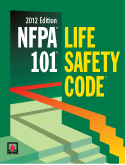
The 2012 NFPA 101 Life Safety Code has been made available for purchase on the NFPA web site:
http://www.nfpa.org/catalog/product.asp?pid=10112&title=2012-NFPA-101-Life-Safety-Code&category_name=&target_pid=10112&source_pid=10109&link_type=edition_change

This edition has changes that relate to egress paths, so they have used that theme on the cover design.


The 2012 NFPA 204 Standard for Smoke an Heat Venting (that smoke hatches / vents over the stage for the theatre folks) has also been updated and information can be found here:
http://www.nfpa.org/catalog/product.asp?pid=20412&title=2012-NFPA-204-Smoke-and-Heat-Venting&category_name=&target_pid=20412&source_pid=20412&link_type=edition_change

This describes the means of operations, quantity required, and recommended inspection procedures and scheduling.

If you have a Fire Curtain (many theatres) or Fire Doors (almost all buildings), then you need to fully understand the requirements for inspecting and testing these critical devices.  The 2010 NFPA 80 Standard for Fire Doors and Other Opening Protectives is the key to this part of your facility management.

This talks about door props, latches, crash bars, automatic closers, painting doors, and identifying Fire Doors.

Also of interest to many is the 2011 NFPA 70 National Electric Code which is everything you need to know, and them some, about electrical issues.  There are sections about the wire and cable we are permitted to use in the theatre environment, special requirements for dressing room lights and power receptacles, and many important items.  Product information can be found here:
http://www.nfpa.org/catalog/product.asp?pid=7011SB&title=Code-70-2011-National-Electrical-Code-NEC-Softbound&category_name=&target_pid=7011SB&source_pid=7008SB&link_type=edition_change

The companion book for those working on electrical equipment (almost all of us, whether we should or not) is the 2012 NFPA 70E Standard for Electrical Safety in the Workplace.  This addresses Lock-Out-Tag-Out (LOTO) procedures, ArcFlash, working 'HOT', and many other life-threatening activities when working with electricity.
http://www.nfpa.org/catalog/product.asp?pid=70E12&title=2012-NFPA-70E-Standard-for-Electrical-Safety-in-the-Workplace&category_name=&target_pid=70E12&source_pid=70E09&link_type=edition_change

Many of the NFPA publications have companion Handbooks that are available that break-down the codes and standards into manageable concepts with great graphics and explanations describing both proper and improper conditions.

Put these books in your budget.  Each one usually has a 3 to 5 year update cycle, so setting aside the funding for each of these should be a simple task.  If you need justification for the expenditures, then ask the powers that be how you are supposed to do your job without the actual books that define the Laws you must obey and the Standards to which you should adhere.

Warning:  Reading these books may induce drowsiness. Do not drive or operate heavy machinery while reading them.

Tuesday, July 19, 2011

Fire Doors 101


Associate Editor Kylie Wroblaski at Buildings.com posted a good article about Fire Doors:

www.buildings.com/Default.aspx?TabId=3334&ArticleID=10186

Take note of the
other posts on Fire Doors to see how they play in your theatre.


Make a pre-emptive strike against the spread of smoke and fire by keeping all fire doors closed and latched unless you are moving equipment or personnel through the door.  Do not prop fire doors open with chairs, microphone stands, stage weights, flag poles, desks, speakers, pianos, boxes, backpacks, wedges, flip-down props / stops, or by tying the handle to a nearby railing or wall.  If the door cannot close and latch on it's own, then it must be repaired.

Friday, July 15, 2011

Rihanna Concert Shutdown By Fire on Truss

The concert on 10 July 2011, in Dallas, Texas' American Airlines Center Arena (AAC) came to an abrupt halt after some pyrotechnics started a fire on a lighting truss near the front of the stage.  Witnesses say the front rows of the audience quickly cleared-out after sparks and fire started spewing from the truss.  Local TV station and CBS affiliate KTVT had first-hand reporting because several of their employees were attending the show.  KTVT's coverage of the situation can be found here:  http://dfw.cbslocal.com/2011/07/08/rihanna-concert-ends-with-fire/

A video of the fire shot by concert goers can be found on YouTube:


Up close view:


Quick acting show crew managed to get to the blaze with a fire extinguisher and subdue the flames.  (Not an easy task 30' in the air on a wiggly piece of truss!  Kudos to that guy!)  It appears that the AAC and concert promoter Live Nation didn't have a coherent emergency plan, as it was several minutes before the arena lights came up, and then another minute before an announcement was made that the show was over and that patrons should exit the facility.  Although there was some sense of urgency by the crowd that caused a back-up at the arena exits, once they made it to the concourse they were greeted by vendors still trying to sell them t-shirts and other souvenirs.  Hmmm.  What part of 'LEAVE THE BUILDING" didn't they get?


When watching the video shot by local news crews at the Great White concert in the Station nightclub in East Warwick, Rhode Island, three minutes into the fire there had already killed numerous people.  So, what took so long in the AAC?  Who was asleep at the switch in Dallas?

You can hear the show cancellation announcement on some of the videos found on-line, and it's not very good sounding (OK, it was a cell-phone mic making the recording, but you can still get a sense that the speech quality was less than ideal).  Yet another reason that a professionally recorded announcement is a good idea.  The playback device should be EQ'ed so that the voice track has maximum intelligibility (i.e. not muddy with too much bass) when played-back through the venue's sound system.  It should automatically override ALL other program feeds so that any stage mics, musical instruments, and/or background music tracks are completely muted.

When there is a fire or other emergency incident during a show, there should always be someone that has the authority to call the show, get the lights on, and see to it that an appropriate announcement is made to the audience without any delay.  There is no time to think abut Box Office losses, only people's lives.

Know the difference between a safety plan and an emergency plan - the first is what you need so you don't need the second,  The second is what you need when the first one wasn't successful.  An article published in the IAVM (formerly IAAM) Facility Manager magazine about this can be found here:  www.scribd.com/doc/21929545/Teqniqal-Systems-Facility-Safety-Planning

IAVM (International Association of Venue Managers) sponsors regular training classes on Emergency Planning and Employee Training to address these types of scenarios.  Is your venue a participating member?  If not, consider becoming one, as they have a large body of resources that can help any venue, large or small, non-profit or for-profit, private or public.

This blog's author, Teqniqal Systems, also provides assessment, guidance, and training for venue staffs.  Just like the Girl Scouts, you should always 'Be Prepared.'

Thursday, July 14, 2011

OSHA approves alternate definition for means of egress standard.


The U.S. Department of Labor’s Occupational Safety and Health Administration (OSHA) has recognized the International Code Council’s (IIC) 2009 International Fire Code (IFC) as an alternate compliance option for means of egress in its Occupational Safety and Health Standards.  The ICC petitioned the federal agency asking for its code to be recognized as a way for an employer to demonstrate compliance with the OSHA Exit Routes and Emergency Management (formerly called Means of Egress) requirements.

“In jurisdictions where the 2009 International Fire Code is enforced, employers whose buildings have been inspected and approved can use that approval to demonstrate compliance with OSHA requirements (Section 1910, Subpart E, Standard 1910.35),” International Code Council CEO Richard P. Weiland said. “We thank OSHA for recognizing the safety attributes of our code as well as the professional expertise and science that goes into the code’s development.”

The Council’s petition, which started in 2004, was offered on behalf of ICC Members and all jurisdictions that adopt and enforce I-Codes; building and fire code enforcement officials; and building owners and managers with facilities that are maintained in compliance with the I-Codes.

“Allowing the IFC regulations to be used for exiting buildings will save money by eliminating the need to demonstrate compliance with dual regulations, and by avoiding potential construction modifications due to conflicting codes,” Weiland said.  “OSHA’s recognition demonstrates collaboration between the agency and those who share the mission of protecting the health and safety of building occupants.”

The U.S. Department of Defense and the U.S. General Services Administration supported the Code Council’s petition along with local and state jurisdictions, including New York state, Jefferson County, Colorado, and the city of Hampton, Virginia.

Twenty-seven states with approved Occupational Safety and Health plans also will have to update their plans to incorporate the new rule within six months of the final rule’s publication.  The final rule was published in June and takes effect July 8, 2011.

The International Code Council (www.iccsafe.org), a membership association dedicated to building safety, fire prevention, and energy efficiency, develops the codes used to construct residential and commercial buildings, including homes and schools. Most U.S. cities, counties and states choose the International Codes, building safety codes developed by the International Code Council.  The International Codes also serve as the basis for construction of federal properties around the world, and as a reference for many nations outside the United States.

Thursday, December 30, 2010

107th Anniversary of the Iroquois Theatre Fire

As we start the new year let's take a moment to look around our facilities with a fresh set of eye's.  It never ceases to amaze me at the number of obvious fire hazards I see when visiting theatres, gymatoriums, cafetoriums, and other assembly spaces.

It sometimes seems like we haven't learned anything since that fateful day in Chicago where over 600 people lost their lives.  These are the common fire code violations I frequently see that also fueled the Iroquois Theatre tragedy:
Learn not to burn.  Keep your Fire and Smoke Protective Systems working properly and accessible.

Here is a blog entry from Lori Green at Ingersol-Rand Security Technologies, the manufacturers of Von-Duprin Door hardware.  They make one of the few crash-bar exit systems that don't make a lot of noise - Great for Theatres!  http://idighardware.com/2010/12/iroquois-theater-fire/

Tuesday, October 5, 2010

Blocked Fire Exits - Live at 10 o'clock

When it comes to Fire Exits, it is amazing what I find in them.  Above is an exit corridor with a big sign, a large screen rear projection TV, and other miscellaneous stuff.  Please take the time to put this junk somewhere that it does not block an exit!

Tuesday, October 6, 2009

Natonal Fire Prevention Week - A look back at the Iroquois Theatre Fire

Much hasn't changed in the last 100 years - I still routinely find Fire Exits blocked, dysfunctional Fire Curtains, and flammable scenery, props, and costumes in every theatre I visit.  These were the very cause of the Iroquois Theatre fire. Think about it!
Asbestos Fire Curtain in an older theatre

For a bit of perspective, visit the following web sites a read-up on this disaster
Please, think twice before you set the stage for another disaster.