Showing posts with label NIOSH. Show all posts

Wednesday, October 2, 2013

Ladder Safety now a smartphone application

NIOSH has released its first smart phone application (app) for mobile devices.  This free app is aimed at improving extension ladder safety by providing real-time safety information delivered via the latest technology.  Falls from ladders are a persistent source of workplace injuries.

Misjudging the angle at which an extension ladder is set-up is a significant risk factor that can be reduce and prevent falls. If an extension ladder is set too steeply, it is more likely to fall back or slide away during use, and if it is set too shallow then the bottom can slide out. The NIOSH Ladder Safety phone app has an angle of inclination indicator which uses visual and audible signals making it easier for workers and other users to set an extension ladder at the proper angle of 75.5 degrees.

The NIOSH Division of Safety Research tested and patented the concept of the app’s inclination indicator. They compared existing ladder positioning methods and found that the indicator improved both the accuracy and efficiency for extension ladder positioning. The Ladder Safety app also includes other information about ladder safety including ladder selection, inspection, accessorizing, and use. While it may seem obvious, we have to say it: for your safety, use the app to set the proper ladder angle before climbing an extension ladder.


 The app can help workers prevent falls and is also a tool for employers who want to ensure a safe workplace. The app is available through the NIOSH website, the Apple App-storeExternal Web Site Icon, and Android Apps on Google PlayExternal Web Site Icon. It works with most SmartPhones that have inclination sensors.

Friday, April 19, 2013

OSHA Campaigns for Ladder Safety

The US Occupational Safety and Health Administration unveiled a new bilingual English-Spanish booklet, "Falling Off Ladders Can Kill: Use Them Safely."  The short guide, part of OSHA's national campaign to prevent fatal falls — the leading cause of  death  in construction — provides clear, easy-to-follow information about ladder hazards and how to use ladders safely, featuring illustrations and plain language writing.  The falls prevention campaign now enters its second year and OSHA is working with the National Institute for Occupational Safety and Health (NIOSH) and the National Occupational Research Agenda on outreach.

You can download the booklet here:  www.osha.gov/Publications/OSHA3625.pdf


Don't be 'that guy' !
 ----------------------
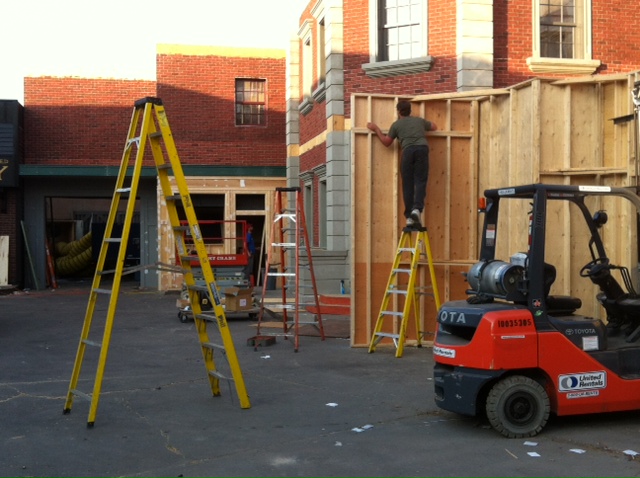
Follow-up:  Janet Sellery at Sellery Health + Safety in Canada sent me the following picture.  She commented that you'd think that just maybe this guy had access to a taller ladder, or maybe scissor lift, or  . . .


Wednesday, March 28, 2012

Emergency preparedness from the other side of the pond

Good guidance is often hard to come by, particularly for free.  Most standards to which we must operate are usually published by somebody that wants a chunk-o-change for the priviledge of reading the rules by which we must abide.  In the United States the NFPA manuals & books, ANSI standards, ASTM standards, PLASA / ESTA standards, and most Buiding Codes are priced anywhere form $20-30 bucks up to several hundreds of dollars.  Now that's not so bad if you only need one of the books, but for most of us in the theatre industry, we need maybe 15 to 50 of these to cover our collective bacon on all of the hazards and project types we are typically exposed to or involved with.  This can really add-up quick.  Especially when they change with locality and adoption dates.  Think about this the next time you hire and Architect, Engineer, or Theatre Consultant - part of your fees go to keep this library up-to-date so that they can prescribe the best and most current designs that satisfy the local code requirements.

There are a few free publications out there, too.  So here are some good resources that won't break the bank:

American's with Disabilities Act (commonly known as the ADA):
www.access-board.gov/adaag/html/adaag.htm

Occupational Health Safety Administration (OSHA):
www.osha.gov

National Institute for Occupational Safety & Health (NIOSH):
www.cdc.gov/niosh
(Great ladder safety info here!)

And with a big thank-you for the United Kingdom government:
www.communities.gov.uk/fire/firesafety/firesafetylaw/aboutguides
This is a set of Fire Safety Risk Assessment Guides that clearly and logically cover many different types of performance venues.  They may be metric (oh, the horror!) and they may be formatted on funny sized paper, but doggonit, these are good guides!

Wednesday, February 22, 2012

Ladder Safety Should Be A High Priority

Ladder Safety is an ongoing concern in the performing arts as more and more venues are constructed with inadequate access to the working parts of a production facility. Powered Manlifts are one possible solution, yet many administrators somehow think that they are less expensive than a trip to the hospital.  Even with a Powered Manlift, ladders are frequently found around many workplaces because they are a convenient way to access many items

Make a concerted effort to train students, co-workers, and administrators about Ladder Safety so that there is a consistent perspective on the subject throughout your organization.

The AFL-CIO's Construction Trades Department has produced an 8-page Ladder Safety Guidebook that can be downloaded free at: www.sprick.net/ARES060808/LadderSafety.pdf

OSHA QuickCard on Ladder Safety: www.osha.gov/Publications/portable_ladder_qc.html

OSHA Training Tools - Falls from Scaffold, Ladders, & Roofs: www.osha.gov/dte/grant_materials/fy08/sh-17787-08.html

American Ladder Safety Institutewww.laddersafety.org


Don't use other junk for Ladders!

Saturday, October 22, 2011

Zombies are key to workplace safety.

Slippery floors, hot cooking equipment, heavy lifting, loud noises and working alone are some of the dangers teens face as they take that first job or seasonal employment. These are not too dissimilar from the hazards encountered in a performing arts environment.  These dangers can lead to fatalities and serious injury if workers are not aware of them and how to protect themselves against being injured on the job. To help teens stay safe at work, the American Society of Safety Engineers (ASSE) launched an interactive online computer game called “Don’t be a Zombie at Work” and to illustrate how occupational safety, health, and environmental professionals are key to staying safe.

Located at http://www.dontbeazombieatwork.org, the ASSE game is free and features the imaginary evil “BodgeDab” industries. Players find themselves helping their co‐workers avoid becoming a “zombie” by finding tools and information from professionals to stay safe on the job. The game involves a mysterious corporation that has just moved into a large city, led by reputed evil boss Damballa Bokor, and opening businesses all over town. At the same time, the people working at these establishments are becoming “unnatural” ‐‐ zombie-like. And the "virus” is quickly spreading among all workers. The player’s job is to move through these establishments ‐ a restaurant (Club BodgeDab), a warehouse, and an office to save the workers by undoing the workplace hazards. This will save the zombiefied employees and create a safe work environment. If done successfully, the player moves to the final challenge ‐ BodgeDab headquarters and a showdown with Damballa Bokor.

Throughout the game Elle, an ASSE professional, is working undercover to help stop BodgeDab industries and inform the player of the dangerous and underlying dangers of BodgeDab industries.

Just a call away, Elle and a team of safety professionals provide the player with clues on how to prevent workplace hazards, save the zombies and stop the dreaded BodgeDab industries.

In addition to Elle and the safety professionals, the player has several tools that can be moved to a tool box / inventory to fix the hazardous situations in each level. Instructions are provided throughout the game as are quizzes.

The “Don’t be a Zombie at Work” game, developed by ASSE members, is another tool ASSE has created and made available to its members and the public in an effort to prevent workplace injuries and fatalities. The other free young worker tools include the “Be Safe At Work: Tips for Teens” book mark and the brochures titled “Important Workplace Safety Guide for Young Workers” and “Preventing Roadway Crashes” available by contacting ASSE at customerservice@asse.org , by calling 847‐699‐2929 or downloading them from www.asse.org/newsroom in the press kit.

In 2007 a total of 117 teens under the age of 18 died from work‐related injuries and another 77,000 teen workers were hurt badly enough to end up in hospital emergency rooms. Nationally, about 230,000 teens suffer work‐related injuries, with most of those injuries occurring in the retail or service industries, according
to the National Institute of Occupational Safety and Health (NIOSH). Overall, close to 6,000 workers die from on‐the‐job injuries and 4.4 million more suffer from injuries and illnesses in the U.S. alone.

Founded in 1911, the Des Plaines, IL‐based ASSE is the oldest and largest safety society. Its 32,000 occupational safety, health and environmental professional members lead, manage, supervise, research and consult on safety, health, transportation and environmental issues in all industries, government, labor, health
care and education. For more information please go to www.asse.org/newsroom or to http://www.dontbeazombieatwork.org.

Monday, July 11, 2011

Breath deep (if you can)

Professional Propmaster, Eric Hart, writes a handy blog called "Eric Hart's PROP Agenda".  His latest post about the need for fresh air in the shop and in particular, your lungs, is a good read.  Check it out!

ISO Standard Signage for Mandatory Dust Protection

Other good resources include:

Monday, April 18, 2011

UK Training Opportunities for Health & Safety in the Theatre

RB Health & Safety Solutions, a UK based service company is now offering two courses focused especially on the unique needs of the theatre worker.

The first course is an all day session that addresses First Aid in the theatre environment.  It will cover topics from the regulatory and medical aspects so you will know what you can do, what you must do, and what you shouldn't do.  From burns and ban-aids, to resuscitation, shock, and transport of the injured, they will get you certified for 3 years.

More info at: www.rbhealthandsafety.co.uk/firstaidfortheatres.html

Their other training is only 3 hours, and it covers AEDs (Automatic Defibrillator Devices) so you can zap heart attack victims the right way and get their ticker beating again.
More info at: www.rbhealthandsafety.co.uk/aedfortheatres.html

Both of these courses can be invaluable for those working Front of House or Back of House.  Injuries and Heart Attacks can happen to Staff, Performers, and Guests at any time, so be prepared to come to their aid.  As a part of the theatre you need to be able to help those that have been injured.  Everything form a twisted-ankle to an electric shock can happen, not to mention serious falls, and injuries of all sort from tools.

For those of you that aren't in the UK, look-up your local Red Cross or Health and Safety training providers to get similar courses.

www.RedCross.org                www.AmericanHeart.org

Tuesday, August 17, 2010

Hear, Hear!

The illusion that we're indestructible is sometimes hard to overcome, so we occasionally do risky things.  The way we treat our hearing is just one of those areas of transgression against our mortality.  The younger we are, the louder we like our music, and the less likely we are to use hearing protection when working or playing.  NEWSFLASH:  Hearing damage can happen at any time, any age, and in just about any setting.  It's not just a malady suffered by gray-haired old folks.

Enter H.E.A.R., a non-profit 501(c)(3) charitable organization that promotes hearing conservation, aural education, for the general welfare of everyone with an ear or ears.  The H.E.A.R. web site at http://www.hearnet.com/ is a great resource for learning about hearing protection, protection products, and what you can do to keep yourself with a working set of ears into your old-age.

The H.E.A.R. web site has a great tools for teachers and healthcare professionals.  There are informational posters, handouts, Public Service Announcements (PSA's), product resources for hearing protection devices, Training DVD's, curriculum guides and coursework for teachers, articles, whitepapers, artist bios, and event listings.

Damage to your ears is gradual, cumulative, and most of all, permanent.  So, do yourself a favor and learn more about what you can do to keep tinnitus at bay, and your hearing in good shape.

Noise that is impulsive in nature like hammering, stapling, the clatter of scaffolding parts, or the clang of dropped tools can be every bit as damaging as sounds that are continuous like saws, music, grinding, or the droan of a truck or bus engine.  Learn when to use hearing protection, and what devices can help the most and the least.

Oh yeah, you can make donations to support their awsome work, too.  Don't be a cheapskate - chunk 'em some change.

Friday, July 23, 2010

Protecting your hairy eyeball: Safety Glasses with Magnification

For those of use that lack perfect eyesight, wearing corrective lenses and safety goggles at the same time can be a real pain. Put on the goggles and you can't read the manual or see the fine detail of your workpiece, or try to wear them both and get dust leaks and/or fogging. Dang!  No good deed goes unpunished.  Until now.

 
Sperian Protection (www.sperian.com/), a world leader in personal protective equipment (PPE), announced that its flagship eyewear brand, Uvex, has launched the Uvex Stealth® Reader Goggle, the industry’s first safety goggle with reading magnifier lenses.  The lenses are available in five diopter strengths ranging from +1.0 to +3.0.

“The Uvex Stealth family of safety goggles . . . combines modern design with the best technology and materials,” said David Iannelli, senior product manager for Sperian Eye & Face Protection. “Now workers can enjoy the added benefit of magnifying fine details with comfort and safety.”

The Uvex Stealth Reader Goggle is available in a clear lens with Uvextreme® anti-fog coating, and its economical lens replacement system extends the life of the goggle.  Made in the USA, this goggle meets the ANSI Z87.1-2010 standard for high impact protection as well as the CSA Z94.3 safety standard.  Like all Uvex® lenses, the Uvex Stealth Reader Goggle offers 99.9 percent ultraviolet protection.
Works for those with unibrows, too.

The Uvex Stealth Reader Goggle’s low profile and wrap-around style delivers complete coverage and unobstructed vision on the job. Its wide, adjustable slide headband features pivoting clips for an easy-to-adjust fit for complete comfort, even when worn with hard hats.  Its soft elastomer body conforms to facial contours for a secure, gap-free fit to provide optimum all-day protection.  With multiple models to choose from, the Uvex Stealth family offers workers the protection they need and the selection they want, helping promote a culture of safety in the workplace.

More information about the Uvex Stealth family of safety goggles is available at: www.uvex.us/

A friendly reminder:  No spare eyeballs are available at this time.
You loose 'em, scratch 'em, or poke 'em, and you are S-O-L.

Thursday, April 22, 2010

Oh! My Aching Back!

It is estimated that 80% of the population has experienced back pain or discomfort in their working lives.  In the theatre we move a lot of equipment around, many times while reaching out or leaning over railings.  Stacking boxes, loading trucks, lifting counterweights, moving chairs, and working with platforms and staging are but a few of the things we do that could strain your back.

When we lift a load, we use muscles in the low back as part of a lever system. Unfortunately, because the muscles in our low back are only about two inches from the spine, the further a load is from our body, the more stress transfers to the low back and the amount of work required increases. Think about snow on the branch of a tree; the further the snow is from the trunk, the more the branch bends under its weight.

The National Institute for Occupational Safety and Health (NIOSH) developed a model that determines whether a lifting task is safe. The result of the NIOSH Lifting Equation is the Recommended Weight Limit (RWL), a weight that 99% of males and 75% of females should be able to lift safely. Under perfect circumstances lifting an object with good handles only once in a certain posturethe highest possible RWL is 51 pounds. In calculating the RWL, other factors are also considered including horizontal distance, vertical location at the beginning of the lift (floor level is the least desirable), and whether there is twisting during the lift.

The NIOSH Lifting Equation makes it is easy to identify opportunities for design improvements. By working with the numbers, you can quantify the risk reduction that results from raising a load from the floor (0") to table height (30"), or decreasing the width of a table to minimize reach distance. The equation is equally useful for identifying ergonomic solutions, as well as ergonomic challenges.

Use the right tool for the job!
When I was about 10 years old I was sitting at the kitchen table trying (without much success) to strip the insulation from a 26 gauge wire with a big old and well worn set of linesman’s Kleins (heavy duty wire cutters for 8 & 10 gauge solid conductor steel wire).  My father came by and saw my frustration, brought me a set of small gauge wire strippers, and lectured me: ”Don’t use a Blacksmith’s tools to do a Jeweler’s job!”  We have forklifts, pallet jacks, carts, winches, pulleys, block-and-tackle, j-bars, and most importantly — other people, to help us. We are not Iron Man, Superman, or the Incredible Hulk, so don’t be shy, get help!  It’s better to be called a ‘wimp’ than to be called at the hospital.

Caveat to the Equations:  The NIOSH Lifting Equation does not apply if any of the following occur:
  • Lifting/lowering with one hand
  • Lifting/lowering for over 8 hours
  • Lifting/lowering while seated or kneeling
  • Lifting/lowering in a restricted workspace
  • Lifting/lowering unstable objects
  • Lifting/lowering while carrying, pushing or pulling
  • Lifting/lowering with wheelbarrows or shovels
  • Lifting/lowering with high-speed motion (faster than 30 inches/second)
  • Lifting/lowering with unreasonable foot floor coupling (<0.4 coefficient of friction between the sole and the floor)
  • Lifting/lowering in an unfavorable environment (i.e., temperature significantly outside of 66-79 degree F range; relative humidity outside 35-50% range
So, that covers almost everyting we do in the theatre.  What good are all these equations?  What can we do?  Think before your lift!  When in doubt, get help.  Ergonomics aren't about egos or machismos - it's about planning your work task so it doesn't tear-up your body.  Work smarter, not harder.

Resources:
NIOSH:  http://www.cdc.gov/niosh/docs/94-110/
NIOSH:  http://www.cdc.gov/niosh/docs/2007-122/
NIOSH:  http://www.cdc.gov/niosh/docs/2007-131/
NIOSH Lifting Equation (on-line calculator): http://www.emcins.com/losscontrol/quick_links/employee_safety_health/ergonomicsNIOSH.aspx
UCLA Ergonomics Lab: http://www.ergonomics.ucla.edu/
Canadian OSH (with online metric calculator): http://www.ccohs.ca/oshanswers/ergonomics/niosh/