Showing posts with label liability. Show all posts

Thursday, September 24, 2015

OSHA Safety Violations upheld in death of camerawoman Sarah Jones

2015-10-15 - Sarah Jones, was a 27-year-old camera assistant when she was killed while trying to escape an oncoming freight train during the filming of a scene on February 20, 2014, for the movie “Midnight Rider,” a biopic based on the life of musician Gregg Allman. Eight other workers were injured.

OSHA cited Film Allman LLC in August 2014 for one willful and one serious safety violation for exposing employees to struck-by and fall hazards.

Judge Sharon D. Calhoun of the Occupational Safety and Health Review Commission (OSHRC) upheld those citations on September 15.

“Bad management decisions have real and lasting consequences, and when those decisions involve safety, the consequences can be tragic,” said Kurt Petermeyer, OSHA’s regional administrator for the southeast. “The death of Sarah Jones is particularly disheartening because it was entirely preventable.”

Petermeyer went on to say that Film Allman’s management “blatantly disregarded their obligation to ensure the safety of their crew and cast. They were fully aware that the railroad tracks were live, and that they did not have permission to film there. “

He added that while the OSHRC’s decision cannot correct or reverse the events of February 20, 2014, “we hope that it will serve as a reminder to the film industry that safety has an important, necessary role on every set and in every workplace.”


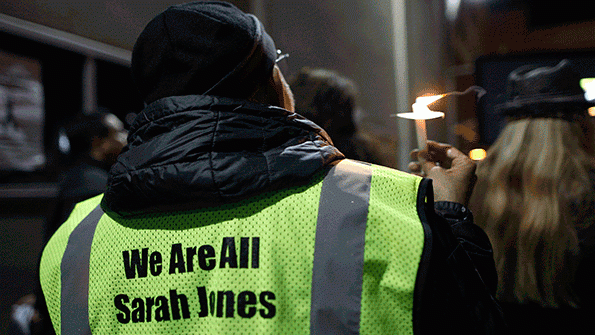
People gather in Los Angeles at the International Cinematographers Guild national offices on March 7, 2014
during a candlelight walk and memorial for Sarah Jones.

The backstory about this tragic incident can be found at:
http://ehstoday.com/safety/director-pleads-guilty-involuntary-manslaughter-case-involving-death-camera-assistant

Friday, June 28, 2013

Gut Feeling Can Prevent Accidents

A Pat Benatar benefit concert scheduled for Friday, June 21, 2013 was cancelled at the bequest of her stage crew.  Upon arrival to the venue, an outdoor covered arena in Iverness, Florida, the crew was presented with a stage platform that they did not think was robust enough for the show.  Rather than risk the potential for a structural collapse, they requested that the promoter have the stage structure inspected and reinforced.  A local engineer was brought-in to certify the stage, but the caveats included with the inspection did not satisfy them in time to mount the show.

An article at Celebrity Examiner (www.celebrityexaminer.com/2013/06/26/benatar-releases-photos-of-substandard-stage) describes the scenario at length. Below are some picture released by Pat Benatar and her husband Neil Biraldo that show the deficiencies they found.  It is noteworthy that a performer and crew would postpone an event until it can be presented safely, rather than throwing caution to the wind and saying "Damn the torpedos - full steam ahead!

Just because it might have worked doesn’t mean you shouldn’t give it a second look.   If something looks ‘hinky’, give it a good going-over.


WalkerFest Stage
Upstage End Looking Towards Downstage Right

I’ve seen stages with these types of support legs before, and they are generally pretty strong as far as static column loading, which may have been the assumption by the engineer that allegedly certified the stage.  He may have not been considering the lateral dynamics of movements on the stage during load-in, performance, and strike.

The lack of regular diagonal (cross) bracing would make it a wobbly experience.  Note that the 2x4 diagonals shown along the upstage end are not pinned in place to fix their length, instead, they are only pinched against the suport legs with C-Clamps, a connection that can slip loose when loaded becasue it is only held together by friction.

 
WalkerFest Stage
Understage View Looking From Upstage Towards Downstage Right

The understage picture shows the manufacturer’s Quick Connect Braces along the downstage row of support legs, but does not show any other intermediate braces or braces along the side stage support legs.

Surprisingly, the manufacturer’s catalog (www.graniteind.com/DOWNLOADS-SeatingStagingFencing.asp) has a chart of the required number of diagonal braces (not cross-braces) that are recommended for stages of various sizes, and it appears to advocate only installing the diagonal braces at about 50-90% of the perimeter locations, with none at the interior supports; whereas their competitor, BilJax (Model ST8100, www.biljax.com/products/events, also sold as AlphaDeck in Europe, www.alphadeckstaging.com recommends a higher number of X-Braces along both axes and between the interior support legs.

The stage in the photos appears to be about 54” tall (as measured by counting the hole spacing in the legs), and according to both Granite and BilJax, stages over 48” tall should have two sets of braces at the recommended minimum spacing.

Stages need diagonal bracing along both axes,  not just one, and all support legs should be braced to prevent them from being skewed from vertical by unexpected circumstances.

The 2x2 or 2x4 stringers seen running along beside the support leg feet do not appear to be attached to the support legs, but even if they were, they would only serve to keep the feet spaced relative to each-other, not to counteract any parallelogram type collapse of the structure.  Diagonal X-braces would both prevent the legs from tilting away from vertical and provide sway-bracing for the entire stage structure.

The foot-pads on the ends of the support legs are resting on what appears to be a dirt arena floor (but it could be dust on a concrete floor, or a canvas drop-cloth – it’s really difficult to tell from the pictures).  Note the plywood square ‘mud seals’ lying adjacent to each leg – they were NOT installed, so the legs could sink into the surface below if it is not a concrete deck.  The ground surface appears dry in the picture, but that doesn’t mean it will stay dry; nor does it mean that the ground is dry and compacted below the visible surface.

HEY!  Er, ah, HAY!  What's that hay doing under the stage?  It's a fire hazard that should have been removed, too.

Show Some Moxy.  If it 'just don't look right', then verify that it will be safe.  Risk Analysis is part of your job!

Thursday, April 4, 2013

Fan injured by unsecured canon equipment sues promotor

William Mueller Jr. sued Live Nation and others, in St. Louis County Circuit Court in March 2013.  Mueller claims he suffered injuries to his groin and upper thigh and suffered pain, mental distress, and temporary loss of consortium (see below).  Mueller says he attended the KISS concert at Verizon Wireless Amphitheater on August 27, 2012 when a cannon was discharged during the band's final song.
Live Nation Logo
He claims he was standing at his assigned seat when the cannon "exploded and with great force launched a metal ratchet tie-down strap" that hit him.  "(P)rior to this incident plaintiff had been diagnosed with a rare brain cancer (Esthesioneuroblastoma) and had experienced major surgeries and intense radiation therapy," he says in the complaint. "At the time of his injury, plaintiff's body was in a weakened and vulnerable condition.  Defendants owed to plaintiff the duty to exercise the highest degree of care for his safety.  [The] Defendants actions, conduct, or omissions were negligent, negligent per se, or both and were not those of a reasonably prudent person."


While the band KISS is known for outrages theatrical performances from raised platforms amidst fireballs, canons, smoke machines, and pyrotechnics, it would be reasonable to assume as an attendee of the concert that there would be precautions taken to ensure the audiences' safety.

Mueller seeks actual and punitive damages for negligence.  He is represented by David Diamond of St. Peters, Missouri.

The band KISS is not a party to the complaint.  The defendants are Contemporary Group Acquisition, Live Nation Worldwide, Live Nation Entertainment, All Access Staging & Productions, and Live Nation general manager Leslie Ramsey.

**********************

Loss of consortium is a legal principle that awards monetary compensation for the damages that an individual had to suffer because of family member being injured or for being deprived of a normal family relationship. Damages can mean the loss of love, emotional relations and other services offered by a family member or spouse, if he/she had not been injured. The injury may also have occurred because of assault and battery, wrongful death, false imprisonment, medical malpractice, negligence, sale of addictive drugs and the like.

According to the loss of consortium definition, the basis for awarding these damages is simply the inconvenience of having an injured spouse. This can also be when this injury or act has a devastating effect upon the individual filing the consortium lawsuit or if the injury can directly affect the individual’s personality such as getting depressed or general unpleasantness.

The term consortium encompasses a wide variety of meanings to include all the benefits that a person receives from another family member such as affection, companionship, cooperation, and financial support.

Monday, January 21, 2013

Have we learned nothing?

The festival season starts early in the south, and Mardi Gras is one of the first events we see set-up for numerous stages and shows.  Outdoor festival stage canopies have proven to present opportunities for accidents because they have large surfaces that can be caught by side winds and uplifting plow winds.  To counter-act the forces developed by gale-force winds, event riggers rely heavily on large ballast weights to tie-off canopy structures in an attempt to anchor the framework to the ground.


These ballast weights work well if they are massive enough for the predicted winds and effective 'sail area' presented by the canopy roof and side walls.  If they are too light, the ballast weights will just be dragged across the ground and bulldoze a path of their own.  Slippery grass, or dirt that turns to mud, just act as a lubricant to free the ballast weights up for sliding in the event of a downpour, so anchoring or pinning the ballast weights to keep them from moving is also part of a good rigging plan.  (The ballast weights shown above were not pinned or anchored to prevent sliding)

Wind is not a steady-state event.  You know that.  It gusts.  It starts and stops.  It changes direction.  It generally whips everything around a bit as it works it mayhem.  For this reason, we need to use secure connections on the guy wires for the ballast weights and stabilizing X's that are used to stiffen the structures against parallelogram movements.  If you don't, a gust of wind can slack the line, unhook the conenction(s), and you loose all anchoring in the blink of an eye.


As you can see above, the anchor ties used in the blocks in the first picture are common ratcheting tie-downs in the trucking industry, and they only have a open hook at the load securing end.  This may be de rigueur for the transport industry, but it's a no-go for event safety.  If the wind gets to blowin' and this bad boy comes loose, it could rip the flesh right off of someone unlucky enough to get in it's flailing path.

So, it was bad enough to see the above tie-down terminations at almost every corner of the stage, but then I looked further up the anchor line and found this:


Each anchor line had two possible points of failure.  Three stages and a major cable bridge over the street, all in close proximity, four to eight anchor blocks secured in this manner for each one, and two possible failure points per securement.  All of this within a city block of a major open waterway (read: obstruction-free wind-path).  Personally, I don't like those odds.

The City is relying on the Event Producers to Employ Staging Subcontractors that will erect facilities that will be safe for the (possibly highly intoxicated) general public to hang-out around and potentially be leaning-on, climbing on, or even messing with.  Plan for the worst, and you may have a chance of having an incident-free event, but if you leave opportunities for failures in the system like are shown above, be ready to pay the piper (or at least the plaintiffs).

Follow-up to commenter:
If you are going to use ratchet-straps to secure anything (subject to load rating), then utilizing products that have a self-closing clip is highly recommended.  Here is a picture of that type of ratchet and clip:


It is also recommended to have a wire rope safety cable that runs in parallel with this, preferably one that is only slightly longer than the final tensioned length of the ratchet strap.  This can prevent a total release of the system should the ratchet strap fail.  Fabric based straps and slings are subject to weakening due to abrasion, minor cuts, and rot.  Straps exposed to sunlight have shortened lifespans due to the exposure to UV light which weakens the fibers.

Wednesday, November 21, 2012

SchoolDude & Facility Masters Team-up with Theatre Safety Blog for Free Webinar


Facility Masters Webcast Series
Register Now – Free Webcast – Wednesday, November 28, 2012 at 12:00pm EST
Improving Auditorium and Theatre Safety: Tips for Reducing Risk

More than 250 of your peers have already signed up for this can’t miss seminar!  Register today to join them, and please forward this invitation to colleagues who might be interested.
If you’re not able to attend, register anyway – we’ll email you a link to the recorded webcast to view at your convenience!


Properly maintaining and inspecting auditoriums / theatres is a critical component of a proactive safety plan that minimizes potential hazards, reduces risk and safeguards event participants.

Join a FREE, interactive 75-minute webcast to hear industry experts discuss how preventive inspections and regular maintenance of auditorium / theatre facilities and equipment protect you from liability issues while also providing a safe environment that protects students, teachers, staff and the community from injury.
 

Improving Auditorium and Theatre Safety: Tips for Reducing Risk
Wednesday, November 28, 2012
12:00pm-1:15pm Eastern Standard Time (11:00AM CST, 10:00AM MST, 9:00AM PST)

Register Now!

You will learn safety tips and PM checks for auditoriums and theatres that will help you: 
  • Protect occupant safety, reduce risk and liability
  • Develop a regular theatre and auditorium inspection process
  • Document inspections, maintenance and repairs
  • Establish policies for facility access, supervision and use
  • Develop a method for reporting problems with these facilities
  • Train staff and students on proper use of these facilities
  • Achieve a safe and well maintained environment
Register now for this free webcast: https://cc.readytalk.com/r/ddwzo3zjjq5
Presenters are:
  • Tom Watkins:  Fine Arts Director        Van Buren School District, AR
  • Erich Friend:   Theatre Consultant       Teqniqal Systems
  • Roger Young: Executive Director         Facility Masters 
  • Justin Turner:  Applications Specialist – SchoolDude.com
Click or copy and paste the below link into your internet browser to register:
https://cc.readytalk.com/r/ddwzo3zjjq5

 
This Facility Masters webcast is sponsored by your friends at SchoolDude!

For additional resources on improving safety, PM and the learning environment, visit the Facility Masters Resource Library and the SchoolDude Resource Library.

http://img.en25.com/eloquaimages/tinydot.gifRoger Young
Facility Masters
1-978-886-6093
roger (at) facilitymastersonline (dot) com

Visit my Blog:  www.facilitymastersonline.com/blog/
Facebook:       www.facebook.com/facilitymasters
Twitter:            www.twitter.com/facilitymasters
LinkedIn:         www.linkedin.com/company/facility-masters 

Tuesday, July 10, 2012

Protecting Performers AND the Audience

Unruly spectators can pose a risk to themselves, those around them, crew, and performers.  In rowdy rock concerts with drugs and/or alcohol added to the mix, it can be even more unpredictable.  On May 24, 2010, the lead singer for the heavy metal band Lamb of God, was performing in Abaton, a nightclub in Prague, Czech Republic.

In the course of the show, fans were allegedly enticed to come onstage and dive into the audience for a little body surfing.  Things got out of control and one patron went off of the stage backwards and was not caught by the crowd.  He supposedly struck his head on the floor, but was able to get-up and walk out of the club.  He later collapsed, was taken to the hospital, and remained in a comma for several weeks before dying.

The band's promoter said that they had not heard anything about the pending arrest and had booked dates without any knowledge that the performer might be held accountable for the incident.  The lead singer, Blythe, was arrested June 27th, 2012 as he entered the country to promote the bands newest album.  Blythe has been held by the Czech Republic police awaiting a bail bond hearing since entering the country.  He has been charged with manslaughter.  Several web sites have followed the incident and some have posted cell-phone videos from that night's concert.  Depending who you believe, it may have been an accident, or there may have been other people involved or responsible for the circumstances.

It is important that performers can work safely on stage and not worry about being assaulted by guests, and it is incumbent upon venue managers to see that proper controls are placed between artists and fans.
 ---------------------------------
However, it is not just artists and fans that require protection, either -- on October 30th, 2004 there was an incident in a Dallas, Texas nightclub where the lead guitarist Vince Neil (formerly with the rock band MÖTLEY CRÜE was unhappy with the stage monitor mix operator.
After motioning for for more guitar volume during his headlining set at Gilley's Dallas, Neil ran across the stage, leaped onto the monitor mix sound board and swung a leg at sound man Michael Talbert, but missed; then Neil struck him with a "closed fist."

Talbert, who was looking down, saw only the monitor mixing console and Neil's foot next to him before losing consciousness for about 45 seconds after Neil's punch knocked him to the ground.  He said a CT scan revealed that he had suffered a mild concussion. "He tried to kick me and missed, took a swing and connected.  He clocked me pretty good on my eyeball," said Talbert, who works at Gilley's. "He just went cuckoo nutso."  An arrest warrant was later issued for Neil

More information can be found at:

Related Blog Post:

Sunday, March 4, 2012

Audience Platform Collapse Injures 30

Stockholm, Sweden - Friday, March 2nd, 2012 — A section of a VIP platform collapsed during a performance by Swedish disc jockey Avicii at the Globe Arena.  About 30 people fell some 4 meters (~13 feet) when the floor of the structure caved in.  Police spokeswoman Inger Qvennerstedt says about 20 concertgoers age between 15 and 17 were taken to hospital.  She says most of the injuries were minor, but one was "very serious."


Organizers say a second performance by Avicii scheduled for Friday was canceled.  The cause of the collapse was not immediately clear.

The video posted on YouTube shows a very enthusiastic crowd jumping up and down in sync to the beat of the music, which can create tremendous live loading on a structure.  The camera finally pans down to show the gaping hole in the platform at around the 1:20 marker.  Note how visibly the security staff is dressed!

More information can be found at: http://www.beatmyday.com/2012/03/03/platform-collapse-during-avicii-gig-at-globe-arena-stockholm/

Thursday, February 9, 2012

Indiana OSHA Fines Three Entities

[Updated - 2014-03-31 - 12:50PM CDT]
February 8, 2012.  Following investigations into the stage canopy collapse at the Indiana State Fair on August 13th of last year, IOSHA has filed fines against the canopy provider Mid-America Sound Corporation, The IATSE Local 30 that provided labor to erect the stage, and the Indiana State Fair Commission, sponsors of the event.

The IOSHA order against Mid-America Sound claims that MAS knowingly allowed the stage to be erected without cross bracing and failed to provide adequate documentation for the erectors.  MAS said that they will challenge the findings and is already producing documents that they had previously withheld

UPDATE 2014-03-31:  Mid-America Sound has agreed to pay a $50,000 fine for safety violations and has also agreed to additional staff training and a new safety plan for future events..  Indiana’s Occupational Safety and Health Administration (IOSHA) orginally levied a fine of $63,000 against the company.

Michael Moon, attorney for Mid-America Sound, released the following statement via Borshoff, the company’s PR firm:

“On March 20, 2014, Mid-America Sound Corporation and the Department of Labor entered into an Agreed Entry resolving litigation that resulted from IOSHA's citations issued to Mid-America following the events of August 13, 2011 at the Indiana State Fair.  While Mid-America contested the appropriateness of the citations and made no admission of any wrongdoing by entering into the settlement, Mid-America believed that it was important to move forward in a cooperative effort with IOSHA and to avoid the costs and expenses of further litigation.”

Of particular concern was that IOSHA fined the Labor Union Local 30, which is not an employer, and claimed that they were acting as an employer of the stage hands that were injured and killed.  This charge is being vigorously disputed by the Union as they say they were only act as an agent to arrange labor resources.  However, unlike almost all other union offices, this local's officers actually operated a business entity that directly paid the laborers that were contracted to the Indiana State Fair.  If this charge is upheld, it will have a significant impact on the way this Local, and possibly others, is operated.

The State Fair Commission's fines were minimal and they were charged with failing to have an effective emergency plan in-place.  The fines were minimal because the State Fair Commission did not have any employees that were significantly injured in the event.

A little perspective:

This is just the beginning of the legal process.  The report from the forensic engineering firm that is analyzing the failed structure has not yet been published, nor has any other official assessments of the event.  The IOSHA orders are only addressing one small segment of the incident:  The labor relationship between the Employers and the Workers with regard to their safety.  It is not IOSHA's place to address injuries to the general public or the over-all failure of the State Fair Commission that administered the event.  To date, there have been numerous law suits and over 100 tort claims filed that are seeking compensation for the damages and loss of life.

This blogger was told that Sugarland, the band that was to have played that night, had first right of refusal to not play (although they did not assert that right), and they did not have the right to override the State Fair Commission and demand to play.  Being willing to play is not the same thing as demanding to play.  This places the burden of responsibility back on the State Fair Commission for not cancelling the show and clearing the fairgrounds in a timely manner.  It's always a contentious position to be in when one state agency is penalizing another state agency.

Interviews with the Indiana State Police Troopers that were in the scene before the storm struck also said that they were fully expecting the Commissioners to cancel the show in light of the incoming weather front, and were dismayed when the announcer only said that the show would be delayed.  Had they known that the State Fair management team was not securing the site, they could, and probably would have overridden their decision and forced the issue for the sake of public safety.  Unfortunately, that announcement was made hours too late, and the brunt of the storm plowed through the area just moments later.

Additional Resources:

Indy Star article:
http://www.indystar.com/article/20120208/NEWS05/120208016/Agency-cites-State-Fair-union-stage-collapse

Prior Blog Posts:
http://www.theatresafetyblog.blogspot.com/2012/01/alert-notice-on-temporary-structures.html
http://www.theatresafetyblog.blogspot.com/2012/01/indiana-legislature-posts-bill.html


Thursday, August 18, 2011

Updates on Indiana State Fair

Here are some more postings by fellow bloggers to read-up on this tragic event:
Meteorological Musings by Mike Smith:
http://meteorologicalmusings.blogspot.com/2011/08/fundamental-problem-at-indiana-state.html
http://meteorologicalmusings.blogspot.com/2011/08/horror-in-indianapolis.html
Severe Weather Blog by Jon Davies:
http://davieswx.blogspot.com/2011/08/81311-indiana-stage-collapse-example-of.html
Control Geek Blog by John Huntington:
www.ControlGeek.net
Jim On Light Blog by Jim Hutchison:
www.jimonlight.com/2011/08/17/help-a-killed-and-an-injured-brother-in-the-indiana-state-fair-stage-collapse-hoosierstatecollapse-please-rt/
National Public Radio (NPR) by Joel Rose:
www.npr.org/blogs/therecord/2011/08/17/139721112/who-is-inspecting-outdoor-stages
www.npr.org/2011/08/17/139725599/safety-in-question-with-growing-outdoor-concerts?ps=r
Crowd Management Strategies web site by Paul Werthheimer:
Time To Rethink "Rain Or Shine" Mentality? - www.crowdsafe.com/new.asp?ID=2075
What If The Indiana Governor Is Correct? - www.crowdsafe.com/new.asp?ID=2077
Indiana State Fair Official: "He" Did It. - www.crowdsafe.com/new.asp?ID=2078
More news about the Indiana State Fair:
Gov. Daniels hires outside firm to review fair procedures: www.wthr.com/story/15293118/gov-daniels-hires-outside-firm-to-review-fair-procedures and; www.indystar.com/article/20110819/NEWS15/108190339

Engineers question cross bracing on State Fair stage: www.wthr.com/story/15286083/engineers-question-cross-bracing-on-state-fair-stage (a really good comparison of this year's stage to a prior year's stage)
Weather Assessment by MSNBC:   www.msnbc.msn.com/id/44166368/ns/weather/#.TkteS2FICcE
6th and 7th victims die in weeks following the incident:
www.reuters.com/article/2011/08/20/us-indiana-fair-toll-idUSTRE77J02B20110820
www.wthr.com/story/15307336/seventh-person-dies-from-fair-collapse

Survivor Update:
September 21, 2011 - State Fair incident victim awakens from coma.  News story at:
http://heraldbulletin.com/local/x94880346/Pendleton-woman-injured-in-state-fair-stage-collapse-wakes-from-coma-writes-messages-to-loved-ones
October 27, 2011 - Stagehand recounts the event.  News story at:
www.wthr.com/story/15893812/stagehand-recounts-sugarland-stage-collapse

Legal Proceedings Update:
September 2012, PLSN Magazine, Memorial erected at incident site, No settlement agreed upon, Another incident occurs on fairgrounds one day before anniversary.
http://digitaleditiononline.com/display_article.php?id=1172084

Monday, August 15, 2011

Third Stage Collapse in 5 Weeks Injures 45, Kills 6

Following the weather induced collapse of stages in Ottawa, Canada and Tulsa, Oklahoma, this event at the Indiana State Fair on Saturday, August 13, 2011 should be a wake-up call to promoters, Health and Safety administrators, and insurance companies that shoddy stage construction, ill-prepared emergency plans, and apparently non-existent weather monitoring by qualified individuals has to be curtailed.  Lives are at stake and people are being injured and killed.


More pictures and news reports about this most recent debacle can be found here:
ABC News: http://abcnews.go.com/GMA/video/die-indiana-stage-collapse-14300933
CNN News:  http://www.cnn.com/2011/US/08/14/indiana.stage.collapse/ (Kudos for best video image!)

Further thought provoking commentary by this blogger and others can be found on fellow blogger's site: Jim On Light (http://www.jimonlight.com/2011/08/15/indiana-state-fair-stage-collapse-five-dead-now-what/)

What has this author upset are the bone-headed attitudes that are portrayed by the participants and onlookers:  They seem to accept that these stage collapses are 'no big deal' or that they are somehow 'unforeseeable' or 'unpredictable' events.

Indiana Governor Mitch Daniels described the canopy collapse at the State Fair as a "freakish accident."  “I’m not clear how anyone could have foreseen a sudden, highly localized blast of wind,” Daniels said.  REALLY!?  NOT clear?  An he is the Governor of the state.  I guess an IQ test isn't a prerequisite for the job.  Has he not heard of weather radar?  Wind shear radar?  Wind Speed Radar?  Or maybe good old common sense:  "We can see a storm coming right at us, and it is a huge storm cloud, and we have 25 tons of lighting and sound gear suspended 60 feet in the air with a 1/4 acre sail attached to it while being supported by a dozen skinny aluminum truss columns"?  How does that work for you?  I'm not even sorry for saying this is stupid.  It is.


After the Tulsa, Oklahoma windstorm that tore a video display frame from the upstage area and sent it crashing to the ground, Ivins, the Flaming Lips' bassist, said the video-screen collapse was unpreventable. "It was a freak thing that happened," he said, adding that the Lips are working on repairing the rolling video screen for their next festival gig, in Somerset, Wisconsin, in about two weeks. "Maybe the stage could've been facing a different direction. We could have tied the screen down, but it would probably have taken the whole stage down. We try to take as many precautions as we can, all the time. It's just sometimes there's stuff out of your control. You just never know what's going to happen."  Really!?  Dang, dood, why do you even get out of bed in the morning (or maybe afternoon) if you don't know what is going to happen.  Yeah, life is unpredictable, but basic physics is VERY predictable.

These kinds of incidents (not accidents) ARE Predictable and Preventable.  It's called engineering, review, and planning.  We know weather happens.  We know it is powerful.  We know if something blows over or collapses and lands on someone it will very likely injure or kill them.  What is so hard to understand about this!?  With attitudes like those promulgated above, it is no wonder that more people don't get killed at concerts.

Demand more safety planning and review.  This stuff doesn't just 'happen' -- it happens when you DON'T plan for it.

Here is a superb article by William Gorlin that was published in October 2008 that addresses many of the structural and operational considerations of temporary structures:
A Mighty Wind (Load) http://livedesignonline.com/theatre/mighty_wind_load_1008/index.html

Monday, October 11, 2010

Can you say "structural failure kills hundreds"? Sure you can. Probably even under oath in court.


Video of the balcony bouncing at The Fabulous Fox Theatre, St. Louis during the 6.16.09 Phish show.
(Great tip from Doug McDonald - Thanks Doug!)


Video of the balcony bouncing at the Fox Theatre, Detroit during the 1.16.10 Nick Jonas show.  The Detroit and St. Louis Fox Theatres are basically identical buildings.

Despite the ampped-up headline for this blog entry, the readers should note that a little bit of structural flexing is typical in many balcony structures.  However, you should also realize that the structural engineer in 1928 may not have fully anticipated this kind of a crowd response.  Thankfully, the audience members were not fully synchronized in their jumping up-n-down to the beat.

For more insight into this trype of structural event, the book "Why Buildings Fall Down; How Structures Fail" by Matthys Levy and Mario Salvadori is a good read.

Tuesday, September 7, 2010

Rigging Report Card - Pass? -or- Fail!

J.R. Clancy Company, one of the largest Stage Rigging component manufacturers in the world, has introduced a new posting section on their Facebook photos page.  It is a Bad Rigging Photo of the Week.  Log in and check it out.  Scary is an understatementwww.facebook.com/JRClancy

These pictures, and similar ones I post here in the Theatre Safety Blog, and those that I show in my USITT workshops "What's Wrong With This Picture?" are all intended to make you take pause and think about what may be lurking in your theatre, or that theatre that you may be traveling to for your next show.

These types of poorly thought-out assemblies really go to show you how important it is to have your facility inspected by an objective party.  Things that you may casually dismiss because you've come to see them every day may actually be a really serious hazard.  A fresh set of eyes can be key to getting a wake-up call.  Independent Consultants (insert shameless plug for my company, Teqniqal Systems, here) can be a great resource for this as they work objectively and are not interested in selling you new equipment, just seeing that you are aware of the current state of affairs with your facility.

The NFPA 80 Standard for Fire Doors and Other Opening Protectives, 5.2, requires that you have your Fire Curtain inspected annually, so this is a good time to have the rest of the rigging system inspected as well.  If your facility is operating under OSHA (State plan, or Federal plan, or even if it's not - it's still a really good idea), then you are required to have your Rigging Systems inspected annually.

Not to be forgotten, your Smoke Vents (an important part of the Fire Curtain System along with the Fire Doors) must be tested annually.  Your Smoke Vents should have rigging that facilitates the operation from the stage floor level (don't tell me you are going to go to the grid iron deck to open them to clear-out extraneous atmospheric effects or summer heat).  This smoke hatch rigging (be it mechanical or motorized) must be inspected semi-annually as a part of the Smoke Vent inspections.  Ref: NFPA 204 Standard for Smoke and Heat Venting, 12.4.3.5.

Ask a lot of questions about the report that you are going to pay for.  What does the inspection include / exclude?  How long will it take?  Who should be present?

"Will you shut me down if I fail?" is a common question I get.  My answer is this:  I'm just the messenger.  I report what I see and put it in context so you and your administration can understand it and the potential consequences.  I quote relevant building or safety codes, if applicable to the situation.  I am not the AHJ (Authority Having Jurisdiction).  You are my customer, so I report to you.  Your building condition is your business, so you can act on the report as you deem appropriate.  Hopefully, you will get the broken stuff fixed.

One thing at a time:  Typically, a Rigging System Safety Assessment report will NOT include any design or specific engineered solutions.  It is only a report on the conditions.  Why is this excluded?  At the time I contract with you to perform the inspection, I will usually only know the general nature of the building layout and rigging systems, I will not yet have seen any of the actual conditions - how could I possibly estimate the cost of my services to (re)design a fix for what I have not seen?

"How much does this cost?" is the battle cry of the administrators.  Don't be smug and ask them why it matters - or retort "Would they rather pay for a funeral?"  That's not the question.  "How much does it cost?" means that they need to find the funds and understand the value.  When they understand what this inspection entails, why it is important and/or necessary, then they can address the funding issue. You can help the process by remaining calm and professional.  Drama Queens can alienate the administrators if they present more bluster than facts.  A good consultant can help you to educate them about this investment / recurring annual maintenance cost.

A little help on your part can be useful, too.  Do some research with your insurance provider, safety department, or even your regional / national arts groups.  Sometimes they have grant money available to help defray the cost of this work.  If it involves facility planning (that is what this is - planning for necessary improvements) and/or safety, the money is usually out there.

The answer, like so many things in life, is: "It depends."  You should be suspicious of anyone that offers you a "Free" or "Discounted" rigging assessment.  It will likely be worthless and largely incomplete.  This type of work takes time.  Time = Money.  No one makes a living on 'free'.  At a minimum, you are paying for the person's travel time and expenses to and from your facility, the time on-site actually testing, inspecting, observing, interviewing, photographing, and documenting what they find.  They then must organize all their findings into a coherent report that addresses your specific facility and put the information in context.  Each item should be clearly tagged with recommendations as to what needs removed, repaired, replaced, re-designed, etc.  The time expended writing the report can be many times the hours spent on-site.

The "It depends" factor is complex:  Do you have a walk-on gridiron?  Or do I need to rent a man-lift to go up a bazillion feet?  Do you have 1, 2, or 3 loading galleries?  How many line sets do you have?  How many are motorized?  Is this a Union House?  Am I inspecting just the Rigging System, or am I doing the Drapes,  Fire Curtain, Smoke Vents, and all the scabbed-on rigging at the Tormentors, Beam Electrics, Speaker Clusters, and Orchestra Shell components?  Is there an Orchestra Pit Lift?  Am I inspecting Fire Doors, Fire Alarms, and/or any other Life Safety Systems?

Be efficient with your investment.  Is your facility part of a School or College District that has multiple venues?  If so, then seriously consider having all the venues inspected under one contract.  No, this isn't a money grab.  It is about identifying the sources of problems.  If your inspector can assess 2, 4, or a dozen facilities as a whole, then the report you receive should be more manageable.  The areas of common concern can be discussed once, and the unique 'features' of each system or building can be addressed individually.  This allows you and your administration to see items that are systemic in nature and those that are local in nature.  A big picture that speaks to all of the district's Theatre Safety needs can be a powerful impetus for change and improvements.

Once the report is written and submitted, you will have a chance to read it and discuss it with your staff.  Don't shoot the messenger.  Understand that the inspector does not have an agenda, they are not 'out to get you', they are not seeking to close-down your theatre.

As Sergeant Joe Friday would say: "Just the facts, ma'am."  Don't interpret the safety report as an indictment of your operations or management.  It is not.  However, it may point to some areas of your operations that could use improvement.  The most dangerous part of a rigging system is the people that operate it.  Use your rigging safety report to improve your policies, methodologies, and show preparation.  Use it to plan repairs, upgrades, and service.  Learn from it.

Questions?  Call me or write me!
Monday, July 19, 2010

Pink Gets Banged-up In Fall From Flying Harness. "Steel barrier-1 Pink-0"

July 16, 2010, Nuremberg, Germany.  According to Pink (30-year-old Alecia Beth Moore), she was "a little embarrassed" and apologized to her fans who had shown up to see her perform. She said that the reason she fell is she was incorrectly clipped to a safety harness.  She went on to say that she had no serious problems, no broken bones, just a pretty bruised ego.

The star slipped out of a harness which was supposed to carry her across the crowd.  Instead, she was dragged off the stage and into a into a crowd control barricade.  There is a video clip shot by an audience member (http://www.thedailybeast.com/video/item/pink-falls-on-stage) of her two assistants helping her into the harness just before the incident, but their costumes blocked the view of the procedure.  As she was about to be pulled into the air over the fans, she raises her arms into the air to make an "X", possibly a 'no-go' sign for the fly crew.  She is then pulled forward and you can here her say "no-no..." and then the harness comes loose and drags her off of the stage along with two assistants that appear to be entangled in the fly lines.  You see her stage right assistant being flung off the stage and into the audience.  There is no news available regarding injuries to the assistants or audience members.

Pink was reported to have argued a bit about leaving during her concert, but was obviously in pain and knew that all medical precautions had to be taken (smart girl!).  She climbed back up onto the stage so that fans could see she was not injured seriously, and was then taken by ambulance to a nearby hospital for observation.  The concert in was halted.

On the way to the hospital she twittered: "To all my nurnberg fans - I am so so so sorry to end the show that way. I am embarrassed and very sorry. I'm in ambulance now but I will b fine,".

"Didn't get clipped in2 harness correctly, drug me off stage, fell in2 barricade. Getting xrays. I hope it at least looked cool!!!"

Later, she wrote on Twitter: "Nothing's broken, no fluid in the lungs, just seriously sore."

She also apologized to fans for having to cut her concert short.

She later tweeted: "Full steam ahead people.  No pain, no gain. or is it no brain, no pain? either way, I will be on that stage, even if I have to crawl."

Carey Hart, Pink's husband, blogged to fans: "Fyi, @pink is out of the hospital and all good. Just got the sh** kicked out of her by the barrier. Steel barrier-1 Pink-0"

Thursday, June 10, 2010

Dance the night away - but not your life.

Keeping, building, or replacing your stage floor so that it is properly sprung, free of cracks, splinters, protruding screw / nail / staple heads, and other little things that can cause serious injuries to dancers and actors should be a continuous process.  Keep the stage swept and clear of debris, watch for discontinuities between adjacent panel edges, floor pocket lids that don't close properly, are missing, or where the entire lid is not installed flush to the surrounding floor area.  Also watch for wall plates installed on floors and loose trim strips that join adjacent flooring areas.


If your stage floor is not sprung, then it should be a priority to have it replaced with a properly constructed floor that will work for your productions, dance, and other general uses.  There are many ways to construct floors that will last and be functional, so enlisting an expert (like a Theatre Consultant) that has experience in this area can be very helpful.  There are many possible materials to be used, and each has advantages and drawbacks.  Knowing what works, and what doesn't, can save money and injuries.

Another dangerous item on stage is old footlight troughs.  If they are not locked and you step on them, or maybe set a scaffoding leg or man-lift outrigger on them, they can fail or flip-over.  Equipment and people can topple and cause major injuries and damage.  This blogger knows of at least one dance instructor that had a career-ending spiral break of the leg bones that left them out of work for months and will never be able to dance professionally again.  That's serious stuff!

Resources:
http://www.danceusa.org/dancerhealth
ANSI E1.26 - 2006 - Recommended Testing Methods and Values for Shock Absorption of Floors Used in Live Performance Venues - http://www.ansi.org/
Dance This Dance That Blog - www.danceartkl.blogspot.com/2005/09/5-common-dance-injuries-how-to-treat.htm
Harlequin Floors FAQ - http://www.harlequinfloors.com/uk/dance-area/about-dance-injuries.html
Center Stage FAQ: http://www.centerstagellc.com/health/importance-of-proper-dance-flooring-injury-prevention-dancer-longevity/