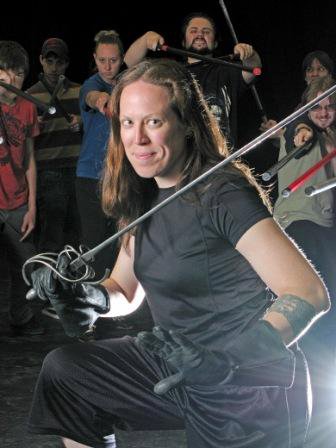
MGM Grand, Las Vegas, Nevada - Saturday, June 29, 2013. In a yet-to-be-explained equipment failure, one of the aerial performers in Cirque du Soleil's KÀ fell about 50 feet from above the show's
massive 3-axis moving stage into the forestage pit during the fight scene at the end of a performance. The pit is nearly 4 stories deep. Sarah Guyard-Guillot, 31, mother of two, came loose from her safety cable and disappeared into pit unexpectedly. The show was halted, the audience informed that they could obtain replacement tickets for a future show, and were dismissed. The show has been suspended indefinitely pending an investigation into the root cause of the accident. Guyard-Guillot, mother of two young children, was pronounced dead at a
hospital late Saturday night. It is reported that her safety harness was intact with her costume when she was recovered from the accident site. She was a trained acrobat and aerialist, originally from Paris, France. She had performed in the industry for about 22 years.
This is the first performance-related death that the troupe has experienced in over 30 years of show production.* Guyard-Guillot was one of the original performer's in the KÀ show when it opened in 2006, and had performed the show since then.
An extremely through and rigorous safety program is entrenched in the companies' culture, so this has been shock to those that work the shows in a tight-knit group. Cirque's safety managers have been very transparent and informative by sharing their safety culture and knowledge at numerous industry events like the annual USITT convention, LDI convention, and UNSCA's Entertainment Innovation Conference.
The death comes at an unfortunate time for the circus, a reportedly $1 Billion (US) company which employs 5,000 people globally, including 2,000 at its headquarters in Montreal, Canada. Cirque maintains around 19 touring productions in operation worldwide, yet has recently reduced it's workforce and is trying to reign-in its expenses.
Cirque du Soleil's founder, Guy Laliberté, said in a statement: "I am heartbroken. I wish to extend my sincerest sympathies to the family. We are all completely devastated with this news. Sassoon was an artist with the original cast of KÀ since 2006 and has been an integral part of our Cirque du Soleil tight family. We are reminded, with great humility and respect, how extraordinary our artists are each and every night. Our focus now is to support each other as a family. "
A thorough write-up about this incident can be found at Jim Hutchison's Jim On Light site:
www.jimonlight.com/2013/07/01/tragedy-at-ka-in-las-vegas-sarah-guyard-guillot-falls-to-her-death-during-final-fight-scene
Local news coverage:
www.kctv5.com/story/22726807/spectator-on-cirque-death-i-thought-there-was-a-net
www.lasvegassun.com/blogs/kats-report/2013/jun/30/cirque-suffers-another-accident-artist-falls-ka-mg
The same night as the deadly fall during KÀ, Cirque's newest show, "Michael Jackson: ONE," held its opening night performance at the Mandalay Bay Resort and Casino in Las Vegas. That production experienced its own trouble the previous week.
On Wednesday, June 26, 2013, Cirque reported that an acrobat taking part in one of the final preview performances suffered a mild concussion after slipping through slack rope in the show's "Stranger in Moscow" scene. That performer, who is expected to return to the production, missed a protective pad below the actors and landed hard on the stage.
2013-10-29 - Nevada OSHA has finished its investigation into the death of Sarah Guillot-Guyard, the Cirque du Soleil performer who fell 94 feet during the climactic scene of Ka on June 29, 1013 and later died. OSHA determined that accident happened when the wire rope she was suspended from broke. According to the report, the wire rope “was severed due to the rapid ascent of the performer, ultimately causing the rope to be freed from the sheave/pulley and scraping against a shear point.” OSHA officials cited Cirque du Soleil with six proposed citations and more than $25,000 in fines and MGM Grand with three citations and a $7,000 fine. Cirque du Soleil and MGM are appealing the fines.
One of the citations for Cirque du Soleil includes a failure to “protect or prevent Ka employees from striking an overhead grid during the Ka show at the Ka Theater.” Reporting for the Las Vegas Sun, John Katsilometes wrote that “This matches reports from those familiar with the Ka staging and fatal incident that Guillot-Guyard did hit the metal grid over the stage as she ascended high above the Final Battle scene, which jarred the rope connecting her to her harness.” Katsilometes also reported that Cirque du Soleil will be appealing the fine:
In a statement that also referenced Cirque’s internal review of the incident, [Cirque du Soleil spokeswoman Rene-Claude Menard] said: “Cirque du Soleil completed an exhaustive review of its safety policies and procedures in the wake of the tragic accident involving Sarah. We have redoubled our efforts to ensure the overall diligence and safety of our performers and crew. We have received and reviewed the OSHA citations. We have initiated the appeal process as part of OSHA’s administrative protocol. Safety always has been the top priority for Cirque du Soleil, its performers and crew members.”
On the KTNV website (www.jrn.com/ktnv/news/Cirque-du-Soleil-MGM-Grand-cited-in-KA-performers-death-229744241.html), Krista Hostetler listed the citations OSHA has proposed. They are:
Summary of Cited Violations
Cirque du Soleil:
- NRS 618.375 (1): A General Duty Citation was issued because the employer did not protect or prevent KA employees from striking an overhead grid during the KA show at the KA Theater. $7,000 proposed penalty.
- The first part of the General Duty Citation was issued because the employer did not provide proper training for the KA Battle Spearman Warrior employee involved in the accident in the use of equipment and tasks used in the Ka show, battle scene at the KA Theater.
- The second part was issued because the employer had a Fall Protection Program with construction requirements that do not apply to theater settings because the KA Theater is regulated by Nevada OSHA general industry standards. $7,000 proposed penalty.
- 29 CFR 1910.132: This citation was issued because the employer did not properly assess the workplace for hazards that required personal protective equipment at the KA Theater, including opensided floors, bloodborne pathogens and other potentially infectious materials, pyrotechnic dust cleanup, and not finalizing a hazard assessment for the performers. $7,000 proposed penalty.
- 29 CFR 1910.132: This citation was issued because the employer did not certify that a workplace hazard assessment had been performed and did not include the date the hazard assessments were conducted. $0 proposed penalty, grouped with the proposed citation above.
29 CFR 1904.32: This citation was issued because the employer did not include on the OSHA Form 300 Log of Injury and Illnesses, the object or substance that directly injured or made a person ill, which prevented a trend analysis and kept the employer from recognizing and conducting employee training involving recurring injuries in accordance with Nevada Revised Statute. $3,300 proposed penalty.
Nevada Revised Statute 618.379: This citation was issued because the employer removed equipment from a fatality site on June 29 before Nevada OSHA authorized the dismantling and removal of the equipment (38 feet of wire rope that was attached to the victim at the time of the accident). $935 proposed penalty.
MGM Grand Hotel & Casino:
- NRS 618.375: This General Duty Citation was issued because MGM Grand employees were exposed to hazards due to deficiencies in the Cirque du Soleil Fall Protection Program with construction requirements that do not apply to theater settings because the KA Theater is regulated by Nevada OSHA general industry standards.
- 29 CFR 1910.132: This citation was issued because MGM Grand employees were exposed to hazards due to the deficiencies in Cirque du Soleil hazard assessments for the KA Theater that included opensided floors, bloodborne pathogens and other potentially infectious materials and pyrotechnic dust cleanup. $7,000 proposed penalty.
- 29 CFR 1910.132: This citation was issued because MGM Grand employees were exposed to hazards due to deficiencies in the Cirque du Soleil hazard assessments because Cirque du Soleil did not certify that a workplace hazard assessment had been performed and did not include the date the hazard assessments were conducted. $0 proposed penalty, grouped with the proposed citation above.
 |
| Sarah Guyard-Guillot 1979-2013 |
This is the first performance-related death that the troupe has experienced in over 30 years of show production.* Guyard-Guillot was one of the original performer's in the KÀ show when it opened in 2006, and had performed the show since then.
An extremely through and rigorous safety program is entrenched in the companies' culture, so this has been shock to those that work the shows in a tight-knit group. Cirque's safety managers have been very transparent and informative by sharing their safety culture and knowledge at numerous industry events like the annual USITT convention, LDI convention, and UNSCA's Entertainment Innovation Conference.
The death comes at an unfortunate time for the circus, a reportedly $1 Billion (US) company which employs 5,000 people globally, including 2,000 at its headquarters in Montreal, Canada. Cirque maintains around 19 touring productions in operation worldwide, yet has recently reduced it's workforce and is trying to reign-in its expenses.
Cirque du Soleil's founder, Guy Laliberté, said in a statement: "I am heartbroken. I wish to extend my sincerest sympathies to the family. We are all completely devastated with this news. Sassoon was an artist with the original cast of KÀ since 2006 and has been an integral part of our Cirque du Soleil tight family. We are reminded, with great humility and respect, how extraordinary our artists are each and every night. Our focus now is to support each other as a family. "
A thorough write-up about this incident can be found at Jim Hutchison's Jim On Light site:
www.jimonlight.com/2013/07/01/tragedy-at-ka-in-las-vegas-sarah-guyard-guillot-falls-to-her-death-during-final-fight-scene
Local news coverage:
www.kctv5.com/story/22726807/spectator-on-cirque-death-i-thought-there-was-a-net
www.lasvegassun.com/blogs/kats-report/2013/jun/30/cirque-suffers-another-accident-artist-falls-ka-mg
~*~*~*~*~*~*~*~
* In 2009, a Cirque performer died in Montreal after sustaining head injuries from falling off a trampoline during training. Oleksandr Zhurov, who was 24, hailed from the Ukraine and was known as Sacha. There also have been several injuries during Cirque performances in the last decade. Actors have been hurt during performances of "Zumanity" in Las Vegas, Nevada; "Corteo" in Portland, Oregon; and "La Nouba" in Orlando, Florida.The same night as the deadly fall during KÀ, Cirque's newest show, "Michael Jackson: ONE," held its opening night performance at the Mandalay Bay Resort and Casino in Las Vegas. That production experienced its own trouble the previous week.
On Wednesday, June 26, 2013, Cirque reported that an acrobat taking part in one of the final preview performances suffered a mild concussion after slipping through slack rope in the show's "Stranger in Moscow" scene. That performer, who is expected to return to the production, missed a protective pad below the actors and landed hard on the stage.
~#~#~#~#~#~#~#~#~#~#~#~#~
FOLLOW-UP
OSHA FINES CIRQUE DU SOLEIL AND MGM GRAND
FOR PERFORMER'S DEATH AND OTHER CONCERNS
FOR PERFORMER'S DEATH AND OTHER CONCERNS
One of the citations for Cirque du Soleil includes a failure to “protect or prevent Ka employees from striking an overhead grid during the Ka show at the Ka Theater.” Reporting for the Las Vegas Sun, John Katsilometes wrote that “This matches reports from those familiar with the Ka staging and fatal incident that Guillot-Guyard did hit the metal grid over the stage as she ascended high above the Final Battle scene, which jarred the rope connecting her to her harness.” Katsilometes also reported that Cirque du Soleil will be appealing the fine:
In a statement that also referenced Cirque’s internal review of the incident, [Cirque du Soleil spokeswoman Rene-Claude Menard] said: “Cirque du Soleil completed an exhaustive review of its safety policies and procedures in the wake of the tragic accident involving Sarah. We have redoubled our efforts to ensure the overall diligence and safety of our performers and crew. We have received and reviewed the OSHA citations. We have initiated the appeal process as part of OSHA’s administrative protocol. Safety always has been the top priority for Cirque du Soleil, its performers and crew members.”
On the KTNV website (www.jrn.com/ktnv/news/Cirque-du-Soleil-MGM-Grand-cited-in-KA-performers-death-229744241.html), Krista Hostetler listed the citations OSHA has proposed. They are:
Summary of Cited Violations
Cirque du Soleil:
- NRS 618.375 (1): A General Duty Citation was issued because the employer did not protect or prevent KA employees from striking an overhead grid during the KA show at the KA Theater. $7,000 proposed penalty.
- The first part of the General Duty Citation was issued because the employer did not provide proper training for the KA Battle Spearman Warrior employee involved in the accident in the use of equipment and tasks used in the Ka show, battle scene at the KA Theater.
- The second part was issued because the employer had a Fall Protection Program with construction requirements that do not apply to theater settings because the KA Theater is regulated by Nevada OSHA general industry standards. $7,000 proposed penalty.
- 29 CFR 1910.132: This citation was issued because the employer did not properly assess the workplace for hazards that required personal protective equipment at the KA Theater, including opensided floors, bloodborne pathogens and other potentially infectious materials, pyrotechnic dust cleanup, and not finalizing a hazard assessment for the performers. $7,000 proposed penalty.
- 29 CFR 1910.132: This citation was issued because the employer did not certify that a workplace hazard assessment had been performed and did not include the date the hazard assessments were conducted. $0 proposed penalty, grouped with the proposed citation above.
29 CFR 1904.32: This citation was issued because the employer did not include on the OSHA Form 300 Log of Injury and Illnesses, the object or substance that directly injured or made a person ill, which prevented a trend analysis and kept the employer from recognizing and conducting employee training involving recurring injuries in accordance with Nevada Revised Statute. $3,300 proposed penalty.
Nevada Revised Statute 618.379: This citation was issued because the employer removed equipment from a fatality site on June 29 before Nevada OSHA authorized the dismantling and removal of the equipment (38 feet of wire rope that was attached to the victim at the time of the accident). $935 proposed penalty.
MGM Grand Hotel & Casino:
- NRS 618.375: This General Duty Citation was issued because MGM Grand employees were exposed to hazards due to deficiencies in the Cirque du Soleil Fall Protection Program with construction requirements that do not apply to theater settings because the KA Theater is regulated by Nevada OSHA general industry standards.
- 29 CFR 1910.132: This citation was issued because MGM Grand employees were exposed to hazards due to the deficiencies in Cirque du Soleil hazard assessments for the KA Theater that included opensided floors, bloodborne pathogens and other potentially infectious materials and pyrotechnic dust cleanup. $7,000 proposed penalty.
- 29 CFR 1910.132: This citation was issued because MGM Grand employees were exposed to hazards due to deficiencies in the Cirque du Soleil hazard assessments because Cirque du Soleil did not certify that a workplace hazard assessment had been performed and did not include the date the hazard assessments were conducted. $0 proposed penalty, grouped with the proposed citation above.