Showing posts with label Stage Rigging. Show all posts

Monday, November 26, 2012

Don't Get Carried-Away - Grab This

While touring the Mesa Arizona Arts Center (which is a fantastic set of four venues:  www.mesaartscenter.com) the Technical Director, Robby Elliot, showed me a simple rig that they use to prevent unexpected run-aways in the fly system.  Robby explained that due to the short time constraints imposed during some show strike operations, sometimes the stage crew gets ahead of the fly crew when unloading the battens.  This leaves the counterweight arbors heavy and prone to accidents while the weight loading crew plays catch-up.


To make the system safer, they install a Ultra-Safe rope grab (www.ultrasafeusa.com/pdfs/US-5000%20manual.pdf) on the hauling lines and anchor it to the locking rail with a SpanSet type roundsling (www.spanset-usa.com/lifting-steeltex.cfm) and an Omega Pacific HMS Jake 3-Stage Lock-action Carabiner (www.omegapac.com/itemdetail.php?id=59&secid=25).  They chose the Ultra-Safe US-5000 rope grab because it is designed to fit over the hauling line ropes (it will fit up to 3/4" diameter ropes).

When a rope lock is released (or slips!) the rope grab will hold the line until the line set is restored to a balanced condition.  Flexible, easy to move around, and simple to train the users on.

Friday, July 6, 2012

Entertainment Innovation Conference planned for at UNCSA


Officials at the University of North Carolina School of the Arts (UNCSA) have announced the school's third annual Entertainment Innovation Conference (EIC).  Formerly known as the Southeast Regional Entertainment Technology Conference, EIC will be a three-day event hosted by UNCSA's School of Design and Production.  The event runs Thursday, September 6 thru Saturday, September 8, 2012, and will be held at the UNCSA Performing Arts Center in Winston-Salem, North Carolina.

Cirque du Soleil and its corporate partners will lead workshops at EIC covering the use of the cutting-edge technologies in Cirque du Soleil productions.

The conference is open to industry professionals, including students and faculty members of university theatre departments.

The UNCSA Entertainment Innovation Conference is one of several regional conferences highlighting the unique, extensive, and carefully orchestrated technological requirements that go into a Cirque du Soleil production. The conferences are a rare opportunity to get a behind-the-scenes looks at Cirque du Soleil productions - perhaps some of the most complicated entertainment experiences being performed today.

Conference topics include: Stage Properties, Scene Design, Stage Management, Company Management , Show Operations (Health and Safety), Costumes, Props, Multi-Media, Sound/Audio, Automation, Rigging, Artistic/Performance, and Research and Innovation in Performance (CRIP).

For more information about the UNCSA Entertainment Innovation Conference, including registration and hotel information, please visit http://www.2012innovationconference.com/

C U There!

Friday, March 30, 2012

Show me a little tail, please

The crimp oval on the left is done with a bit of the cable exposed above the metal, as it should be.

On the right, we have one that came-up a bit short.  To get full strength out of the crimp it must be compressed down around ALL of the cables.

Copper crimp ovals are preferred over aluminum ovals due to reports of cracks and splits in the softer aluminum.  Check your cable terminations regularly to see that they holding-up and were done correctly.
Common tool manufacturers for compression fittings are:
Also notice the split link used to connect the chain back to itself.  This device is not rated for overhead lifting and, therefore, should not be used for stage rigging.

Friday, September 16, 2011

Rigging Schools set-up for December 2011 & January 2012

Columbus-McKinnon Entertainment Technology division (CMET) has scheduled more schools for rigging training.

Rigging Seminar (December 5th - 6th, 2011)
The Rigging Seminar will be presented by Eric Rouse, an ETCP Certified Rigger and ETCP Recognized Trainer. The head of the Scenic Technology program at Penn State University, Eric has been working in the industry for 20 years. He has designed fl ying systems and performed installations throughout the USA and in Japan.
  • This two-day rigging seminar is an intensive exploration of rigging terminology, equipment, and concepts.
  • Day one begins with basic rigging concepts and then progresses to more advanced principles. Topics will include truss rigging, fall protection, math concepts, and rigging formulas.
  • Day two will cover deadhangs, bridles, and the math used to determine sling length, tension, and vertical and horizontal forces on the building structure.
  • Taking this course is an excellent refresher if you are preparing for an industrial certification exam. Those individuals who are already certified will receive 12 renewal credits.
For additional information, please contact Dave Carmack at CM:

Phone: (276) 475-3124 extension 287 • Email: david.carmack@cmworks.com
----------------------------------------------------

Tomcat trusses has also announced their school for February 2012 to be held in beautiful Midland, Texas.  In 2008 in response to the changing needs of the industry and thanks to the input of a team of industry experts, TOMCAT launched a new and improved curriculum. These changes allowed participants to receive both beginning AND advanced training in their area of specialization:  Hoist or Rigging.  Participants can earn 32 renewal credits at each of these ETCP recognized workshops that provide a unique, hands-on learning experience with industry experts. Tomcat invites you to review the Hoist and Truss workshop section as well as the Rigging and Truss Workshop section to learn more about this unique training.

Tomcat Workshops include: All instruction and materials, lodging, lunches, dinners, snacks, transportation for dinner outings.

More information can be found at: http://tomcatglobal.com/workshop.html • Phone: (432) 694-7070  • Email: sales@tomcatusa.com

Thursday, May 19, 2011

Be well hung


The PLASA International Rigging Conference, first held in 2010, has announced it's schedule for the Fall 2011 event in London, England.  Last year's event was the first of its kind, and provided a unique specialist forum that will brought together rigging companies, riggers, venue operators, tour and event production managers from around the globe. They focused specifically on rigging and working at height for temporary installations.
As the entertainment technology industry is going through a process of standardisation, there is a need for the international community to come together and discuss key issues, share knowledge and dispel myths. The expertise on offer at this conference will allow you to do that, with presentations from top industry individuals from the global rigging community.

With a balanced programme of presentations, panel discussions, Q&A sessions, and live demonstrations, the 2-day conference is designed to give you clarity on a wide range of current issues and will allow you the opportunity to air your questions and concerns with industry experts and your peers from around the globe.

A new event this year will be a one-day Rigger's Forum on September 11, just before the main conference.  This has been arranged to allow many that cannot attent the main conference to benefit from the great gathering of experts.
Registration and Conferencde Information can be found at:
http://www.plasariggingconference.com/
The PLASA Show will cun concurrently with the Rigging Conference from September 12 through 14, 2011 

Wednesday, April 27, 2011

Arbor Day is Time to Check Your Arbors

Your Counterweight Arbors are stressed-out.  Make them feel better by giving them a thorough check-up.  Doctor's Orders.

Things to check:

Top Plate Connections:
  • Make sure that all the screws, nuts, and bolts, are tight.
  • Check the Hauling Line rope to see that is secure and not worn.
  • Check the Lift Line Terminations to see that they are all secure.
Not Good Example . . .

 Check to see that Spreader Plates are accessible and Weight Locking Rings are in-use.
Not buried like this . . .
Check to see that the rods nuts are tight:

Tight nuts are good to keep your rod in place.
And check to see of the lower rope connection is properly tied-off:
Note the thimble to keep the rope from abrading on the lower arbor eye.

Keep a good eye on your arbors and watch for loose parts!  If something gives-way it could be deadly!

Every Day is Arbor Day in the Theatre


Wednesday, February 2, 2011

RigCalc for smart phones and on the web

D2 Flying Effects are riggers that fly people and things.  They are also pretty savy programmers, too.  At their web site you can find RigCalc and a bevy of other software tools for making life on the fly rail easier.

They also have a Rigging Math Primer online at: www.d2flying.com/riggingmath/

There are a bunch of really handy online calculators at: www.d2flying.com/RigCalc.html

The smart phone app looks like this (2 of 4 screens shown):


A really handy app for stackin' steel bricks.
If they add a batten loading calculator to get the needed weight it will be great.

Just $9.99.  Where to get it: http://www.androidzoom.com/android_applications/productivity/rigcalc_qmvr.html

Also available for the iPhone and Blackberry with links at: http://www.rigcalc.com/
Other related blog entries:

http://theatresafetyblog.blogspot.com/2010/03/in-god-we-trussed-all-others-pay-499.html
http://theatresafetyblog.blogspot.com/2009/12/jr-clancy-releases-irigging-application.html
http://theatresafetyblog.blogspot.com/2010/06/arena-rigging-app-for-iphone.html

Wednesday, December 22, 2010

Hemp House Rigging - The 'old fashioned way'

Dawn Wilfong, 24, works the fly rail and hauls a piece of coiled rope during a performance of “A Christmas Carol.”  (c) 2010 Photo by Thomas Slusser (For The Virginian-Pilot)

Check out this great story about one of the few remaining active rope rigging houses.  http://hamptonroads.com/2010/12/behind-scenes-wells-theatre-rare-find

This wooden pin-rail is in a theatre built in Texas in the 1920's.

One of the most common scenarios this blogger sees is equipment like this that has never been serviced in 50-70+ years.  The Loft Blocks are sometimes made of dry-rotted wood or sand-cast pigiron, either of which could fail under load without notice.  The ropes need constant review and regular replacement, too, as they weaken with age and abrasion.  As you can see in the second picture, the facility operators in this building don't understand the concept of counterweighting the batten loads, so everything is stage-heavy.  The battens are dead-hauled (bull-dogged) up, and if the tie-off fails or the fly crew looses their grip, then the batten and load will will come crashing to the stage.

Other potential problems are retro-fitted belaying pins:   I've found rebar, conduit, gas pipe, broom handles, steel spikes, and other odd items used in place of the correct items.  Some hemp-house facilities are 'hand-me-down' theatres that started-out as the High School Auditorium, then was the Middle School, and is now part of the Elementary School facility.  Not only is the equipment MORE DANGEROUS, but it is located where young children not familiar with the hazard potential can pull-out the belaying pins and/or untie the rope lines.

It is extremely important that the operators and staff fully understand how the fly system works and what safety precautions must be taken when loading and operating the system.

Wednesday, December 15, 2010

OSHA Cranes and Derricks Standard as iPhone App

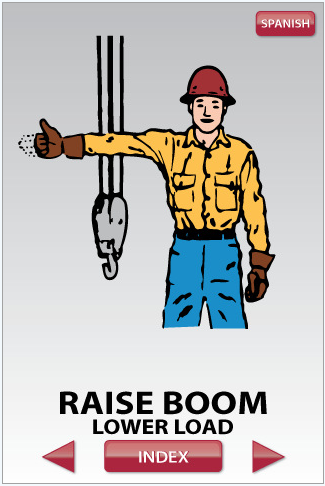
December 14 - The Specialized Carriers & Rigging Association (SC&RA - http://www.scranet.org/) now offers a free mobile phone application for instantly accessing all necessary crane hand signals. The new application is available in the iTunes App Store (http://itunes.apple.com/us/app/crane-operator-hand-signals/id403502739?mt=8) and Blackberry App World (http://appworld.blackberry.com/webstore/content/18294?lang=en).

Every signal included is compliant with the new OSHA Cranes and Derricks Standard, Appendix A to Subpart CC of Part 1926-Standard Hand Signals. Each signal is shown graphically so that operators can quickly and easily reference the appropriate signal for each command. All signals are available in English and Spanish.

This new app is intended for use before entering the workplace. SC&RA does not encourage the use of smartphones on jobsites.  The Specialized Carriers & Rigging Association (SC&RA) is an international trade association of more than 1,300 members from 43 nations. Members are involved in specialized transportation, machinery moving and erecting, industrial maintenance, millwrighting, crane and rigging operations, manufacturing and rental.

The U.S. Department of Labor‘s Occupational Safety and Health Administration (OSHA) released a historic new standard, addressing the use of cranes and derricks in construction and replacing a decades old standard. The significant number of fatalities associated with the use of cranes and derricks in construction and the considerable technological advances in equipment since the publication of the old rule, issued in 1971, led the Labor Department to undertake this rulemaking.
 
The final rule was published on August 9, 2010 by the Federal Register and became effective 90 days later.  The rule can be found at http://www.osha.gov/FedReg_osha_pdf/FED20100809.pdf.

A copy of the regulatory text is available at: http://www.osha.gov/doc/cranesreg.pdf

Tuesday, September 7, 2010

Rigging Report Card - Pass? -or- Fail!

J.R. Clancy Company, one of the largest Stage Rigging component manufacturers in the world, has introduced a new posting section on their Facebook photos page.  It is a Bad Rigging Photo of the Week.  Log in and check it out.  Scary is an understatementwww.facebook.com/JRClancy

These pictures, and similar ones I post here in the Theatre Safety Blog, and those that I show in my USITT workshops "What's Wrong With This Picture?" are all intended to make you take pause and think about what may be lurking in your theatre, or that theatre that you may be traveling to for your next show.

These types of poorly thought-out assemblies really go to show you how important it is to have your facility inspected by an objective party.  Things that you may casually dismiss because you've come to see them every day may actually be a really serious hazard.  A fresh set of eyes can be key to getting a wake-up call.  Independent Consultants (insert shameless plug for my company, Teqniqal Systems, here) can be a great resource for this as they work objectively and are not interested in selling you new equipment, just seeing that you are aware of the current state of affairs with your facility.

The NFPA 80 Standard for Fire Doors and Other Opening Protectives, 5.2, requires that you have your Fire Curtain inspected annually, so this is a good time to have the rest of the rigging system inspected as well.  If your facility is operating under OSHA (State plan, or Federal plan, or even if it's not - it's still a really good idea), then you are required to have your Rigging Systems inspected annually.

Not to be forgotten, your Smoke Vents (an important part of the Fire Curtain System along with the Fire Doors) must be tested annually.  Your Smoke Vents should have rigging that facilitates the operation from the stage floor level (don't tell me you are going to go to the grid iron deck to open them to clear-out extraneous atmospheric effects or summer heat).  This smoke hatch rigging (be it mechanical or motorized) must be inspected semi-annually as a part of the Smoke Vent inspections.  Ref: NFPA 204 Standard for Smoke and Heat Venting, 12.4.3.5.

Ask a lot of questions about the report that you are going to pay for.  What does the inspection include / exclude?  How long will it take?  Who should be present?

"Will you shut me down if I fail?" is a common question I get.  My answer is this:  I'm just the messenger.  I report what I see and put it in context so you and your administration can understand it and the potential consequences.  I quote relevant building or safety codes, if applicable to the situation.  I am not the AHJ (Authority Having Jurisdiction).  You are my customer, so I report to you.  Your building condition is your business, so you can act on the report as you deem appropriate.  Hopefully, you will get the broken stuff fixed.

One thing at a time:  Typically, a Rigging System Safety Assessment report will NOT include any design or specific engineered solutions.  It is only a report on the conditions.  Why is this excluded?  At the time I contract with you to perform the inspection, I will usually only know the general nature of the building layout and rigging systems, I will not yet have seen any of the actual conditions - how could I possibly estimate the cost of my services to (re)design a fix for what I have not seen?

"How much does this cost?" is the battle cry of the administrators.  Don't be smug and ask them why it matters - or retort "Would they rather pay for a funeral?"  That's not the question.  "How much does it cost?" means that they need to find the funds and understand the value.  When they understand what this inspection entails, why it is important and/or necessary, then they can address the funding issue. You can help the process by remaining calm and professional.  Drama Queens can alienate the administrators if they present more bluster than facts.  A good consultant can help you to educate them about this investment / recurring annual maintenance cost.

A little help on your part can be useful, too.  Do some research with your insurance provider, safety department, or even your regional / national arts groups.  Sometimes they have grant money available to help defray the cost of this work.  If it involves facility planning (that is what this is - planning for necessary improvements) and/or safety, the money is usually out there.

The answer, like so many things in life, is: "It depends."  You should be suspicious of anyone that offers you a "Free" or "Discounted" rigging assessment.  It will likely be worthless and largely incomplete.  This type of work takes time.  Time = Money.  No one makes a living on 'free'.  At a minimum, you are paying for the person's travel time and expenses to and from your facility, the time on-site actually testing, inspecting, observing, interviewing, photographing, and documenting what they find.  They then must organize all their findings into a coherent report that addresses your specific facility and put the information in context.  Each item should be clearly tagged with recommendations as to what needs removed, repaired, replaced, re-designed, etc.  The time expended writing the report can be many times the hours spent on-site.

The "It depends" factor is complex:  Do you have a walk-on gridiron?  Or do I need to rent a man-lift to go up a bazillion feet?  Do you have 1, 2, or 3 loading galleries?  How many line sets do you have?  How many are motorized?  Is this a Union House?  Am I inspecting just the Rigging System, or am I doing the Drapes,  Fire Curtain, Smoke Vents, and all the scabbed-on rigging at the Tormentors, Beam Electrics, Speaker Clusters, and Orchestra Shell components?  Is there an Orchestra Pit Lift?  Am I inspecting Fire Doors, Fire Alarms, and/or any other Life Safety Systems?

Be efficient with your investment.  Is your facility part of a School or College District that has multiple venues?  If so, then seriously consider having all the venues inspected under one contract.  No, this isn't a money grab.  It is about identifying the sources of problems.  If your inspector can assess 2, 4, or a dozen facilities as a whole, then the report you receive should be more manageable.  The areas of common concern can be discussed once, and the unique 'features' of each system or building can be addressed individually.  This allows you and your administration to see items that are systemic in nature and those that are local in nature.  A big picture that speaks to all of the district's Theatre Safety needs can be a powerful impetus for change and improvements.

Once the report is written and submitted, you will have a chance to read it and discuss it with your staff.  Don't shoot the messenger.  Understand that the inspector does not have an agenda, they are not 'out to get you', they are not seeking to close-down your theatre.

As Sergeant Joe Friday would say: "Just the facts, ma'am."  Don't interpret the safety report as an indictment of your operations or management.  It is not.  However, it may point to some areas of your operations that could use improvement.  The most dangerous part of a rigging system is the people that operate it.  Use your rigging safety report to improve your policies, methodologies, and show preparation.  Use it to plan repairs, upgrades, and service.  Learn from it.

Questions?  Call me or write me!

Wednesday, July 21, 2010

2010 LDI Show Schedule Available - Sign-up NOW!

The LDI International trade show has grown over the years to include much more than just stage lighting. You will also find sound, rigging, staging, video, projection, special effects, and thousands of tools to do your job more efficiently and safely. This year's show in Las Vegas (aka: Lo$t Wage$) runs Monday, October 18 thru Sunday, October 24 at the Las Vegas Convention Center.

Of particular interest is the growth of show production safety workshops being presented by ETCP trainers:
  • Stage Rigging Fundamentals - two days (L27)
  • Ohm's Law and Order: Essential Electrical Training - two days (L28)
  • Left Brain Rigging: An A-Z on Math and how it applies to rigging - two days (L29)
  • Left Brain Rigging Calculator - build your own spreadsheets for critical repetitive calculations (L30)
  • Tomcat USA: Safely Building the Beast - truss system design, fall arrest systems, ground supported systems - two days (L31)
  • Keep your Stage Rigging Happy & Healthy AR01)
  • Math for Riggers (Made Simple) (AR02)
  • System Integration Trends in Automation (AR03)
  • Is your GO Button Putting You at Risk? - Motor Control Technology & Risk Mitigation (ES01)
  • SIL Explained: Understanding European and Control System Safety Standards (ES02)
  • Fire Safety Curtain Systems - Closing the Door on Smoke (ES09)
  • Hook Up and Go! - Is Climbing on a Portable Structure Really That Easy? (ES10)
  • All About the ETCP (FS01)
  • ETCP paper & Pencil Exams at LDI - actually take the test(s)!
And of course, there will be lots of blinky lights and glittery things both inside and outside the convention center. Be There. See a Show. Have Fun. Learn Something.

More info at: www.ldishow.com/

Tuesday, June 8, 2010

Arena Rigging App for the iPhone


OK, you can use it other places you need a bridle, too (except horseback riding).  It's still handy, just as long as you use it on the ground and don't try to use your iPhone while straddling an iBeam.  Keep that loose stuff ON THE GROUND!  It's also handy for checking your ability to do these calculations IBM -(It's Better Manually) for the ETCP Rigging Tests.

Where to get it:  http://www.bridleapp.com/

Other related blog entries:
http://theatresafetyblog.blogspot.com/2010/03/in-god-we-trussed-all-others-pay-499.html
http://theatresafetyblog.blogspot.com/2009/12/jr-clancy-releases-irigging-application.html

Wednesday, April 7, 2010

You can Huff and Puff, but you won't blow down this Brickhouse

Say what you will about counterweight rigging being medieval, it still goes into a lot of stages and is used every day by many people.  So, if you're going to do it, you might as well make it safer.  At USITT 2010 in Kanasas City, Thern Stage Equipment Company introduced the "Brickhouse Front-Loading Counterweight Arbor System".  This takes a whole new approach at how you handle the counterwights as they are loaded and unloaded, and also takes a new look at securing them in the arbor carraige.

The first thing one notices it that the Brickhouse has side walls and three compartments for counterweights.  This allows you to load weights into the most convenient compartment to access, rather than reaching high or low and possibly overextending oneself.

The next convenience is that as you place weights in the Brickhouse, you don't need two hands to do it.  No awkward twisting, tilting, or finagling of the weights to get them in-between the arbor rods.  Why?  Well, there is no back rod, and the front rod conveniently swings out of the way so you can just slide the weight 'bricks' into the compartment, which is sloped a bit to help with the process.

The weights have a handle built right into them, too.  What a concept:  A counterweight that you can grab onto with one hand and hold it securely without fear of dropping it.  This leaves your other hand free to hang-on for dear life (you are wearing a fall prevention / arrest system as you load weights, right?)

Once the weights are nestled into their compartments (and you can fill the compartments all the way to the top, too), you just swing the front arbor rod back into place and let 'er fly.

Drop testing shows that a stage heavy line set will crash throught the lower arbor stop just like a regular arbor (no surprise there), however, the side walls are built to take a lickin'-and-keep-on-tickin', so you shouldn't have a mess of bricks jumping out of the Brickhouse.  No word yet on the potential for bricks jumping out of the Brickhouse in the event of a stage-heavy run-away, but given the design of the compartments, it looks like the weight-lock free design still keeps them under control and not raining-down a hail storm of steel plates on the fly crew should a line set get away from you.  That said, I'm still wearing my hard hat PPE when I'm onstage or in the fly galleries - there are still a lot of other hazards out there to ping your skull.

More info can be had at: http://www.thernstage.com/products/rigging-systems/counterweight-systems.html

Wednesday, December 9, 2009

J.R. Clancy releases iRigging Application


It's always good to have rigging information at your fingertips - it sure beats guessing or digging in your tool box for that chart of numbers. J. R. Clancy has turned its popular rigging slide rule tool into a free iPhone application. Installers and users of theatre stage rigging should find this handy. The new application delivers instant information in English and metric (SI) units.

iRigging provides wire rope data, including: minimum sheave diameter; cable breaking strength; and recommendations for quantity of cable clips, wire turn-back for cable clips, proper torque for cable clip bolts, and Nicopress sleeve crimp quantities. Other data includes: allowable fleet angles, uniform and midpoint batten loading, arbor capacity, weight of counterweights, recommended working loads for equipment, motor current, stage ropes, and weight of stage fabrics.

The tool is free and currently available at Apple App Store.

More information about J. R. Clancy is available at www.jrclancy.com. As of this date there is no information available about the iRigging application on their web site.

Note: The app does not include iCommonSense, so you have to provide that yourself. It does feature standard GIGO* operation, though.

* Garbage-In yields Garbage-Out

Have fun with it, just don’t be an iDiot and drop your iPhone from the iGrid – it might hit someone in the iHead. Has anyone released the iLanyard to keep this from happening?

Thursday, October 1, 2009

Breaking strength of copper wire vs. steel cable - Gee, which one would you choose?


This scenery flat was found attached to a utility batten with a loop of 12 gauge stranded copper electrical wire. Copper is a soft metal that has little strength when loaded structurally. The director usually doesn't want the performers to wear hardhats during the performance, so eliminating the possibility of scenery falling on them really can work-out well for the wardrobe department.

The use of proper scenery attachment clamps, and securing flats at the bottom as well as the top can improve the safety. By attaching suspension cables both places, the flat framing is loaded in compression, rather than in tension, greatly reducing the likelihood that the flat could be pulled apart at the seams / joints should it snag on something when it is going up (flown-out).
Thread the suspension cable through this at the top of the flat.
Terminate the suspension cable at the bottom with a bracket like this.

Components shown found on Doughty Engineering web site (www.doughty-engineering.co.uk)

Wednesday, May 13, 2009

Cable Bending Radius

Wire rope, like all flexible cables, has a limit as to how sharply you can bend it before it is permanently deformed. This is called the d:D ratio. It is the ratio of the diameter of a sheave to the diameter of the cable. It depends upon the stranding and lay of the rope, and it is usually in the range of 20:1 to 40:1. This ratio is for maximizing the life of the cable as it flexes repeatedly while it transitions from straight to curved and back to straight as the cable passes over the sheave.

For a 1/8" diameter cable, not typically used for stage rigging, but frequently used for operating smoke vent hatches, this would typically use a 4" diameter sheave (32:1 d:D ratio). The picture below is a 1/8" diameter cable that operates a smoke vent. You can see that it is bent under tension over the sharp edge of a steel I-Beam with no pulley or block to smooth-out it's travel around the corner. You can also see where the cable strands have broken due to repeated operation.

So, why is this important? The smoke vents should be configured to allow both manual opening and closing and for the automatic release in coordination with the Fire Alarm and the Fire Curtain systems. It is very typical (but shouldn't be) that the Smoke Vents are rigged by someone other than the Stage Rigging contractor. When that happens, the manual operation system is either non-existent (so you have to climb up on the roof in a rain storm to close the hatches), or is 'user hostile' (isn't convenient for the staff to use on a day-to-day basis).


Dysfunctional mess (left). Neatly marked and operated with a RED handline (right). Sign reads: NOTICE - Smoke Vent Operation Line Inside". Sign is on both sides of hinged protective screen panel. Panel in front of line set is painted red.

Saturday, April 25, 2009

"We don't have to get it inspected, do we?"

That is a common whine I hear from theatre owners / facility managers all the time. Sometimes it's followed by "We're exempt!" Really? Where does this drivel come from?

The Occupational Safety and Health Administration (OSHA) publishes a standard for the use of industrial winch and hoist machinery. That is Stage Rigging Equipment to you and me.

OSHA “29 CFR 1926.550 Cranes and derricks,” paragraph (a)(6):
“A thorough, annual inspection of the hoisting machinery shall be made by a competent person, or government or private agency recognized by the U.S. Department of Labor. The employer shall maintain a record of the dates and results of inspections for each hoisting machine and piece of equipment.”

You can’t get much clearer than that.

"Hoisting machinery" is anything that hoists. It does not have to be motorized.

I cannot find anywhere in the OSHA Regulations that exempts any school (public or private), church, municipality (State, County, City, School District), or non-profit organization (i.e. community theatre).

It’s up to facility owners to be sure that stage rigging equipment is in top working order. The inspections are intended to protect the staff, students, and guests from using mis-designed, mis-installed, damaged, or worn-out equipment. Inspections can also shield the institution from potential lawsuits should there be an accident, and it can prevent the assessment of fines should there be an OSHA inspection. Yes, you can be fined by OSHA just for not having a record of the inspections, let alone not actually having the inspections.

A "competent person" would typically be either a Theatre Consultant or Stage Rigging Company that has experience in this area. The person doing your inspection should, however, be looking at the big picture when they come into your facility. I frequently find recently installed or recently inspected stage rigging systems that have gross violations of other safey codes immediately adjacent to the rigging equipment, and discover that no one had mentioned or reported those conditions when filing their final reports.

If it involves safety, "NOT MY JOB" can't be used to side-step the issue. You see it. You report it. Period.