Showing posts with label Fire Safety. Show all posts

Thursday, October 29, 2015

Yet another way to learn about Theatre Safety


The Theatrefolk Podcast offers-up a thoughtful piece on Theatre Safety - come and tune-in as Lindsay Price interviews Kristy Ross-Clausen about rigging, emergency egress routes, hand and foot PPE, and flame-proofing.

Theatre Safety Podcast

Friday, June 28, 2013

Gut Feeling Can Prevent Accidents

A Pat Benatar benefit concert scheduled for Friday, June 21, 2013 was cancelled at the bequest of her stage crew.  Upon arrival to the venue, an outdoor covered arena in Iverness, Florida, the crew was presented with a stage platform that they did not think was robust enough for the show.  Rather than risk the potential for a structural collapse, they requested that the promoter have the stage structure inspected and reinforced.  A local engineer was brought-in to certify the stage, but the caveats included with the inspection did not satisfy them in time to mount the show.

An article at Celebrity Examiner (www.celebrityexaminer.com/2013/06/26/benatar-releases-photos-of-substandard-stage) describes the scenario at length. Below are some picture released by Pat Benatar and her husband Neil Biraldo that show the deficiencies they found.  It is noteworthy that a performer and crew would postpone an event until it can be presented safely, rather than throwing caution to the wind and saying "Damn the torpedos - full steam ahead!

Just because it might have worked doesn’t mean you shouldn’t give it a second look.   If something looks ‘hinky’, give it a good going-over.


WalkerFest Stage
Upstage End Looking Towards Downstage Right

I’ve seen stages with these types of support legs before, and they are generally pretty strong as far as static column loading, which may have been the assumption by the engineer that allegedly certified the stage.  He may have not been considering the lateral dynamics of movements on the stage during load-in, performance, and strike.

The lack of regular diagonal (cross) bracing would make it a wobbly experience.  Note that the 2x4 diagonals shown along the upstage end are not pinned in place to fix their length, instead, they are only pinched against the suport legs with C-Clamps, a connection that can slip loose when loaded becasue it is only held together by friction.

 
WalkerFest Stage
Understage View Looking From Upstage Towards Downstage Right

The understage picture shows the manufacturer’s Quick Connect Braces along the downstage row of support legs, but does not show any other intermediate braces or braces along the side stage support legs.

Surprisingly, the manufacturer’s catalog (www.graniteind.com/DOWNLOADS-SeatingStagingFencing.asp) has a chart of the required number of diagonal braces (not cross-braces) that are recommended for stages of various sizes, and it appears to advocate only installing the diagonal braces at about 50-90% of the perimeter locations, with none at the interior supports; whereas their competitor, BilJax (Model ST8100, www.biljax.com/products/events, also sold as AlphaDeck in Europe, www.alphadeckstaging.com recommends a higher number of X-Braces along both axes and between the interior support legs.

The stage in the photos appears to be about 54” tall (as measured by counting the hole spacing in the legs), and according to both Granite and BilJax, stages over 48” tall should have two sets of braces at the recommended minimum spacing.

Stages need diagonal bracing along both axes,  not just one, and all support legs should be braced to prevent them from being skewed from vertical by unexpected circumstances.

The 2x2 or 2x4 stringers seen running along beside the support leg feet do not appear to be attached to the support legs, but even if they were, they would only serve to keep the feet spaced relative to each-other, not to counteract any parallelogram type collapse of the structure.  Diagonal X-braces would both prevent the legs from tilting away from vertical and provide sway-bracing for the entire stage structure.

The foot-pads on the ends of the support legs are resting on what appears to be a dirt arena floor (but it could be dust on a concrete floor, or a canvas drop-cloth – it’s really difficult to tell from the pictures).  Note the plywood square ‘mud seals’ lying adjacent to each leg – they were NOT installed, so the legs could sink into the surface below if it is not a concrete deck.  The ground surface appears dry in the picture, but that doesn’t mean it will stay dry; nor does it mean that the ground is dry and compacted below the visible surface.

HEY!  Er, ah, HAY!  What's that hay doing under the stage?  It's a fire hazard that should have been removed, too.

Show Some Moxy.  If it 'just don't look right', then verify that it will be safe.  Risk Analysis is part of your job!

Thursday, February 14, 2013

Quoting them chapter and verse . . . the NFPA moves into the 21st century

Tact, it is said, is the ability to make a point, without making an enemy.  Sometimes you need to show someone that it's not you, personally, that has an opinion about a safety issue - it's the NFPA.  Just like Sgt. Joe Friday on Dragnet, you can show 'em "Just the facts, ma'am".  Carrying around a set of code books isn't that easy, it's like a set of encyclopedias (only much more boring).

Well, our friends at the NFPA have just made that a lot easier, and probably saved you some chiropractic bills in the process.  You can now get access to the NFPA code books in PDF format and browse the codes on your iThing-a-ma-bob (https://itunes.apple.com/us/genre/ios-reference/id6006?mt=8&letter=N&page=4#page, then scroll to NFPA . . .).

NFPA Mobile

And to top that off, the NFPA has Podcasts about numerous Fire Safety subjects.


Saturday, November 24, 2012

Reminder about Facility Preparedness

The National Trust for Historic Preservation has posted resource links for preparedness information on their web site (www.preservationnation.org/resources/technical-assistance/disaster-recovery/cultural-institutions-prep.html),  Aside from the safety implications for severe weather, earthquakes, fire, and floods, it is socially responsible to protect our historic architecture from the ravages of arson, time, insects, and natural disasters.  "They don't build 'em like they used to" may be a common phrase, however, it it is not just the structures that are at risk, it is the contents of the buildings, too.

Finding safe and secure off-site storage for historical documents and records should be a priority for any organization that owns or manages a facility.  Storing fragile wood and paper items in basements is an invitation to destruction in the event of a fire or flood, and insect infestations can also erode and damage goods.  Water damage can be significant when even a small fire erupts, as fire fighters work vigorously to see that a fire won't spread throughout a building by dousing it liberally with thousands of gallons of water.  Water runs down hill, so anything in lower levels can be flooded by fire suppression water as it drains down through cracks and crevices.
How is your fuel supply?

Another good reason to use off-site storage for scenery, props, and costumes is in the cause of fire reduction.  What is not present as fuel cannot contribute to the fire.  Other benefits are the reduction of clutter allowing more efficient use of the available spaces.

Wednesday, March 28, 2012

Emergency preparedness from the other side of the pond

Good guidance is often hard to come by, particularly for free.  Most standards to which we must operate are usually published by somebody that wants a chunk-o-change for the priviledge of reading the rules by which we must abide.  In the United States the NFPA manuals & books, ANSI standards, ASTM standards, PLASA / ESTA standards, and most Buiding Codes are priced anywhere form $20-30 bucks up to several hundreds of dollars.  Now that's not so bad if you only need one of the books, but for most of us in the theatre industry, we need maybe 15 to 50 of these to cover our collective bacon on all of the hazards and project types we are typically exposed to or involved with.  This can really add-up quick.  Especially when they change with locality and adoption dates.  Think about this the next time you hire and Architect, Engineer, or Theatre Consultant - part of your fees go to keep this library up-to-date so that they can prescribe the best and most current designs that satisfy the local code requirements.

There are a few free publications out there, too.  So here are some good resources that won't break the bank:

American's with Disabilities Act (commonly known as the ADA):
www.access-board.gov/adaag/html/adaag.htm

Occupational Health Safety Administration (OSHA):
www.osha.gov

National Institute for Occupational Safety & Health (NIOSH):
www.cdc.gov/niosh
(Great ladder safety info here!)

And with a big thank-you for the United Kingdom government:
www.communities.gov.uk/fire/firesafety/firesafetylaw/aboutguides
This is a set of Fire Safety Risk Assessment Guides that clearly and logically cover many different types of performance venues.  They may be metric (oh, the horror!) and they may be formatted on funny sized paper, but doggonit, these are good guides!

Tuesday, February 21, 2012

Yeah, they have an app for that, too.

The iAuditor application for the iPad provides a convenient way to deploy checklists to all of your department heads and workers.  This customizable tool allows you to set-up check-lists, take photos, sign the document, and e-mail it so you have a clear record of inspections.

This app replaces paper-based reporting and allows the user to enhance reports with photographs showing compliance issues.  It also greatly reduces the likelihood of late submissions and falsified time-stamping.

With a smart interface to build forms, iAuditor allows for forms to be created on-the-fly from within the app, a form can be created and modified to suit departmental needs throughout the theatre plant.  By giving users the power to create their own audits, iAuditor can be applied to thousands of situations. This level of customization in auditing has never been seen before in the safety industry.


The iAuditor app has full GPS integration, too, so it can identify reports applicable to specific venues for large areas like theme parks, or be used on tour venue-to-venue.


An unlimited number of forms and checklists can be created using the form building screen, and templates can be shared between users. Ready-to-use audit forms are also available for free download from the SafetyCulture Secure Online Cloud.

Upon completion of an audit or checklist, the form can be quickly e-mailed as a PDF, which is compatible with almost any computer, smartphone, or tablet with a PDF reader application.

An audit checklist can be used by workers to ensure they are meeting their reporting and record-keeping requirements. Uses include:
  • Life Safety Code Inspections
  • Occupational Heath and Safety Codes
  • Governmental Reporting Requirements
  • Fire Prevention Checklists
  • Building Safety Checklists
  • Electrical Safety Checklists
  • Ladder Safety Checklists
  • Pre-Show, Intermission, and Post-Show Checklists for both FOH and Backstage
  • Shop, Storage, and Loading Dock Safety Audits
  • Vehicle Inspections
  • Emergency Lighting & Exit Sign Inspections
  • Fire Extinguisher Inspections
  • Fire Door Inspections
“Businesses all over the world are using technology to work smarter, not harder. We’ve listened to the people who are out in the field every day, and we’re committed to helping them work safer by using technology. With iAuditor, we’ve shown another example of this commitment; an incredibly versatile auditing and checklist app that is free to use and free to download.” Said Luke Anear, Managing Director of SafetyCulture Australia (www.safetyculture.com.au).

More information about the iAuditor app can be found at: www.safetyculture.com.au/iauditor/

Friday, December 16, 2011

December is Fire Safety Month (yes, AGAIN)

The always vigilant writer Patrick Hudson at BackStage At BackStageJobs.com has been after this one again, and he has some good words to read.
It hasn't been a pretty year for Fire Safety in Theatres:  http://backstageat.backstagejobs.com/?p=837
It’s always a series of problems, not just one:  http://backstageat.backstagejobs.com/?p=729
Twenty-Two Years, Multiple Theatre Fires:  http://backstageat.backstagejobs.com/?p=738

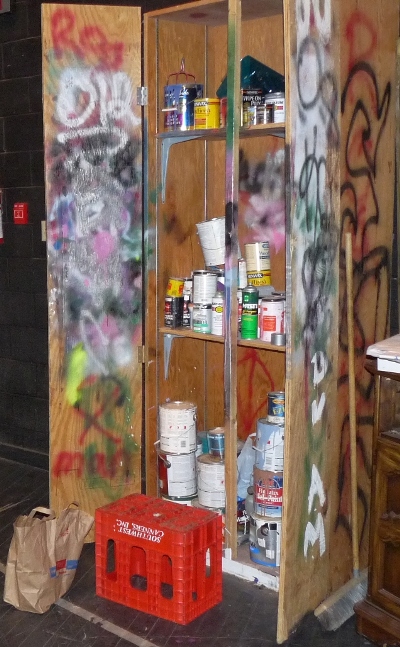
Compartmentalize Your Storage:  Keep the fuel load to a minimum!
But don't do it like this:
Paint Storage Cabinet Made From Wooden Bookcase

Thursday, December 15, 2011

Pants on Fire!

Station Nightclub Fire - West Warwick, Rhode Island 2003
Most of us mere mortals never get to play Fireman in real life, so getting the opportunity to handle fire extinguishers, find-out about the adrenaline rush of putting out a fire, and experiencing the actual time constraints of a fire event up-close and personal doesn't come along too often.

This can change for all of us if we get together with our local community and make an effort to get Fire Extinguisher Training Programs set-up and active.  Most communities and fire departments cite the expense of recharging fire extinguishers as the main reason they don't provide this kind of training.  So, whats a wanna-be fire fighter to do?

Bullex Corporation decided that there needed to be a better way and they came-up with a training device that doesn't go through fire extinguisher powder.  It's call the Bullseye and it kind of looks like a flat-screen TV with a big remote control.  The screen is not a TV display though, instead, it is a computerized fire simulator that grows, glows, flickers, and dances just like a real fire (only without the heat and smoke).  At the base of the unit are special sensors that detect laser light that comes from a simulated Fire Extinguisher.

The Bullseye simulated Fire Extinguishers are pretty fancy units - not just a Wii controller stick.  They come in three sizes just like the real deal: 5 pound, 10 pound, and 20 pound; and they have a loudspeaker inside of them so you get that sense of whoosh! as they simulate a discharge.  Real nozzles, pull-pins, and squeeze handles, too.  They are even heavy like a real fire extinguisher.

The trainer sets-up the fire simulation to suit the type of training to be performed - they set the type of fuel and how big the (simulated) fire is going to be, and they say GO! (Or, maybe they don't say GO! and you have to figure it out for yourself - just like real fire.)

The system has a timer that keeps track of how long you take to respond and how long it takes you to put-out the fire.  And guess what?  If you use-up all of your fire extinguisher before you put out the fire -- it keeps burning.  D'OHP!  The system knows how much stuff you have to shoot and when it's gone, it's gone!  Game over.

WHY IS THIS IMPORTANT?

Real fires don't have an OFF button, and real Fire Extinguishers only have a limited amount of fire fighting capacity.  IF YOU WASTE IT - YOU LOOSE.

PASS  - Know this phrase!
Pull the pin - this is so you are ready to do the job when you get to the fire.
Aim the nozzle at the BASE of the fire - if you point it somewhere else you will just waste the  fire fighting chemical.
Squeeze the handle - don't squeeze it until after you have aimed! (Just like a ketchup bottle)
Sweep the nozzle side-to-side along the base of the flame so you coat the fuel source with the chemical.

The cost of a training kit is about that of a small car, but if you spread that out over the whole community, it can approach a-dollar-a-head.  And there is no reason that the unit couldn't be used to train everybody from kindergarteners up to senior citizens.

Hands-on Training is the most memorable and effective training you can provide.  The community can make the rounds with this and see that schools, social organizations, community groups, and churches could all share in the benefits.  Training all of your performers and stage crew would be a high priority.  Maybe you can give them merit badges!  I'd say that if you didn't keep this thing busy at least 360 days per year that you were probably missing the point.

Dang, this is starting to sound like a Ginsu knife advertisement . . . however, one more thing that is interesting:  Bullex knows that this is a chunk 'o change to spend, so they rent the unit for test drives, too.  And if you decide to buy one within a year of the test drive, then they apply the rental fee to the purchase price.  Good Deal!

More info at: www.BullexSafety.com

Saturday, October 29, 2011

FEMA? - No, the OTHER FEMA

The Fire Equipment Manufacturer's Association (FEMA) web site http://femalifesafety.com has several resources that can be helpful in training staff and students about fire safety.  They have a Fire Extinguisher Training Video and other Fire Extinguisher information, as well as information about using a racked Fire Hose Systems.  Take the quizzes and download the info they offerLearn not to burn.