Showing posts with label Trip Hazard. Show all posts

Tuesday, October 18, 2011

Weebles Wobble - But They Don't Fall Down

What better time to talk about Ghost Lights than during the Halloween season?  One of the prime reasons to have a Ghost Light on your stage is to prevent accidents.  Stages have places you can fall off of like trap openings and the front of the stage, and they have plenty of things to bump into and trip over, or at least bust-up your face or shin real good.  Ouch!  Halloween scars that are permanent.  Just what every aspiring actor needs.

One of the most common reasons for not having a Ghost Light is that they aren't commonly available from theatrical supply houses.  All of the Ghost Lights I've ever seen have been cobbled together by well meaning shop craftsmen. The problem with this approach is that whenever you manufacture something you assume the liability for it as well.  When you combine this with poor electrical knowledge and make-shift adaptations the results can be electrically hazardous as well as physically hazardous.  So where is the safety in that?
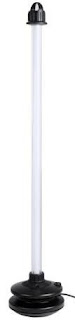
I was at the local big-box hardware store the other day and I noticed this gizmo:
Item 212004, Model GL600 (www.lowes.com/pd_212004-337-GL600_0)
[Update 2015-08:  This product is no longer available.]

Lowes sells it under their Utilitech brand (made by Cooper Lighting), it is UL and CSA safety listed, fairly inexpensive, and most of all, pretty darn indestructible.  The unit has a weighted base that houses the fluorescent lamp ballast, and incorporates a groove around it to wrap-up the cable when it is not in use.

The case is plastic and has a tie loop at the top if you need to hang it up for storage or suspend it. The clear plastic tube that house the lamp acts as a container to keep broken glass off of the stage should you give it a really significant whack.

Fortunately, the unit does NOT come equipped with a lamp (yes, this is a GOOD THING).  When you outfit it with a lamp you can choose the color temperature (CCT) and color rendering index (CRI, or Ra) so that it doesn't clash with your other work lighting, and if you elect to beef-it-up a bit you can install a hard-use lamp like those made by ShatRShield (www.shatrshield.com/catt8page.html)

This unit uses less than 40 Watts of power and lights-up a pretty good area around the stage, so pop one out onto the proscenium line so nobody has to grope in the dark and fall off into the orchestra pit.  That's a dangerous fall to make unexpectedly, and many people over the years have been killed or received career-ending injuries this way.

And a note about the Energy Nazies:  There is always some well-meaning but oblivious-to-the-safety-implications individual that feels compelled to turn-off every light they find glowing.  For a  Ghost Light  to be effective, it must be left ON.  You have to twart them at their game.  What can you do?  Post a sign at both the on/off switch on the Ghost Light AND at the end of the cord(s) that supply the power.  Be polite, but be firm.

 "I want you to meet my little friend." said Al Pacino's character in Scarface.  This will confuse the energy Nazies for sure:  Add a  photoluminescent  tube over the lamp.  This will continue to glow for about 40 hours after you remove the power from the lamp - so it will give any stage marauders a bit of a chance see where they are going should the power go off (or be switched off).  The Lumenite® Light Sleeve is a semi-translucent,  photoluminescent  sleeve that fits readily over new or existing fluorescent tubes.
More Luminite info here:
www.lumenite.biz/shop.php/light-sleeves/c_12.html

Do you really want to keep it safe and confuse the Energy Nazies?  Add an Uninterruptible Power Supply (UPS) to the Ghost Light.  At only 40 Watts power draw, a small UPS will keep the lights on for hours.  If you use an LED based lamp, then the darn thing could glow for a day or more.

Thursday, June 10, 2010

Dance the night away - but not your life.

Keeping, building, or replacing your stage floor so that it is properly sprung, free of cracks, splinters, protruding screw / nail / staple heads, and other little things that can cause serious injuries to dancers and actors should be a continuous process.  Keep the stage swept and clear of debris, watch for discontinuities between adjacent panel edges, floor pocket lids that don't close properly, are missing, or where the entire lid is not installed flush to the surrounding floor area.  Also watch for wall plates installed on floors and loose trim strips that join adjacent flooring areas.


If your stage floor is not sprung, then it should be a priority to have it replaced with a properly constructed floor that will work for your productions, dance, and other general uses.  There are many ways to construct floors that will last and be functional, so enlisting an expert (like a Theatre Consultant) that has experience in this area can be very helpful.  There are many possible materials to be used, and each has advantages and drawbacks.  Knowing what works, and what doesn't, can save money and injuries.

Another dangerous item on stage is old footlight troughs.  If they are not locked and you step on them, or maybe set a scaffoding leg or man-lift outrigger on them, they can fail or flip-over.  Equipment and people can topple and cause major injuries and damage.  This blogger knows of at least one dance instructor that had a career-ending spiral break of the leg bones that left them out of work for months and will never be able to dance professionally again.  That's serious stuff!

Resources:
http://www.danceusa.org/dancerhealth
ANSI E1.26 - 2006 - Recommended Testing Methods and Values for Shock Absorption of Floors Used in Live Performance Venues - http://www.ansi.org/
Dance This Dance That Blog - www.danceartkl.blogspot.com/2005/09/5-common-dance-injuries-how-to-treat.htm
Harlequin Floors FAQ - http://www.harlequinfloors.com/uk/dance-area/about-dance-injuries.html
Center Stage FAQ: http://www.centerstagellc.com/health/importance-of-proper-dance-flooring-injury-prevention-dancer-longevity/

Tuesday, March 30, 2010

Boxes full of booty (no, not that kind of booty!)

As I perused the Stage Manager's exhibits at the theatre conference I found some other items of interest, too.  Most of the kits had some sort of First Aid section, and several had Flash Lights and/or Spare Batteries, and a few had Chemical Light Sticks stowed-away.  All good things to have if the lights go out.

However, what was really interesting was that all of the portable kits I saw were BLACK.  All black.  Barely a fleck of color anywhere.  It reminded me of the picture below:

"Polar bear in a snow storm"
Now I know that black is the color of choice for all things theatre, but this doesn't make any sense.  It's not like you don't want to be able to find your tool box.  It's not like your tool box is going to be flirting around the wings and might be seen by the audience.  And guess what?  If the lights go out - you wouldn't be able to find your flashlight or Calume light sticks!  A black box in a black backstage environment with the lights out is nothing but a trip hazard or shin-buster.

Not  black ? Sacrilege!  Keel-haul the scallywag! At the very minimum, place some photoluminescent marker tape around the perimeter so that you can find it when the lights go out.  A bit of highly reflective (i.e. retroreflective) marker tape along side the photoluminescent tape would be a good idea, too - this way if you shine even the weakest of flashlights in the general direction of the toolbox, it'll light-up like a fireworks display and you can grope your way toward it a bit easier.  There is a reason that Firefighters and Liferafts both have SOLAS* type marker tape on them - so they can be seen under the worst of lighting conditions.

*SOLAS - Save Our Lives At Sea - Solas type marker tape is commonly used on road signs and highway barrier marking because it does such a darn good job of blinding you with your own headlights.

So, how about some alternatives?  OK. Lets try these:
DuraTool D00403
DuraTool D00407
Stanley 2-in-1 Mobile Work Center
(a bit black, but nothin' a bit-o-tape won't fix either)

Stanley 3-in-1 Mobile Work Center

Thursday, February 4, 2010

Painting the town

As wonderful as glow-in-the-dark photoluminescent tape is, sometimes it is just easier to paint something.  Odd shaped or textured surfaces, or just bulk application frequently makes it more economical to do this, too.  Another reason to paint rather than stick, is that the finish is more permanent.  Tape-based products vary in the type of base material they are made from, and adhesive backing provided.  In high traffic areas (for hands, too, not just feet) tapes can sometimes snag on the edge and either create a trip hazard and/or a peeling problem.  Curious vandals may want to re-appropriate your carefully applied glow-tape, too.

When looking for glow-in-the-dark photoluminescent paints, it is highly recommended that you verify that the products meet ot exceed the New York City MEA 451-05-M-2 Standard for LL26 Safety Evacuation Markings.  These aren't the only certification for products, but it is one of the most common and well publicized references out there.

Also, note that some products don't use the Stontium Aluminate (SrAl) based pigments, either.  The products by GloNation, although very cool and helpful for special effects, use phosphorescent dyes; and the Rustoleum 214945 'Glow-in-the-Dark' Latex paint, which uses zinc sulfide (ZnS).  Many of the cheaper photoluminescent Low Location Lighting (LLL) systems in use today are based on zinc sulfide (ZnS) as the main pigment. The advantage is relatively quick charging, but these products have a limited 'storage' life and the ZnS corrodes over time (2-4 years lifespan).  It also doesn't glow as long or brightly after being charged. However, the introduction of Stontium Aluminate (SrAl) as a pigment, has provided a much higher level of performance. Although it takes slightly longer to charge, it can 'store' more light, making it much more suitable for use in locations where ambient light levels are low, or dark for extended periods.

Lastly, in order to get a good bright glow paint treatment, it is very important to follow the manufacturer's directions (you know: RTFM! ).
  • Most of them require a bright white base coat so that there is a reflective surface behind the paint to assist the glow.  If you paint the glow material over a dark surface, then the glow that emits from the back-side of the coating will just be absorbed into the background instead of reflected back out through the nominally transparent glow paint coating.
  • Apply several coats of the material to build-up a few mils of  paint thickness.  One thing you will notice with most photoluminescent products is that the brightness of the product is related to the thickness of the product (it is also related the formulation).
  • Apply a clear coating to protect the photoluminescent coating.  Otherwise it will eventually scrape-off or wear-off.  This stuff ain't cheap, so make the effort to keep it intact.
You can also apply traction grit additives to the coatings.  Ask your vendor what they recommend, and whether it should be mixed into the photoluminescent coatings, or into the clear over-coat.

Resources:
American Permalight (http://www.americanpermalight.com/) - Spray paint, Acrylic Wall paint, and 2-part Epoxy & Polyurethane paints
EverGlow (www.everglow.us/?everglow=&photoluminescent=6&signs=coatings-paints)
GloBrite (http://www.globriteltd.com/coatings.asp)
GloNation (www.glonation.com/pigmented-glow-paint.html)
GloTech International (www.glotechint.com/paint.htm)
KanKote (http://www.kankote.com/)
KryptaGlow (http://www.krypta-glow.com/)
GBC Coatings (www.gbcsafetyglow.com/glow-polyurea-photoluminescent-glow-in-the-dark-safety-floor-marking-coatings/industrial-photo-luminescent-floor-striping-and-coating.html)
Metal Safe Sign International (www.mss-int.com/prod01.html)
ProLayer Inc. (http://www.prolayerinc.com/)

Get samples.  Apply.  Test - for a really long time - say . . . 12 hours.  Buy the one that works best.

Wednesday, September 16, 2009

Pardon me while I trip over this pipe and impale myself...


This is a good example of where NOT to have a fire sprinkler pipe installed: Running right across the floor of a walk-on wire tension grid. Not only is it a huge trip hazard, but the hold-down calmps they used were left with bolt ends sticking up far enough to impale someone. Clearly, the bolts should be trimmed-off and the pipe maked with a bright yellow / black OSHA hazard marking tape.

Poor coordination in the design and installation phases cause things like this to happen. In reviewing the site, it was obvious that the sprinkler contractor just took the easy way through, as there was plenty of room overhead to run the pipes above even the tallest person working on the grid.

Not seen in the picture: right above the pipes were 2'x4' fluorescent work-lights that were suspended with the bottoms at about 5-8" above the grid deck. So, while you were busy looking down to keep from tripping, you hit your head on the sharp metal corners of the light fixtures (painted black to hide them). Yet another good reason to wear a hard-hat in the theatre!

Wednesday, July 8, 2009

Shin busters in the dark

Orchestra Shell Tower Counterweights. There are two things that you can do to make these a little friendlier:
  • Install some foam padding along the edges that will hurt you if you find them in the dark,
  • Install / Paint the corners and edges with glow-in-the-dark tape / paint so you can see them in the dark.

Good Resources:

Monday, June 22, 2009

Toe busters!

Here is a metal strip that was intended to cover the transition from a sprung wood stage floor to the adjacent tile on concrete floor.Here you can see a side view of the metal showing how it has become bent and sticks up into the travel path.
Here is a floor pocket that was not properly installed and is resting upon the stage floor deck instead of being set flush with the wood surface.