Showing posts with label OSHA. Show all posts

Thursday, February 4, 2016

OSHA issues fines for Stage Manager killed in blast

2016-02-03 -Last summer we reported about an incident in west Texas where a Stage Manager was killed when a pyrotechnics storage bunker for an outdoor show exploded  (http://theatresafetyblog.blogspot.com/2015/08/fireworks-storage-building-explodes-and.html)

OSHA has now investigated the incident and issued a statement:  “A 21-year-old worker, with three months of work experience under her belt, lost her life because Texas Panhandle Heritage Foundation failed to provide appropriate training and protective equipment to workers handling pyrotechnics.”

That was the assessment of Elizabeth Linda Routh, OSHA’s area director in Lubbock, Texas, after a young worker was fatally injured last summer while taking an inventory of the pyrotechnics for an outdoor musical production at the Palo Duro Canyon State Park in Canyon, Texas.

After an inspection following the fatality, OSHA issued six serious citations for failing to train workers on the use of explosives, provide fire retardant clothing, perform a hazard assessment and develop a written hazard communication program.

Proposed Penalties: $42,000

Texas Panhandle Heritage Foundation is a performing arts employer.

------------------

Although $42,000 may not seem like much for a human life, this assessment of the situation opens the door for civil litigation so the victim's family can pursue further compensation.

Sunday, September 27, 2015

Strippers can take you breath away - permanently

Methylene chloride, also called dichloromethane, is the solvent common in many paint strippers.  The widely available products with labels that warn of cancer risks but do not make clear the possibility of rapid death. In areas where the fumes can concentrate, workers and consumers risk asphyxiation or a heart attack while taking care of seemingly routine tasks.  PublicIntergrity.org has researched the many deaths that have occurred while using these products and the report can be found here: http://www.publicintegrity.org/2015/09/21/17991/common-solvent-keeps-killing-workers-consumers  It's a lengthy read, but it could save your life.

In the fine print of most labels they manufacturers allude to the precautions necessary when using their products, but without a magnifying glass and good lighting, the labels are often difficult to read and easily ignored.  While these products can be bought at home-improvement and general retail stores across the U.S., the specialty respirators and polyvinyl-alcohol gloves needed to handle them safely are not usually available from those same retailers.  OSHA and the National Institute for Occupational Safety and Health say only a full-face respirator with a separate air supply, or exhaust ventilation to remove the fumes, will provide sufficient protection.


Setting aside longer-term health concerns, such as cancer, the danger posed by methylene chloride is its one-two punch when fumes accumulate. Because it turns into carbon monoxide in the body, it can starve the heart of oxygen and prompt a heart attack. The chemical also acts as an anesthetic at high doses, so its victims slump over, no longer breathing, because the respiratory centers of their brains switch off.


READ AND UNDERSTAND YOUR CHEMICAL PRODUCT LABELS AND SDS
THIS REALLY IS A "DO OR DIE" SITUATION


Thursday, September 24, 2015

OSHA Safety Violations upheld in death of camerawoman Sarah Jones

2015-10-15 - Sarah Jones, was a 27-year-old camera assistant when she was killed while trying to escape an oncoming freight train during the filming of a scene on February 20, 2014, for the movie “Midnight Rider,” a biopic based on the life of musician Gregg Allman. Eight other workers were injured.

OSHA cited Film Allman LLC in August 2014 for one willful and one serious safety violation for exposing employees to struck-by and fall hazards.

Judge Sharon D. Calhoun of the Occupational Safety and Health Review Commission (OSHRC) upheld those citations on September 15.

“Bad management decisions have real and lasting consequences, and when those decisions involve safety, the consequences can be tragic,” said Kurt Petermeyer, OSHA’s regional administrator for the southeast. “The death of Sarah Jones is particularly disheartening because it was entirely preventable.”

Petermeyer went on to say that Film Allman’s management “blatantly disregarded their obligation to ensure the safety of their crew and cast. They were fully aware that the railroad tracks were live, and that they did not have permission to film there. “

He added that while the OSHRC’s decision cannot correct or reverse the events of February 20, 2014, “we hope that it will serve as a reminder to the film industry that safety has an important, necessary role on every set and in every workplace.”


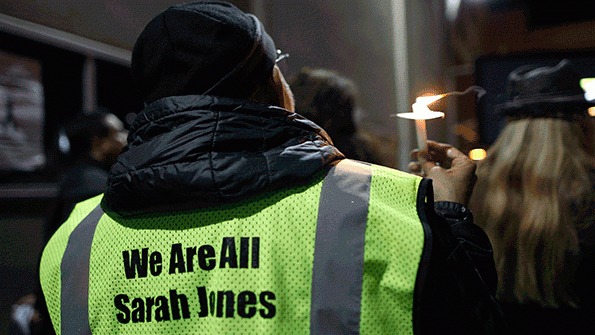
People gather in Los Angeles at the International Cinematographers Guild national offices on March 7, 2014
during a candlelight walk and memorial for Sarah Jones.

The backstory about this tragic incident can be found at:
http://ehstoday.com/safety/director-pleads-guilty-involuntary-manslaughter-case-involving-death-camera-assistant

Monday, August 12, 2013

Guess what? - OSHA is looking at theatre shop operations

Below is an article published on the Department of Labor's OSHA.gov web site:

Trade News Release Banner Image

Region 3 News Release: 13-1492-NEW (osha 13-72)
July 25, 2013
Contact: Leni Fortson      Joanna Hawkins
Phone: 215-861-5102      215-861-5101
Email: uddyback-fortson.lenore@dol.gov      hawkins.joanna@dol.gov
Jersey City, NJ, theatrical equipment company cited by US Department of
    Labor's OSHA for exposing workers to workplace safety and health hazards

JERSEY CITY, N.J. – The U.S. Department of Labor's Occupational Safety and Health Administration has cited Acadia Scenic Inc., which builds scenery for the entertainment industry, with 22 safety and health violations, including two willful. The citations followed an April inspection, prompted by the agency's Health-High-Hazard Top 50 Local Emphasis Program and its Amputations and Combustible Dust Emphasis Program. Proposed penalties total $49,600.
The willful violations, with $28,000 in penalties, were cited for a lack of guarding on hand-fed circular ripsaws and crosscut table saws. A willful violation is one committed with intentional, knowing or voluntary disregard for the law's requirements, or with plain indifference to worker safety and health.
The 19 serious violations, with $21,200 in penalties, include the company's failure to keep the workplace clean and orderly; prevent accumulations of explosive dust; provide railings on stairs; establish or implement a written respiratory protection program for workers required to wear respirators; have fire extinguishers mounted and readily accessible for use; and provide an educational program on the general principles of fire extinguisher use and hazards involved for workers expected to fight incipient stage fires. The company was also cited for failing to provide machine guarding for a miter saw; provide spreaders and nonkickback devices on two hand-fed circular ripsaws; properly adjust a work rest on grinding machinery; determine each employee's exposure to methylene chloride; provide appropriate gloves and eyewash facilities for workers using methylene chloride-containing adhesives; and develop and implement a written hazard communication program that includes training for workers exposed to hazardous chemicals. A serious violation occurs when there is a substantial probability that death or serious physical harm could result from a hazard about which the employer knew or should have known.

"Each of these hazards threaten the company's ability to provide employees with a safe and healthful work environment, and should be corrected immediately," said Kris Hoffman, director of OSHA's Parsippany Office. "OSHA will continue to hold employers responsible when they fail to protect their workers."
Inspectors also cited the company for one other-than-serious violation, which carries a $400 penalty, for not recording a workplace injury on the employer's OSHA Form 300 Log of Work-Related Injuries and Illnesses. An other-than-serious violation is one that has a direct relationship to job safety and health, but probably would not cause death or serious physical harm.
Acadia Scenic Inc. has 15 business days from receipt of the citations to comply, ask for an informal conference with OSHA's area director in Parsippany or contest the citations and proposed penalties before the independent Occupational Safety and Health Review Commission.
To ask questions, obtain compliance assistance, file a complaint, or report workplace hospitalizations, fatalities or situations posing imminent danger to workers, the public should call OSHA's toll-free hotline at 800-321-OSHA (6742) or the agency's area offices.
Under the Occupational Safety and Health Act of 1970, employers are responsible for providing safe and healthful workplaces for their employees. OSHA's role is to ensure these conditions for America's working men and women by setting and enforcing standards, and providing training, education and assistance. For more information, visit http://www.osha.gov.

Thursday, July 25, 2013

Hose me down, but not with hydralic fluid

Lock-Out / Tag-Out (LOTO) is probably most commonly thought-of in terms of electrical safety, however, pneumatic, mechanical, gravitational, and hydraulic forces must always be considered, too.  Hydraulic systems in the theatre are uncommon due to the potential mess that can be made when hydraulic fluid leaks from a system.  Non-the-less, the extreme pressure inside of some hydraulic hoses is a potentially lethal source of energy.

Very small cracks or pin-holes can expel hydraulic fluid at extreme velocities, much like a high pressure water sprayer or pneumatic paint gun.  These high velocity fluid jets can not only penetrate the skin and inject hydraulic fluid into your blood stream, they can cut through fabrics (gloves, shirts, pants) and do damage just about anywhere.  If you get sprayed in the eye it can do permanent damage to your cornea, or worse cause total blindless (yet another reason for safety glasses!).

Hydraulic fluid can be hot, which can lead to unnecessary burns; it can be flammable, which can lead to fire hazards; and it can be very slippery, which can lead to slip and fall accidents.


Safe-T-Bleed company has introduced a pressure bleeding manifold valve the facilitates the safe shut-down of hydraulic lines before they are disconnected for service.  The Hydraulic Energy Control Module (HECM) can be used in-line with any system line up to 5000 psi.

The product web site has several pages of good-to-know info about OSHA compliance with hydraulic systems - visit and get your LOTO knowledge up-to-date.

Saturday, May 11, 2013

SDS, not MSDS - This is the path we chose.

These times they are a changin'.  If you haven't noticed, or been given notice, the same old way of tracking hazardous materials around your shop has changed.  Changed for the better, too.  Just like the CocaCola advertizements from the 70's (We'd like to teach the World to sing, in perfect harmony . . . .), we really did get the world to put aside their petty differences and agree on something that was good for everyone.  Congresses and Parliaments around the world could learn from this!

Introducing GHS - Globally Harmonized System - brought to you from your friends at the International Standards Organization (ISO) with help from the Unitedd Nations (UN).  What we once referred-to a MSDS (Material Safety Data Sheets) are now called just SDS (Safety Data Sheet).


OSHA is on-board with this initiative, too, and they have declared that all employers must train their employees about the new standard by December 1, 2013 in order to be in compliance with their revised Hazard Communication standard.  This means training on the new / revised labeling requirements, signal words, and pictograms (icons).  Before this standard was adopted it was frequently  difficult to locate all the pertinent information you might need in an emergency - the new format strives to simplify this and make all the forms more consistent.

ISHN magazine (Industrial Safety and Hygiene News), has put together an overview of the GHS requirements that you can download from their web site for free.  You do have to sign-up for their free magazine, but that is a worthwhile read in itself, so no inconvenience there at all.  Click on over to:  www.ishn.com/articles/95846-osha-ghs-training-must-be-completed-by-december-1-2013


Here are some more resources to get you oriented to this new way of thinking:

OSHA's GHS Web Site with a complete indexed version of the GHS Purple Book:
www.osha.gov/dsg/hazcom/ghs.html  Yes, make that a permanent Bookmark in your web browser!

GHS 101: Safety Data Sheets (SDS) from msdsonline.com (I guess they may have to change their web name now!):  www.msdsonline.com/blog/ghs-101-safety-data-sheets-sds

HCS Labeling and HazCom 2012 Guide By DuraLabel
www.graphicproducts.com/articles/ghs-label-information.php

Friday, May 10, 2013

6 Ways Small Breaches in Electrical Safety Have Shocking Results

By   Published 05/01/2013
Reposted with permission from DuraLabel's web site:  www.DuraLabel.com

At first it may appear that most commercial facilities are fairly safe. You’ll find OSHA-compliant safety signage, well-marked exits, clear pathways, adequate floor marking, and even a pretty good safety training program in place. But a silent killer lurks at every industrial and office facility, and every year, ignorance of its danger costs hundreds of workers their lives. In fact, industry’s systemic failure to address this hazard results in three of OSHA’s top 10 safety violations every year.

Electricity is the lifeblood that makes industry possible, powering everything from desk lamps to giant machines. Because it is so reliable and ubiquitous, workers—even trained electricians—often take it for granted. Electricity is an instant killer: One tenth of an amp of electricity traveling through a human being for only two seconds is enough to kill. Electrocution isn’t the only hazard, however. OSHA’s regulations concerning use and wiring of electricity are also designed to prevent fires that can result from faulty wiring.

The OSHA regulations related to electricity that most employers are cited for are 29 CFR 1910.147 (Lockout/Tagout), 29 CFR 1910.303 (Electrical General Requirements) and 29 CFR 1910.305 (Electrical Wiring Methods). Let’s put on our compliance officer’s hat and go over six typical electrical hazards. We bet that if you do a thorough review of your facility, you’ll find at least one problem to correct.


1. Extension Cord/Power Strip Issues

For starters, extension cords are meant for temporary use only. OSHA compliance officers commonly cite for this issue. “If it is obvious it has been there for an extended period of time they can cite it as temporary wiring in place of permanent,” said safety consultant Jonathan Brown, of Advanced Safety and Health in Louisville, KY. What’s the threshold between temporary and permanent? Ninety days, and only for temporary holiday décor such as lights. Here are some other extension cord issues:
  • Damaged cords: Nicks, cracks, frays, and shorts can render a cord useless or worse, an electrocution hazard. Destroy damaged cords and purchase new ones. Running them through walls or across walkways damages them. Try stringing them overhead.
  • Daisy-chaining extension cords and power strips: Plugging one extension cord or power strip into another reduces the wattage capacity of each cord and creates a fire hazard. Now that surge-protected power strips with cable lengths of 10-25 feet are commonly available, the need to daisy-chain is eliminated. If you need additional electricity, hire an electrician to install power outlets where they are needed.


2. Amateur Wiring/Grounding Issues

Electricity is simply too dangerous to trust to amateurs. Cutting off the grounding plug to a power or extension cord or splicing together a couple of cords might seem harmless, but doing so can have lethal consequences to an always-unsuspecting worker. Case in point: A Chinese immigrant restaurant owner and his wife were refurbishing their new restaurant, and he had replaced the electrical cord to a glass-fronted cooler by splicing a 10/2 wire to a one-foot length of extension cord plugged into a wall receptacle. He never saw the ground wire on the 10/2 cord come loose and when he contacted the metal frame of the cooler and an adjacent metal stove, he was electrocuted.

In another case, a 20-year-old lifeguard at a large apartment complex was electrocuted when he entered the pump house to adjust the chlorine pump. Tragically, the metal pump motor housing had become energized with 220 volts—it wasn’t grounded properly, and hadn’t been approved for wet locations such as the pump house.


3. Inaccurate Labeling

 10 Tips for Safe Electricity

  1. Always use a licensed, bonded electrician for any electrical work in your facility.
  2. If you have not tested your circuitry, have it analyzed for safety and thoroughly labeled.
  3. Treat all conductors as dangerous until they are locked and tagged out.
  4. Regularly inspect all electrical tools.
  5. Use ground fault circuit interrupters (GFCIs) and overcurrent protection devices.
  6. Review your electrical safety program.
  7. Avoid using ungrounded home appliances and overuse of extension cords in the office environment.
  8. Have fire extinguishers rated for electrical fires easily accessible.
  9. Use non-conductive ladders when doing electrical work.
  10. Never allow workers to do electrical work without the proper personal protective equipment (PPE).
It’s critical that electrical circuits are accurately labeled, and that switches, cabinets, arc flash hazards, etc. leave no room for confusion. How accurate and easy to read is the labeling on your facility’s electrical panels?

The story of a 32-year old maintenance worker illustrates this point: He had been asked to change a broken metal halide bulb in a ceiling fixture and had taken several precautions, including studying the “as-built” plans so that he could de-energize the circuit. However, the plans were not accurate and he was electrocuted when he used an uninsulated tool to remove the broken bulb. He had turned off a breaker, but it was mislabeled and the circuit was still energized.

Labeling switches and other components is critical too. A 43-year-old man testing the insulation on a conduit coil was electrocuted because of a faulty cable repair. However, a coworker was unable to de-energize the coil tester because the power switch was not labeled.


4. Openings in Electrical Enclosures

All the unused openings in an electrical panel have to be closed, including unused slots for breakers and knock-outs. If the opening isn’t replaced with a blank, a shock hazard exists if someone places a finger into an open slot.


5. Lack of Training and Electrical Safety Program

Nearly every electrocution or electrical burn suffered by workers could have been prevented had they been properly trained and followed standard operating procedures.

NFPA 70E (Article 110) and OSHA both spell out training requirements for electrical workers. The standards mandate that electrical workers are considered “qualified” when they know how to use a voltage detector and have specific knowledge and skills. According to these standards, employers must provide a documented electrical safety program that spells out safe work practices for employees. In addition, employees must be periodically retrained and the safety program audited for effectiveness.


6. Look! Up in the Sky!

Many electrocutions occur as a result of contacting overhead power lines. Whenever starting an electrical job, conduct a hazard analysis that takes into account location of nearby power lines. Poles, pipes, ladders, and other lengthy items held aloft are tall enough to convey a deadly jolt to a hapless worker.

Read more at: www.duralabel.com/duranews/2013/may/your-facility-death-trap

Friday, April 19, 2013

OSHA Campaigns for Ladder Safety

The US Occupational Safety and Health Administration unveiled a new bilingual English-Spanish booklet, "Falling Off Ladders Can Kill: Use Them Safely."  The short guide, part of OSHA's national campaign to prevent fatal falls — the leading cause of  death  in construction — provides clear, easy-to-follow information about ladder hazards and how to use ladders safely, featuring illustrations and plain language writing.  The falls prevention campaign now enters its second year and OSHA is working with the National Institute for Occupational Safety and Health (NIOSH) and the National Occupational Research Agenda on outreach.

You can download the booklet here:  www.osha.gov/Publications/OSHA3625.pdf


Don't be 'that guy' !
 ----------------------
Follow-up:  Janet Sellery at Sellery Health + Safety in Canada sent me the following picture.  She commented that you'd think that just maybe this guy had access to a taller ladder, or maybe scissor lift, or  . . .


Saturday, March 16, 2013

LED Screen Falls Injuring Three at Miami Ultra Music Festival

Thursday, March 14, 2013 - Workers setting-up modular LED display screens for the annual Miami Ultra Music Festival were trapped under screen components that fell about 30 feet (10m) from the overhead trusses.  Fortunately, Fire and Rescue teams were on the festival site preparing for the two-weekend event that runs over Spring Break.  They were able to respond immediately and free the trapped workers.  The workers were transported to local hospitals where two were checked and found to have only minor injuries, and one worker remains hospitalized with two broken legs.  The incident occurred just prior to 8:00 PM the night before the festival opens.

The City of Miami had originally passed on requiring special engineering reviews for the festival stages, but the morning after the incident, they rescinded that ruling and city engineers, building inspectors, the Miami Fire Marshal, and OSHA reviewed all six stages to ensure that they were safe.  The event opened on-schedule and over 330,000 people are anticipated to attend.  Reports coming-in the first evening of the festival indicated that more than 15 patrons were transported for medical reasons due to a variety of causes.

A video from a Miami TV station is here: http://miami.cbslocal.com/latest-videos?autoStart=true&topVideoCatNo=default&clipId=8633167

Hopefully, the recently developed Event Safety Guide organized by the Event Safety Alliance will reduce the number of worker and patron injuries over the years to come.  This assumes, of course, that cities and states chose to adopt this as a best practices manual.

Tuesday, November 20, 2012

OSHA Urges Black Friday Crowd Management

WASHINGTON -- OSHA is encouraging retail employers to take precautions to prevent worker injuries during Black Friday and other major sales events during the holiday season.


In 2008, a worker was trampled to death while a mob of shoppers rushed through the doors of a large store to take advantage of an after-Thanksgiving Day Black Friday sales event. OSHA recommends that retailers follow certain safeguards against this type of tragedy.

"Crowd control [management] and proper planning are critical to preventing injuries and deaths," said Dr. David Michaels, assistant secretary of labor for occupational safety and health. "OSHA urges retailers to adopt a crowd management plan during the holiday shopping season that includes a few simple guidelines."

Crowd Management plans should include:

• On-site trained security personnel or police officers.
• Barricades or rope lines for pedestrians that do not start right in front of the venue's entrance.
• Implementing crowd management measures well in advance of customers arriving at the event.
• Emergency procedures in place to address potential dangers.
• Explaining approach and entrance procedures to the arriving public.
• Not allowing additional customers to enter the venue when it reaches its Maximum Occupancy level (NO SRO for spaces with fixed seating).
• Not blocking or locking of exit doors.

A fact sheet outlining these and other safety measures is available at www.osha.gov/OshDoc/data_General_Facts/Crowd_Control.html.

A letter that OSHA has sent to major retailers about preventing crowd-related injuries can be viewed at www.osha.gov/asst-sec/blackfriday_letter_2012.html.

Comments on this subject from Dr. Michaels are available for radio stations to rebroadcast.  To download the audio file, or view a transcript, visit www.osha.gov/ooc/previous-focus.html.

A crowd management guide can be downloaded from: http://forms.valorsecurity.com/rs/smsholdingscorporation/images/vss_crowd_management_guide.pdf

The National Retail Federation has also published an Effective Crowd Management Guide that can be found at: http://www.nrf.com/effectivecrowdmanagement/2012/#/0

Thursday, October 11, 2012

Going Down? Self-Rescue Beats Hanging Around

The US OSHA and UK HSE Fall Protection standards include a requirement that a rescue plan be in-place before climbing operations begin.  Calling 911 is not a rescue plan.  When a worker is hanging in a fall protection harness they can be subject to suspension trauma, so getting them down to terra-firma (the more firmer, the less terror) is the first priority.

Suspension trauma is the shut-down of the circulatory system due to the constrictions placed on the body by the fall protection harness.  There are kits that you can supplement on your climbing gear that will deploy a short set of bootstraps that tie back to the suspension D-Ring and will allow you to 'stand-up' and take some of the pressure off of your leg and waist fittings, but this is only a temporary solution to the problem.

The OSHA / HSE rescue requirements allow for self-rescue.  This can be a real time saver, as getting to a rescue kit, taking it up to an attachment point above the fallen worker, and reaching or rappelling down to attach the kit, then lowering the fall victim to the ground can be very time-consuming.  Here are three self-rescue solutions that are worthy of consideration:

--------------------------

The DUES 3700 is a small hands-free speed controlled descender that can be pre-attached to your climbing gear and deployed as-needed, or it can be pre-deployed and ready to go.  It can be used with up to 500 feet of rope.

The 3700 features quadruple-redundant braking, automatic speed-limiting technology, hands-free descent, and a speed control dial to control descent with just two fingers. Plus, the ropes can be replaced so it’s cost-effective and versatile.  The unit can be reused repeatedly.  More info at:  www.deusrescue.com/products/devices/deus3700.aspx

--------------------------

The Latchways PRD (Personal Rescue Device) is a backpack module that is fully-integrated with the climbing harness and preconnected to the fall arrest lanyard.  If you fall, you just reach up to your shoulder and pull a release cord that unlocks the descender and it lowers you to the ground.  Current models have a 65 foot rescue rope, and longer options are forthcoming. One drawback to this system is that you must send the unit to a Latchways service center to have it reset for the next use.  More info at:  www.latchways.com/personal-rescue-device-US

--------------------------

The Petzel EXO personal escape system is a manually operated self-braking descender packaged with rope, carbiners and a easy carry pouch.  Originally designed for the NYFD, this is a lightweight and reliable solution.  The unit can be reused repeatedly.  More info at:  www.petzl.com/en/pro/verticality/descenders/exo-individual-evacuation-system-0/exo-eashook

--------------------------

Climb Safe:
Plan the Climb.  Plan the Rescue.
Climb the plan.

Friday, October 5, 2012

ZOMBIE HAZARD

When it comes to OSHA compliance,  proper workplace signage can be your first line of defense against being cited for failure to post hazard communications.  The October DuraLabel newsletter hits the nail on the [zombie's] head this month, and they have been so kind as to allow us to re-post their timely information here.
-----------------------

DuraNews - Industrial Labelling Report
ZOMBIE Signs must be OSHA Compliant
Hazard check for October:  Maintain walkways to eliminate soggy leaves; adjust outdoor lighting; get brake jobs for auto fleet; and most importantly – protect your workers from zombie invasions.

As the undead begin to encroach during the waning daylight hours, it’s critical to make sure your safety signs are OSHA-compliant.  OSHA’s primary hazard classifications for danger, warning, caution, and biohazard are designed to be noticed – important when you want to ensure your employees show up for work alive the next day.  Use the following information to keep your employees safe, and at the same time avoid being cited by OSHA.

DANGER
Danger signs indicate an immediate hazard which, if not avoided, will result in death or serious injury.  Danger signs should be reserved for the most serious hazards and signify special precautions are necessary.

The DANGER signal word is printed in  white letters on a red background  and preceded by the safety alert symbol.  The message panel, beneath the signal word, is where the safety message is printed, usually in black or red over white.  You can also print in white over a black safety panel.  Pictograms may be used to help workers recognize hazards sooner and from safe distances.

WARNING
Warning signs are one hazard level below danger signs.  They describe a hazard which, if not avoided, could result in death or serious injury.

The WARNING signal word is written in  black on an orange background  header and proceeded by a safety alert symbol.  The text in the message panel may be printed in white letters on a black panel or black letters on a white panel.  Warning signs and labels can be any size and printed in a landscape or portrait format.  Keep in mind, alternative design and color options should only be used to improve worker comprehension.

CAUTION
A caution sign indicates a potentially hazardous situation which, if not avoided, may result in minor or moderate injury.  Caution signs are used in areas where potential injury or equipment damage is possible, or to caution against unsafe practices.  Caution signs should only be used if there is a risk of personal injury.

The CAUTION signal word is written in  black letters on a yellow background  and is preceded by a safety alert symbol, except when used for a non-personal injury.  The message panel below the signal word contains the safety message and any additional safety symbols.  Everything printed inside the message panel is black text on white or white text on black.

BIOHAZARD
OSHA 1910.1459(e)(4) states, “The biological hazard warnings shall be used to signify the actual or potential presence of a biohazard and to identify equipment, containers, rooms, materials, experimental animals, or combinations thereof, which contain, or are contaminated with, viable hazardous agents… presenting a risk or potential risk to the well-being of man.”  The symbol design must conform with the example shown and contain the word “BIOHAZARD" or “BIOLOGICAL HAZARD.”

The biohazard symbol can be black, fluorescent orange, or an orange-red color.  Background color is optional as long as there is sufficient contrast for the biohazard symbol to be clearly defined.  A biohazard can also be indicated on a danger or warning sign and may include the safety alert symbol.  If incapacitated zombies are strewn about your work area, they should be tagged with biohazard signs.
--------------------------

Not included the DuraNews article was the correct use of ANSI NOTICE signs, so:

NOTICE
A notice sign provides information regarding operational policies.  Notice signs are used to inform workers about operational procedures that may affect safety or to instruct workers that specific PPE is required in the workplace.

Notice signs may include other graphic symbols to convey intent.  The NOTICE signal word is written in  white letters on a blue background , or  blue letters on a white background .  The message panel below the signal word contains the policy message and any additional safety symbols.  Everything printed inside the message panel is black text on white.

For more information about signage, labels, and markers that are useful around your production environment, go to DuraLabel's web site.

Thursday, October 4, 2012

Keeping Dents Out of Co-workers Noggins

Ty-Flot, makers of tool restraint lanyards, has introduced a new way to work with drop prevention equipped tools and tool belts.  The Quick-Switch system allows the use of a short lanyard that fits between the tool and the worker's wrist so that long floppy lanyards are eliminated.


Conventional lanyards that are tied-off to work belts and climbing harnesses must be long enough to facilitate using the tool at extreme reach positions.  These longer lanyards allow dropped tools to travel farther and pick-up more speed before they are restrained.  If the tool lanyard loops over a railing, it can swing back and strike a worker severely.

The Quick-Switch lanyard connection on the short lanyards allow tools to change hands, and be stored without presenting large loops to snag on protruding objects around the worker.

More info at: www.ty-flot.com

Wednesday, August 15, 2012

Don't Drop What You Are Doing - Get a Grip

Objects at Heights: Love Stinks But Gravity Hurts. 
Free Webinar • Duration: 60 minutes

With the exception of Chuck Norris, hurricanes, and halitosis, there’s little more dangerous than a plummeting object. Unfortunately, most tools don’t come with wings, so when you have a butter-finger type of day (and we’ve all had ‘em), the tools and equipment you rely on can quickly turn into plummeting little (or big) bombs of destruction. Aerial safety goes beyond your standard fall protection. In the past, objects at heights hazard-planning has been an afterthought – or not even a thought. Today, regulators and professionals acknowledge the serious, life-threatening risks of falling objects and are instilling rules to ensure proper precautions are followed in the workplace

This educational webinar will overview:
  • Objects at Heights Safety and how it is part of Safety at Heights planning
  • Awareness of the costs of dropped objects and other Objects at Heights hazards
  • Best practices for Objects at Heights within the Hierarchy of Controls 
Seminar brought to you by: EHS Today (The Magazine for Environment, Health, and Safety Leaders) and Ergodyne Work Gear.

Register at: Love Stinks But Gravity Hurts

Wednesday, March 28, 2012

Emergency preparedness from the other side of the pond

Good guidance is often hard to come by, particularly for free.  Most standards to which we must operate are usually published by somebody that wants a chunk-o-change for the priviledge of reading the rules by which we must abide.  In the United States the NFPA manuals & books, ANSI standards, ASTM standards, PLASA / ESTA standards, and most Buiding Codes are priced anywhere form $20-30 bucks up to several hundreds of dollars.  Now that's not so bad if you only need one of the books, but for most of us in the theatre industry, we need maybe 15 to 50 of these to cover our collective bacon on all of the hazards and project types we are typically exposed to or involved with.  This can really add-up quick.  Especially when they change with locality and adoption dates.  Think about this the next time you hire and Architect, Engineer, or Theatre Consultant - part of your fees go to keep this library up-to-date so that they can prescribe the best and most current designs that satisfy the local code requirements.

There are a few free publications out there, too.  So here are some good resources that won't break the bank:

American's with Disabilities Act (commonly known as the ADA):
www.access-board.gov/adaag/html/adaag.htm

Occupational Health Safety Administration (OSHA):
www.osha.gov

National Institute for Occupational Safety & Health (NIOSH):
www.cdc.gov/niosh
(Great ladder safety info here!)

And with a big thank-you for the United Kingdom government:
www.communities.gov.uk/fire/firesafety/firesafetylaw/aboutguides
This is a set of Fire Safety Risk Assessment Guides that clearly and logically cover many different types of performance venues.  They may be metric (oh, the horror!) and they may be formatted on funny sized paper, but doggonit, these are good guides!

Saturday, March 24, 2012

Save Your Canadian Bacon


www.actsafe.ca is a great web site to visit.   actsafe  is a leader in promoting workplace health and safety in British Columbia’s performing arts and motion picture industries. This site has a monthly Safety newsletter, Library resources, Training courses, Posters, and much more.  This information covers a wide range of safety topics.  Good info regardless of your nationality!

Wednesday, February 22, 2012

Ladder Safety Should Be A High Priority

Ladder Safety is an ongoing concern in the performing arts as more and more venues are constructed with inadequate access to the working parts of a production facility. Powered Manlifts are one possible solution, yet many administrators somehow think that they are less expensive than a trip to the hospital.  Even with a Powered Manlift, ladders are frequently found around many workplaces because they are a convenient way to access many items

Make a concerted effort to train students, co-workers, and administrators about Ladder Safety so that there is a consistent perspective on the subject throughout your organization.

The AFL-CIO's Construction Trades Department has produced an 8-page Ladder Safety Guidebook that can be downloaded free at: www.sprick.net/ARES060808/LadderSafety.pdf

OSHA QuickCard on Ladder Safety: www.osha.gov/Publications/portable_ladder_qc.html

OSHA Training Tools - Falls from Scaffold, Ladders, & Roofs: www.osha.gov/dte/grant_materials/fy08/sh-17787-08.html

American Ladder Safety Institutewww.laddersafety.org


Don't use other junk for Ladders!

Tuesday, February 21, 2012

Yeah, they have an app for that, too.

The iAuditor application for the iPad provides a convenient way to deploy checklists to all of your department heads and workers.  This customizable tool allows you to set-up check-lists, take photos, sign the document, and e-mail it so you have a clear record of inspections.

This app replaces paper-based reporting and allows the user to enhance reports with photographs showing compliance issues.  It also greatly reduces the likelihood of late submissions and falsified time-stamping.

With a smart interface to build forms, iAuditor allows for forms to be created on-the-fly from within the app, a form can be created and modified to suit departmental needs throughout the theatre plant.  By giving users the power to create their own audits, iAuditor can be applied to thousands of situations. This level of customization in auditing has never been seen before in the safety industry.


The iAuditor app has full GPS integration, too, so it can identify reports applicable to specific venues for large areas like theme parks, or be used on tour venue-to-venue.


An unlimited number of forms and checklists can be created using the form building screen, and templates can be shared between users. Ready-to-use audit forms are also available for free download from the SafetyCulture Secure Online Cloud.

Upon completion of an audit or checklist, the form can be quickly e-mailed as a PDF, which is compatible with almost any computer, smartphone, or tablet with a PDF reader application.

An audit checklist can be used by workers to ensure they are meeting their reporting and record-keeping requirements. Uses include:
  • Life Safety Code Inspections
  • Occupational Heath and Safety Codes
  • Governmental Reporting Requirements
  • Fire Prevention Checklists
  • Building Safety Checklists
  • Electrical Safety Checklists
  • Ladder Safety Checklists
  • Pre-Show, Intermission, and Post-Show Checklists for both FOH and Backstage
  • Shop, Storage, and Loading Dock Safety Audits
  • Vehicle Inspections
  • Emergency Lighting & Exit Sign Inspections
  • Fire Extinguisher Inspections
  • Fire Door Inspections
“Businesses all over the world are using technology to work smarter, not harder. We’ve listened to the people who are out in the field every day, and we’re committed to helping them work safer by using technology. With iAuditor, we’ve shown another example of this commitment; an incredibly versatile auditing and checklist app that is free to use and free to download.” Said Luke Anear, Managing Director of SafetyCulture Australia (www.safetyculture.com.au).

More information about the iAuditor app can be found at: www.safetyculture.com.au/iauditor/

Saturday, February 11, 2012

Fork Lift Safety - There's an App for that

Select Equipment has launched Forklift Safety Pro, the first ever Forklift Daily Inspection Mobile Application for Apple’s iOS platform to run on iPhone, iPod, and iPad.  A version for Google’s Android operating system will be launched shortly.

The Forklift Safety Pro application allows lift truck operators to complete their daily or pre-shift inspections electronically using their iPhone or iPod mobile device.  The completed inspection reports are then transmitted electronically to the email address of your choosing, typically a supervisor or dedicated inspection form repository.


According to Dale Verseput, Select Equipment’s Director of Sales, “The daily and pre-shift inspection reports as required by OSHA under Section 1910.178(q)(7) really lend themselves to the portability of a mobile application.  With Forklift Safety Pro, the employer has an inspection report which is Date/Time Stamped, is secure and durable, and can be archived in a paperless format.”

Other features of the application include a daily safety question, a counter which lets the operator know how many days are left before he or she is required to be “re-certified”, and if needed, an OSHA incident report form, a service request form, and an unsafe vehicle reporting form.

Additional Resources and Safety Video:
http://theatresafetyblog.blogspot.com/2011/08/forklift-incident-drops-led-screen-on.html

Thursday, February 9, 2012

Indiana OSHA Fines Three Entities

[Updated - 2014-03-31 - 12:50PM CDT]
February 8, 2012.  Following investigations into the stage canopy collapse at the Indiana State Fair on August 13th of last year, IOSHA has filed fines against the canopy provider Mid-America Sound Corporation, The IATSE Local 30 that provided labor to erect the stage, and the Indiana State Fair Commission, sponsors of the event.

The IOSHA order against Mid-America Sound claims that MAS knowingly allowed the stage to be erected without cross bracing and failed to provide adequate documentation for the erectors.  MAS said that they will challenge the findings and is already producing documents that they had previously withheld

UPDATE 2014-03-31:  Mid-America Sound has agreed to pay a $50,000 fine for safety violations and has also agreed to additional staff training and a new safety plan for future events..  Indiana’s Occupational Safety and Health Administration (IOSHA) orginally levied a fine of $63,000 against the company.

Michael Moon, attorney for Mid-America Sound, released the following statement via Borshoff, the company’s PR firm:

“On March 20, 2014, Mid-America Sound Corporation and the Department of Labor entered into an Agreed Entry resolving litigation that resulted from IOSHA's citations issued to Mid-America following the events of August 13, 2011 at the Indiana State Fair.  While Mid-America contested the appropriateness of the citations and made no admission of any wrongdoing by entering into the settlement, Mid-America believed that it was important to move forward in a cooperative effort with IOSHA and to avoid the costs and expenses of further litigation.”

Of particular concern was that IOSHA fined the Labor Union Local 30, which is not an employer, and claimed that they were acting as an employer of the stage hands that were injured and killed.  This charge is being vigorously disputed by the Union as they say they were only act as an agent to arrange labor resources.  However, unlike almost all other union offices, this local's officers actually operated a business entity that directly paid the laborers that were contracted to the Indiana State Fair.  If this charge is upheld, it will have a significant impact on the way this Local, and possibly others, is operated.

The State Fair Commission's fines were minimal and they were charged with failing to have an effective emergency plan in-place.  The fines were minimal because the State Fair Commission did not have any employees that were significantly injured in the event.

A little perspective:

This is just the beginning of the legal process.  The report from the forensic engineering firm that is analyzing the failed structure has not yet been published, nor has any other official assessments of the event.  The IOSHA orders are only addressing one small segment of the incident:  The labor relationship between the Employers and the Workers with regard to their safety.  It is not IOSHA's place to address injuries to the general public or the over-all failure of the State Fair Commission that administered the event.  To date, there have been numerous law suits and over 100 tort claims filed that are seeking compensation for the damages and loss of life.

This blogger was told that Sugarland, the band that was to have played that night, had first right of refusal to not play (although they did not assert that right), and they did not have the right to override the State Fair Commission and demand to play.  Being willing to play is not the same thing as demanding to play.  This places the burden of responsibility back on the State Fair Commission for not cancelling the show and clearing the fairgrounds in a timely manner.  It's always a contentious position to be in when one state agency is penalizing another state agency.

Interviews with the Indiana State Police Troopers that were in the scene before the storm struck also said that they were fully expecting the Commissioners to cancel the show in light of the incoming weather front, and were dismayed when the announcer only said that the show would be delayed.  Had they known that the State Fair management team was not securing the site, they could, and probably would have overridden their decision and forced the issue for the sake of public safety.  Unfortunately, that announcement was made hours too late, and the brunt of the storm plowed through the area just moments later.

Additional Resources:

Indy Star article:
http://www.indystar.com/article/20120208/NEWS05/120208016/Agency-cites-State-Fair-union-stage-collapse

Prior Blog Posts:
http://www.theatresafetyblog.blogspot.com/2012/01/alert-notice-on-temporary-structures.html
http://www.theatresafetyblog.blogspot.com/2012/01/indiana-legislature-posts-bill.html