Showing posts with label Fire Marshal. Show all posts

Friday, December 11, 2015

Burn Survivor from The Station Nightclub fire speaks-out for the NFPA

On February 20th, 2003, a fire broke out in a nightclub that killed 100 people in just minutes.  Rob Feeney was there, and was one of the lucky ones that got out before the fire and smoke became to intense to survive.  Join Rob to read more about his experience at the NFPA's Fire Sprinkler Initiative blog.

http://sprinkler.blog.nfpa.org/2015/12/burn-survivor-from-the-station-nightclub-fire-now-nfpas-newest-blogger-and-fire-sprinkler-champion.html

For other posts about nightclub fires use the Theatre Safety Blog's search for keyword 'Station Nightclub'.


Tuesday, August 4, 2015

Summer Storm Collapses Circus Tent Killing Two

Lancaster, New Hampshire 2015-08-03, 5:46PM - A summer storm struck a circus tent about 15 minutes into the performance.  Witnesses say that the tent lifted-up allowing the metal support poles to fall over onto the audience.  The National Weather Service had issued a severe thunderstorm warning just 20 minutes before the tent collapse.  The show was on-going when the storm hit the site bringing one inch hail, 60 mile per hour winds, and lightning.

The circus company, Walker International Events of Sarasota, Florida, made no effort to notify anyone of the pending conditions, stop the show, or evacuate the tent.  About 100 people were in the tent when it collapsed.

Visiting from Concord, Vermont, 41 year old Robert Young and his 6 year old daughter Annabell were killed when a tent support pole landed on them.  Another 32 people have also been treated for injuries.

State Fire Marshal Bill Degnan said "The circus did not have a place of assembly permit, and that's one of the things that we're looking into."  Degnan also said that it's unknown why the show continued during a severe thunderstorm warning.  He added that it was the responsibility of the circus organizer to monitor weather conditions.

Lancaster is a small town in the northern part of the state near the White Mountains National Forest.

Fireworks Storage Building Explodes and Kills Assistant Stage Manager

Amarillo, Texas - 2015-07-31, 5:54PM - 21 year old Peyton Trueblood was killed Friday evening when a fireworks storage building exploded and sent flaming debris over 200 yards from the blast site.  Peyton worked in the Palo Duro Canyon park amphitheatre where the musical "Texas" is presented.  Reports say she was taking inventory between two storage building when the explosion occurred.  Peyton was from Tuscaloosa, Alabama.

Peyton Trueblood (on left) (from facebook)
The Texas State Fire Marshal is investigating to find the cause of the incident.  Kris Miller, executive director of the Texas Panhandle Heritage Foundation, which produces the show, said that about 1,600 rounds of fireworks — enough to last until the end of the show’s season on August 15th, plus rounds stored for homecoming at West Texas A&M University — went up in the explosion.

Miller added “She had talked about what an honor it was to work with the fireworks and being certified to do that.  And when I spoke to her mother last night, she said something about how Peyton felt proud about that.”

Palo Duro Canyon Park Superintendent Shannon Blalock says the park has resumed normal operations following yesterday's tragic accident.  2015 marked the 50th season for the popular musical located about 25 miles south of Amarillo.  Information about the show can be found at: www.texas-show.com

Park officials say they will continue to working with the State Fire Marshal and the Randall County Sheriffs Office as the investigation continues.

(Updated details 2015-08-05)
Follow-up:  OSHA issues fines:  http://theatresafetyblog.blogspot.com/2016/02/osha-issues-fines-for-stage-manager.html

Saturday, April 6, 2013

Fire and Audience Safety in Nightclubs

I went to a nightclub / restaurant tonight to get a bite to eat, and they had me seated upstairs in a balcony area that overlooked the main level of the nightclub.  Just as I was getting ready to leave, I went to go down the staircase that I had originally come-up, only to find that it was blocked with a portable sign that read:  "Stairs Closed" hand-scrawled in chalk.

There were no other instructions, signs, arrows . . . nuttin!  And the  EXIT  sign above the 'closed' stairs was still illuminated, beckoning all to "come-hither".

I look over the railing back towards the bottom of the staircase, and I see that the club has cordoned-off what was the main entrance to the club, and a band is loading-in their stuff.  The usual junk is piled every which-way: drums, speakers, guitars, mic stands, road cases . . .

Huh?  I look again, a sure enough, my eyes are not fooling me, they have removed the host stand and they are using the main entrance to the club as the stageI can see the glowing red  EXIT  signs over the doors.  I look around upstairs and I do find another exit, although it's not well-marked. So this means that 1/2 the upper balcony audience may have to go down the other stairs, and 1/2 may have to find their way out through the adjacent bar area (again - the  EXIT  sign in the adjacent bar area is NOT visible from the show room balcony seating area).
Band Set-up in front of EXITs

Next, I go downstairs to get a better look.  Once there, I see that at the bottom of the 'closed' staircase (which ended right at one of the two front doors), they had amplifiers and junk stacked in the travel path.  So I look around some more.  To the other side of the other main entrance / exit door there was a doorway that went into a souvenir shop at the time I came in to dine.  The souvenir shop had another exit door to the street, but now it was closed-off and inaccessible.  I moved away from the band's makeshift performance area and I found a passage out to anther adjacent part of the bar, it has an  EXIT  sign, but the lamps are burned-out, and the passage is circuitous and poorly illuminated.

I follow that passage into the adjacent bar chamber, and I can see two possible egress routes.  One has a vestibule with another door leading to the outside, but the  EXIT  sign for this door is only visible to about 1/2 of the room, or less.  I walk closer to this exit door and gradually the overhanging soffit that forms the vestibule area around the door reveals that there is an  EXIT  sign above the door.  Mystery solved!

Final count:  One functional exterior EXIT from upstairs (sign not visible from the balcony audience area), Two functional exterior EXITS from downstairs (one of which the sign is mostly obscured, neither of which are visible from the central audience area for the make-shift stage).

This means that a space that had SIX exits during the day (a light density crowd, mostly people dining) when the Fire Marshal visited and there was a lot of outside light filling the space through the windows; and only had THREE working exits at  night  when the patrons are highly inebriated and more densely packed.   All this on a Friday night in a college town . . .

Friday, March 30, 2012

Well, it seemed obvious to me...

A cruise ship passes a small desert island.  Everyone watches as a ratty-looking bearded man runs out on the beach and starts shouting and waving his hands.

"Who's that?" asks one of the passengers.

"I have no idea," replies the captain. "But every year we sail past and he goes nuts."

Why don't we see the obvious?  Here we have a brand-new facility where the sound folks have commandeered the paint storage cabinet from the scene shop and hauled it to the control booth so they could lock-up their microphones...

On the other extreme, these folks have re-purposed a wooden book case to store flammable paints and solvents.

Let's think about our actions so we can be safer this year!  Ask yourself: "Why are we really doing this?" before you act.  Get to the root cause of the need so you can choose the best and most appropriate solution to a problem, not just the quick path to a 'make-do' remedy.

Friday, August 19, 2011

NFPA Announces New Editions of Codes and Standards

Theatres are complex buildings, and they don't usually don't come with an Instruction Manual. You need to know what you can do, and what you can't do. And it usually helps if you can quote the authorities 'Chapter and Verse'.  This way people understand that it's not you that's being a pain in the butt, but that there really is a law, rule, or standard that defines the proper way to handle situations around the venue.

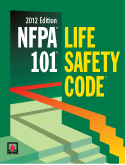
The 2012 NFPA 101 Life Safety Code has been made available for purchase on the NFPA web site:
http://www.nfpa.org/catalog/product.asp?pid=10112&title=2012-NFPA-101-Life-Safety-Code&category_name=&target_pid=10112&source_pid=10109&link_type=edition_change

This edition has changes that relate to egress paths, so they have used that theme on the cover design.


The 2012 NFPA 204 Standard for Smoke an Heat Venting (that smoke hatches / vents over the stage for the theatre folks) has also been updated and information can be found here:
http://www.nfpa.org/catalog/product.asp?pid=20412&title=2012-NFPA-204-Smoke-and-Heat-Venting&category_name=&target_pid=20412&source_pid=20412&link_type=edition_change

This describes the means of operations, quantity required, and recommended inspection procedures and scheduling.

If you have a Fire Curtain (many theatres) or Fire Doors (almost all buildings), then you need to fully understand the requirements for inspecting and testing these critical devices.  The 2010 NFPA 80 Standard for Fire Doors and Other Opening Protectives is the key to this part of your facility management.

This talks about door props, latches, crash bars, automatic closers, painting doors, and identifying Fire Doors.

Also of interest to many is the 2011 NFPA 70 National Electric Code which is everything you need to know, and them some, about electrical issues.  There are sections about the wire and cable we are permitted to use in the theatre environment, special requirements for dressing room lights and power receptacles, and many important items.  Product information can be found here:
http://www.nfpa.org/catalog/product.asp?pid=7011SB&title=Code-70-2011-National-Electrical-Code-NEC-Softbound&category_name=&target_pid=7011SB&source_pid=7008SB&link_type=edition_change

The companion book for those working on electrical equipment (almost all of us, whether we should or not) is the 2012 NFPA 70E Standard for Electrical Safety in the Workplace.  This addresses Lock-Out-Tag-Out (LOTO) procedures, ArcFlash, working 'HOT', and many other life-threatening activities when working with electricity.
http://www.nfpa.org/catalog/product.asp?pid=70E12&title=2012-NFPA-70E-Standard-for-Electrical-Safety-in-the-Workplace&category_name=&target_pid=70E12&source_pid=70E09&link_type=edition_change

Many of the NFPA publications have companion Handbooks that are available that break-down the codes and standards into manageable concepts with great graphics and explanations describing both proper and improper conditions.

Put these books in your budget.  Each one usually has a 3 to 5 year update cycle, so setting aside the funding for each of these should be a simple task.  If you need justification for the expenditures, then ask the powers that be how you are supposed to do your job without the actual books that define the Laws you must obey and the Standards to which you should adhere.

Warning:  Reading these books may induce drowsiness. Do not drive or operate heavy machinery while reading them.

Tuesday, July 19, 2011

Fire Doors 101


Associate Editor Kylie Wroblaski at Buildings.com posted a good article about Fire Doors:

www.buildings.com/Default.aspx?TabId=3334&ArticleID=10186

Take note of the
other posts on Fire Doors to see how they play in your theatre.


Make a pre-emptive strike against the spread of smoke and fire by keeping all fire doors closed and latched unless you are moving equipment or personnel through the door.  Do not prop fire doors open with chairs, microphone stands, stage weights, flag poles, desks, speakers, pianos, boxes, backpacks, wedges, flip-down props / stops, or by tying the handle to a nearby railing or wall.  If the door cannot close and latch on it's own, then it must be repaired.

Thursday, October 7, 2010

Tuesday, October 5, 2010

Blocked Fire Exits - Live at 10 o'clock

When it comes to Fire Exits, it is amazing what I find in them.  Above is an exit corridor with a big sign, a large screen rear projection TV, and other miscellaneous stuff.  Please take the time to put this junk somewhere that it does not block an exit!

Thursday, July 15, 2010

Brady Label Company Offers Free Handbook on Photoluminescent Marking

Free.  That's always helpful.  Even more helpful is the handy handbook that Brady has published that discusses the International Building Code (IBC), NFPA Life Safety Code, and LEED requirements for Emergency Egress signage and markings.


This objective guide outlines the various code sections, provides some graphics showing placement examples for photoluminescent items, and is very light on advertising hype.  Wow.  Real info not obscured by marketing schmooze.  That's refreshing.

Get yours at:  www.bradyid.com/bradyglo

Thursday, June 17, 2010

'Paint it black' isn't just a song by the Rolling Stones


Dontcha just hate those glaring  EXIT  signs?  Some director's sure do.  They'll go so far as having the stage crew cover them up, or better yet:  Paint over them!

This is a great way to get a big fat fine from your Fire Marshal or the AHJ (Authority Having Jurisdiction), as it is an obvious deliberate act.

While we're on the subject of  EXIT  signs, it is important that you file a written request for repairs whenever you find them damaged or otherwise disfunctional.  Common problems with  EXIT  signs are:
  • Lamps burned-out (LED replacement lamps are very cost-effective).
  • Glass / Acrylic letters broken or missing (leaving exposed bulb).
  • Failed Battery Back-up (you have to test these at prescribed intervals per the NFPA).
  • Broken or Missing Covers.
  • Sign units torn from the wall and hanging by wires.
  • Sign units missing (I see these in brand new buildings!)
  • Sign units over doors that are not really Fire Exits (I see these in brand new buildings!).
  • Sign units above / adjacent to overhead rolling doors.
  • Sign units in  Black Box  theatres covered by perimeter drapery tracks so that audience can't see them.
  • 'Light-pipe' designs that don't effectively pipe the light to the sign (internal obstruction or bad product design?).
  • Sign units that are obscured by pipes, ducts, tracks, junk, stuff, scenery, greenery, or other crud.

Saturday, April 3, 2010

Doors - Not just for Jim Morrison

Did you know that Fire Doors must be inspected annually? Yup, just like a Fire Curtain. Ref: 2010 NFPA 80, chapter 5.2.1. Most doors in an institutional building are Fire Doors, and an easy way to verify if a door is a Fire Door it is to look at the edge of the door leaf that is attached to the hinges.


If it is a Fire Door then you will see a small metal placard that says: FIRE DOOR and a bunch of other information about the door.  Look closely if you don't see it at first -- it may have been painted-over -- which is also a fire code violation. Ref: 2010 NFPA 80, chapter 4.2.2.

Inspections of Fire Doors are to check that the door is:
  • There (yes, I find them missing sometimes).
  • In proper operating condition (windows not broken, operating hardware all functioning).
  • The latches work (and aren't covered with gaffer's tape) - this is so the door can stay closed against the atmospheric forces of a fire.
  • The crash-bar (panic hardware) works and allows the door to open (no extra dead-bolts, pad-locks, or chains).
  • To make sure the door is not blocked on either side in a manner that would prevent it from being opened (things like pianos, stacks of chairs or desks, book cases, filing cabinets, cars, trucks, orchestra shells, etc.).
  • To make sure that the door is not propped open in a manner that would prevent it from being closed automatically (this means NO stage weights, NO chairs, NO desks, NO microphone stands, NO speakers, NO road cases, NO scenery, NO flag pole bases, NO . . . well, you should get the point).
  • To see if the automatic door closer hardware actually automatically closes the door (this is how you keep the smoke-in, air out, and keep the fire from spreading).  Disconnected, clamped, maladjusted, or broken closers must be repaired or replaced.
  • To  make sure that 'extra things' haven't been added to the door like kick-down door props (no, you cannot add these to Fire Doors!) or bailing wire to tie the door open.
  • And to check that the magnetic door release latch, if any, is properly working in conjunction with the Fire Alarm System (yes, this is the only legal way to prop a door open).

Friday, April 2, 2010

Alright, Bugsy - It's curtains for you!

Didja ever notice how Directors hate it when the theatre is suddenly flooded by light when a door is opened?  Yeah, it happens all the time.  It's really not their fault, it was the person designing the building that failed to recognize how disruptive this can be.

Denial is not just a river in Egypt.  It sometimes stems from a complete lack of admission that anyone would enter or leave a performance at anytime other than the designated time (yeah, like that's gonna happen!).

So what we get instead is folks trying to make-do.  They string-up curtain rods and cover the Exits to block the stray light.  Sometimes they cover the  EXIT  signs, too.  News Flash:  You cannot block or obscure a Fire Exit Door or Fire Exit Route.  Ref: 2010 NFPA 80, chapter 5.2.13.

Thursday, January 28, 2010

It's about time . . . to replace your smoke detector.

Most theatres have Smoke Detectors as a part of their Fire Detection and Alarm System.  For many years these devices have been the bane of Stage Managers because they unexpectedly trip a Fire Alarm when smoke, fog, haze, dust or other atmospheric effects are used during shows.  Building and Fire codes have recognized this problem and some now require that smoke detectors in the fly loft are replaced with Rate-of-Rise type thermal detectors. These detectors are not sensitive to visible atmospheric effects, but instead look at how rapidly the temperature changes.  That works great if you have a burning fire, but does little to detect a smoldering fire.  A smoldering fire can ruin drapes and scenery, and if unchecked, can leak smoke into other parts of a facility as well.

In recognition that fires are serious events in performance spaces, and also that false alarms can be quite disruptive to a show, several manufacturers have developed sensors that employ multiple fire detection technologies.  One of these stands-out above the rest and should be considered when upgrading your systems to meet the current fire safety codes (or to get rid of those pesky false alarms):  It is the 2251-COPTIR Advanced Multi-Criteria Fire Detector manufactured by System Sensor (http://www.systemsensor.com/).

The sensor’s four elements — photoelectric, thermal, carbon monoxide (CO), and infrared — all work together to intelligently analyze the environment and decide whether the sensors are detecting a true fire condition or a nuisance condition. The Advanced Multi-Criteria Fire Detector samples the environment every five seconds with each of these four elements and will only sound the alarm when at least two of the four elements positively confirm a fire.

Having these sensing elements working in tandem is what sets the detector apart from any other technology available on the market. The confirmation and intelligent assessment capabilities will also prove to be ideal for places that are prone to nuisance alarms. Such sites include theaters and other entertainment venues that use special effect smoke.

“It allows us to provide the most accurate fire detection possible while providing superior nuisance rejection for those problem sites,” said Todd Alford, product manager. “Different fires have different characteristics, and each fire is a little bit different. By combining four elements, we can successfully filter out nuisance concerns and provide accurate fire detection.”

One side note:  The detector's CO (Carbon Monoxide) sensor has a limited life span and must be replaced about every 5-6 years.  The good news is that just because the CO detector ceases to function after that time, doesn't mean that the rest of the Multi-Function fire detector quits working - it just looses one of it's areas of sensitivity.  A small price to pay for virtually no false alarms.  Besides that, if you KNOW it must be replaced after a finite time, then you can PLAN FOR IT, and GET IT IN THE BUDGET and ONTO THE MAINTENANCE CALENDARwhat a concept — planning for an equipment failure — before it happens.
 
Check-out their web site — it has cool videos demonstrating the technology, data sheets, white papers, and more.

Also,  System Sensor OEM's this product to multiple Fire Alarm Panel manufacturers.  Notifier offers it as IntelliQuad with the model number FSC-851.  Gamewell-FCI offers it as 4-WARN with the model number FCS-4-WARN.  Honeywell offers it as COPITR, with the model number TC840C1000.  And finally, Johnson Controls offers it as COPTIR with the model number 2951J-COPTIR.

Caveat:  Fly lofts above stages can become very warm in the summer months, particularly in warmer climates, so warm in fact, that conventional 165°F fusible links can sometimes separate prematurely.  Selecting, configuring, and installing the correct type of sensor must be done by a licensed fire protection professional so that all of these factors can be taken into account.  Don't expect them to fully understand the temperature profile of your fly loft - have them measure it under worst-case conditions so they know what to expect.

Wednesday, December 9, 2009

I've gotta get out of here!

I frequently find tables in the aisles in theatres, and occasionally in exit vestibules, which are both clear violations of fire codes, but this one was particularly troublesome: This was a laboratory table with a heavy top like a pool table, so it was not easy to move or toss aside. Even if you did move it, where would you put it that wasn't still blocking an exit aisle? Especially if there were people crowding toward the exit. On the other side of the door was the real surprise: They had an upright piano cross-wise of the doors (and a trash can, too!). You would have to pull the piano away from the door, open the door, turn the piano and shove it out the door (assuming there was a crush of people behind you also wanting to get out.)

The amazing part of this is that I have found three pianos blocking fire exits in less than two months - and one of them was a grand piano! Billy Joel would not be happy! Not to mention the Fire Marshal!

Oh yeah, did you notice that the EXIT signs did not have functioning lamps?

Friday, November 27, 2009

Head count, please! No SRO seating.


Part of the House Mangers' job is to ensure the safety of the attending patrons. If your customers survive the show, they might come back and buy another ticket! Each Assembly Occupancy" (that's building code speak for "theatre, auditorium, venue, show space, etc.) must have the maximum legal occupancy clearly posted. This means that you shouldn't sell 30,000 tickets for a space designed for 10,000 people. It leaves 20,000 rather frustrated and sometimes angry fans looking for a place to vent their concerns. This recently happened at a major new sports venue. The management team decided to ignore the Fire Marshal's occupancy limits, and the resulting crush of people invaded the spaces reserved for regular seating ticket holders. The customers that pre-paid for their tickets were none to happy. Bathrooms were overloaded, long waits at concession stands, and many that did not ever get to see the game.
Further information can be gleaned by reading the article in the Dallas Morning News:
http://www.dallasnews.com/sharedcontent/dws/dn/latestnews/stories/092209dnmetpartypasses.4026d63.html and this article on Yahoo: http://sports.yahoo.com/nfl/news?slug=ap-cowboys-partypass&prov=ap&type=lgns