Showing posts with label Concert Rigging. Show all posts

Tuesday, August 13, 2013

Risk Management for Rigging from ProSoundWeb

Andrew Martin, the originator of ATM Flyware, wrote a good guide for managing your show rigging assets in the March 28, 2013 edition of ProSoundWeb.  The article provides a short overview of Risk Management Guidelines and provides a series of example graphics to show you specific points of concern to watch-out for.
Example of SpanSet / Round Sling Inspection Points
The article can be found here:  www.prosoundweb.com/article/hanging_out_risk_management_for_rigging

Sunday, August 11, 2013

Wind Gust Topples Stage Canopy in Shelby North Carolina

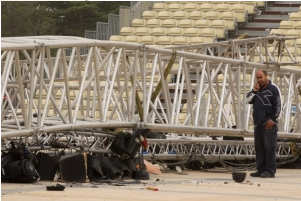
2013-08-10 - Preparations for an evening concert were disrupted at the end of the sound check for one of the bands as a wind gust from an approaching storm blew the overhead lighting and canopy support trusses over.  A band member from The After had just stepped off of the stage when the structure toppled.  The show was set-up at the Cleveland County Fairgrounds near Shelby, North Carolina.

Picture Tweeted by The Afters
The picture from stage left shows a disturbing lack of safety preparation and recovery efforts.

The band’s opening act, The Afters, was doing a sound check around 3:30 p.m. when the wind picked up and the stage started shaking.

“This storm suddenly came in and suddenly I hear 'get off the stage!'” said The Afters’ lead singer Josh Havens, in a cell phone video shot by MercyMe lead singer Bart Millard.  “And we're running, jumping off the stage.”

MercyMe’s stage manager witnessed the collapse.  Joel Bench is used to setting up and taking down stages – just not like this.

“The wind just picked up, the roof lifted a little bit,” said Bench.  “Then it started tilting and just kind of eased down.”

“Luckily we had people watching and eyes on it, and they started screaming and everybody started running and took off safely,” he said.


Reports from the event tell of lightning in the area which should have caused the stage to have been evacuated long before the collapse occurred.  Lightning strike and weather warning applications for smart phones and dedicated lightning strike monitor tools (http://theatresafetyblog.blogspot.com/2010/01/weather-safety-for-outdoor-venues.html) are commonly available and should ALWAYS be monitored, especially if there are visible adverse weather conditions.

John Huntington's ControlGeek site has a thorough run-down on the actual weather conditions:
http://controlgeek.net/blog/2013/8/11/more-on-the-mercymethe-afters-cleveland-county-fairgrounds-stage-roof-collapse-for-mercy-me

Brittany Spangler, administrative assistant for the American Legion World Series, said “The World Series officials are all devastated, but in the end, it was safety first for the artists.  We’re sad, but you can’t really stop Mother Nature.  We weren’t aware that the winds were going to get that high.”  Commentary:  The venue should have had a weather service monitoring the local and regional weather.


Fortunately, no one was injured and the scheduled event that was expecting as many as 10,000 2,500 attendees was cancelled.  Hopefully, the event promoters and staging company have learned from this near-miss.

Tuesday, June 18, 2013

Spring Storm in Thailand Topples Stage and Kills One

June 17, 2013 - Phuket, Thailand.  A poorly built stage canopy and adjacent speaker towers fell-over during high winds at Paphan Hin public park.  One person seeking shelter near the stage was crushed and killed instantly by the weight of the speakers that fell on him.  The stage was erected for a Prison Fair where furniture and other goods fabricated by the prisoners are sold to benefit them.

Witnesses say a 62 year old man that was a motorbike taxi driver, Mohammad Poksakul, sat near the stage and when a 60 kph wind gust pushed the canopy sideways, it forced the 10m tall speaker tower over, which in-turn, fell on to him and killed him.
The victim lies covered-up, stage canopy at right, stage left speaker tower in background.

Toppled Speaker Tower at Stage Left - Note lightweight scaffold framing.
The base does not appear to haven any anchor plates.

View of Stage Right Canopy Supports - Note that they only provide vertical support - no lateral stabilizers, the base was not anchored to the ground.  The orange straps appear to have been guy-lines that tore loose from their attachment points.
Concert season is windy season everywhere.  Be alert to bozos that do not understand how to secure the stage.  Be alert to promoters that don't evacuate the area when storms approach.

Saturday, March 16, 2013

LED Screen Falls Injuring Three at Miami Ultra Music Festival

Thursday, March 14, 2013 - Workers setting-up modular LED display screens for the annual Miami Ultra Music Festival were trapped under screen components that fell about 30 feet (10m) from the overhead trusses.  Fortunately, Fire and Rescue teams were on the festival site preparing for the two-weekend event that runs over Spring Break.  They were able to respond immediately and free the trapped workers.  The workers were transported to local hospitals where two were checked and found to have only minor injuries, and one worker remains hospitalized with two broken legs.  The incident occurred just prior to 8:00 PM the night before the festival opens.

The City of Miami had originally passed on requiring special engineering reviews for the festival stages, but the morning after the incident, they rescinded that ruling and city engineers, building inspectors, the Miami Fire Marshal, and OSHA reviewed all six stages to ensure that they were safe.  The event opened on-schedule and over 330,000 people are anticipated to attend.  Reports coming-in the first evening of the festival indicated that more than 15 patrons were transported for medical reasons due to a variety of causes.

A video from a Miami TV station is here: http://miami.cbslocal.com/latest-videos?autoStart=true&topVideoCatNo=default&clipId=8633167

Hopefully, the recently developed Event Safety Guide organized by the Event Safety Alliance will reduce the number of worker and patron injuries over the years to come.  This assumes, of course, that cities and states chose to adopt this as a best practices manual.

Monday, January 21, 2013

Have we learned nothing?

The festival season starts early in the south, and Mardi Gras is one of the first events we see set-up for numerous stages and shows.  Outdoor festival stage canopies have proven to present opportunities for accidents because they have large surfaces that can be caught by side winds and uplifting plow winds.  To counter-act the forces developed by gale-force winds, event riggers rely heavily on large ballast weights to tie-off canopy structures in an attempt to anchor the framework to the ground.


These ballast weights work well if they are massive enough for the predicted winds and effective 'sail area' presented by the canopy roof and side walls.  If they are too light, the ballast weights will just be dragged across the ground and bulldoze a path of their own.  Slippery grass, or dirt that turns to mud, just act as a lubricant to free the ballast weights up for sliding in the event of a downpour, so anchoring or pinning the ballast weights to keep them from moving is also part of a good rigging plan.  (The ballast weights shown above were not pinned or anchored to prevent sliding)

Wind is not a steady-state event.  You know that.  It gusts.  It starts and stops.  It changes direction.  It generally whips everything around a bit as it works it mayhem.  For this reason, we need to use secure connections on the guy wires for the ballast weights and stabilizing X's that are used to stiffen the structures against parallelogram movements.  If you don't, a gust of wind can slack the line, unhook the conenction(s), and you loose all anchoring in the blink of an eye.


As you can see above, the anchor ties used in the blocks in the first picture are common ratcheting tie-downs in the trucking industry, and they only have a open hook at the load securing end.  This may be de rigueur for the transport industry, but it's a no-go for event safety.  If the wind gets to blowin' and this bad boy comes loose, it could rip the flesh right off of someone unlucky enough to get in it's flailing path.

So, it was bad enough to see the above tie-down terminations at almost every corner of the stage, but then I looked further up the anchor line and found this:


Each anchor line had two possible points of failure.  Three stages and a major cable bridge over the street, all in close proximity, four to eight anchor blocks secured in this manner for each one, and two possible failure points per securement.  All of this within a city block of a major open waterway (read: obstruction-free wind-path).  Personally, I don't like those odds.

The City is relying on the Event Producers to Employ Staging Subcontractors that will erect facilities that will be safe for the (possibly highly intoxicated) general public to hang-out around and potentially be leaning-on, climbing on, or even messing with.  Plan for the worst, and you may have a chance of having an incident-free event, but if you leave opportunities for failures in the system like are shown above, be ready to pay the piper (or at least the plaintiffs).

Follow-up to commenter:
If you are going to use ratchet-straps to secure anything (subject to load rating), then utilizing products that have a self-closing clip is highly recommended.  Here is a picture of that type of ratchet and clip:


It is also recommended to have a wire rope safety cable that runs in parallel with this, preferably one that is only slightly longer than the final tensioned length of the ratchet strap.  This can prevent a total release of the system should the ratchet strap fail.  Fabric based straps and slings are subject to weakening due to abrasion, minor cuts, and rot.  Straps exposed to sunlight have shortened lifespans due to the exposure to UV light which weakens the fibers.

Thursday, October 4, 2012

Keeping Dents Out of Co-workers Noggins

Ty-Flot, makers of tool restraint lanyards, has introduced a new way to work with drop prevention equipped tools and tool belts.  The Quick-Switch system allows the use of a short lanyard that fits between the tool and the worker's wrist so that long floppy lanyards are eliminated.


Conventional lanyards that are tied-off to work belts and climbing harnesses must be long enough to facilitate using the tool at extreme reach positions.  These longer lanyards allow dropped tools to travel farther and pick-up more speed before they are restrained.  If the tool lanyard loops over a railing, it can swing back and strike a worker severely.

The Quick-Switch lanyard connection on the short lanyards allow tools to change hands, and be stored without presenting large loops to snag on protruding objects around the worker.

More info at: www.ty-flot.com

Wednesday, August 15, 2012

Don't Drop What You Are Doing - Get a Grip

Objects at Heights: Love Stinks But Gravity Hurts. 
Free Webinar • Duration: 60 minutes

With the exception of Chuck Norris, hurricanes, and halitosis, there’s little more dangerous than a plummeting object. Unfortunately, most tools don’t come with wings, so when you have a butter-finger type of day (and we’ve all had ‘em), the tools and equipment you rely on can quickly turn into plummeting little (or big) bombs of destruction. Aerial safety goes beyond your standard fall protection. In the past, objects at heights hazard-planning has been an afterthought – or not even a thought. Today, regulators and professionals acknowledge the serious, life-threatening risks of falling objects and are instilling rules to ensure proper precautions are followed in the workplace

This educational webinar will overview:
  • Objects at Heights Safety and how it is part of Safety at Heights planning
  • Awareness of the costs of dropped objects and other Objects at Heights hazards
  • Best practices for Objects at Heights within the Hierarchy of Controls 
Seminar brought to you by: EHS Today (The Magazine for Environment, Health, and Safety Leaders) and Ergodyne Work Gear.

Register at: Love Stinks But Gravity Hurts

Wednesday, August 1, 2012

Total Structures to host Outdoor Stage Roof Educational Event

The week of the LDI conference in Las Vegas, Total Structures will present a two-day event that will be held on Wednesday, October 17th and on Thursday, October 18th, 2012.

Engineering Principles
Taught by Jeff Reder, Principal and Partner in Clark-Reder Engineering, a full service consulting engineering firm based in Cincinnati, Ohio. Jeff and his business partner, Daniel Clark, presently hold licenses in 44 U.S. states and are highly experienced in the design and use of both aluminum and steel outdoor stage roof systems

Jeff will explain the process of structurally engineering an outdoor stage roof, provide guidance on how to read such reports, as well as help the attendees develop and perfect important operational documentation such as operating manuals, high wind speed action plans, etc.

Focus will also be brought on explaining relevant standards such as ANSI E1.2 - 2006 (Entertainment Technology - Design, Manufacture And Use of Aluminum Trusses and Towers) and ANSI E1-21 - 2006 (Temporary Ground Supported Overhead Structures Used to Cover Stage Areas and Support Equipment in the Production of Entertainment Events).

Roof and Truss Inspection Principles
Taught by Adrian Forbes-Black, Vice-President of Total Structures. Adrian has nearly twenty years of entertainment rigging industry experience in both the United States and Europe, having worked for companies such as Tomcat and Columbus McKinnon before working for Total Structures

Adrian, assisted by Jeff, will teach the fundamentals of aluminum truss design as well as how to visually inspect the product and document the inspection for continued safe use.


General Information
The cost of the course will be $595 per attendee, if paid on or before 31 August 2012 and $695 if paid on or after 1 September, and can be paid at the time of registration by either check or credit card. The number of attendees is limited so please register soon.

Sessions will begin at 9:00 AM and run until approximately 5:00 PM each day and include a daily lunch break. Lunch will not be included, however, there are many restaurants within walking distance of the facility. A continental breakfast and afternoon snacks will be included along with coffee, tea, water, and soda throughout the day.

Click Here to Register:
 
If you wish to reserve multiple places then please register each person separately using this link so they can obtain each person's relevant details.

Please contact Kandie Koed (kandie (at) totalstructures (dot) com or phone 805-676-3322) if you have any questions.

Monday, June 18, 2012

Stage Canopy Collapse in Toronto Claims One Life

Saturday, June 16, 2012 - Toronto, Canada - Workers erecting the stage for a Radiohead concert scattered as the framework above the stage came crashing down, pining and killing one worker.  The weather was calm and wind did not appear to be a factor.  Arial shots of the aftermath show a scaffold style framework that did not involve portable concert trussing.  The incident occurred at around 4:00PM before the concert and any audience had been allowed into the venue.  The concert was cancelled.


According to Ian McClellend with the cities' EMS department, one man was extricated from under the wreckage and pronounced dead at the scene;  another was transported to the hospital with head injuries; and two more were assessed with minor injuries and released on the scene.

The Canadian Ministry of Labour will be investigating to see what the root cause of the structure collapse was.

More information can be found at:
http://edition.cnn.com/2012/06/16/world/americas/canada-stage-collapse/index.html

Monday, June 4, 2012

The way it is supposed to work - WORKS!

An outdoor show at Buffalo New York's Coca-Cola Field was cancelled due to threatening weather conditions on June 1st, 2012.  The event, featuring country music performer Eric Church, was delayed twice as the stage roof was lowered due to strong wind gusts, and after some of the stabilizing guy wires snapped, it was decided that it was too risky to continue with the show.

Other factors cited were increasing rain and lightning strikes in the area.  The cancellation set-off a few unruly responses from the crowd and some folding chairs were tossed onto the stage.

This is a great step forward in that the event organizers recognized that it would be better to postpone the event until a future date rather than risk injuries to performers, crew, or the audience.  The ticket holders will be given the opportunity to come back in a few weeks to see the show once it is rescheduled.

More information about the cancellation can be found here:
www.wyrk.com/eric-church-promises-free-makeup-show-in-buffalo-for-taste-of-country-2012-ticketholders-video/

And a formal statement from the event promoter is here:
www.wyrk.com/official-wyrk-statement-on-taste-of-country-2012-suspension-before-eric-churchs-set/

Thursday, May 10, 2012

PLASA Rigging Conference 2012

PLASA Rigging Conference 2012, Monday and Tuesday, September 10-11, at Earls Court, London, England.  This will occur in conjunction with the 2012 PLASA event running concurrently Sunday through Wednesday September 9 through 12.

The conference is unique in being the only annual meeting of its size dedicated solely to the rigging community. It brings together practitioners, managers, engineers, safety professionals and policy makers to exchange information and inspire new research, curriculum building and professional development. Over 200 delegates from 30 countries are expected to take part this year so there is no better place to come together with your peers from the global rigging community.


---------------------------
The key-note speaker this year is Roy Bickel.  He was the first rigger in the United States to undertake large arena tours. He started performing and rigging in an amateur circus in Florida in the late 1950's. He worked as a professional circus performer for several years as Roy Zacchini 'The Human Cannonball', and as a trapeze flyer and catcher, trampoline artiste and rigger.

Roy was the first 'Disney Rigger' for a new tour called 'Disney on Parade' in 1969. The 'Disney Riggers' were a small group of riggers with a huge reputation who were responsible for advancing what was at the time the largest touring arena show attempted.

From there he spent a few years working on Broadway shows and in 1975 started touring large scale rock and roll tours and was also the production rigger for the Winter Olympics at Lake Placid.

Many of the practices used in entertainment rigging today were introduced by Roy, the idea of using color-coded fixed length rigging steels was one such advance from the traditional rolling hitch methods of the past.

Now, 50 years later, Roy is still rigging conventions, tours and corporate events. Roy will open the conference, sharing experiences of the challenges of rigging in arenas in the 60's and 70's and his continuing work in early concert touring. Roy will give us insights into the reasons behind many of the techniques that riggers starting out in the industry today take for granted, including the inverted hoist, the basket technique and other familiar methods of rigging.
---------------------------

Riggers' Forum

The Riggers' Forum will take place once again on the afternoon of Sunday, September 9th, and is aimed at riggers who may not be able to attend the full 2-day conference but would still like the opportunity to get together with their peers to discuss issues affecting their daily working lives.

The afternoon will begin with a main presentation, followed by an open-floor discussion with a panel of experts, centering on the issues you wish to discuss. Questions can be emailed in advance or asked on the day.
--------------------------- 

 The 2-day international event creates an annual opportunity for the global rigging community to discuss ideas, for the appraisal of new developments and to review progress of initiatives and projects. In 2011, the combined muscle of industry heavyweights, manufacturers, engineers and safety professionals challenged accepted thinking and dispelled several industry myths. This year will again provide an occasion to debate issues and continue the process of developing this still relatively new industry sector.

For more Information visit: www.plasariggingconference.com

Monday, April 23, 2012

2012 Summer Event Season Post First Death


April 18, 2012 - Jerusalem, Israel.  A twenty year old female IDF medical corps officer, Second Lieutenant Hila Betzaleli, died from injuries sustained when the over-stage canopy for an outdoor event collapsed onto her.  Seven others were injured, too.  The incident happened as the Color Guard soldiers were rehearsing for the National Fallen Soldiers and Victims of Terrorism Remembrance Day ceremony on Mount Herzl.  According to reports, it was very windy at the time of the collapse, and a truss laden with lights fell when a cable failed to stabilize the structure.  The structure was about 10 meters tall.  An initial investigation revealed that a cable supporting the lighting fixture truss was torn apart and as a result, the fixtures collapsed and dragged a concrete cube that weighs a few tons.

Emergency services began treating the wounded shortly after the collapse and there are fears that some people may be trapped under the debris. A spokesman for Magen David Adom said that it was the sound and lighting system that collapsed onto the stage during rehearsal.

Eight of the people involved in the erection of the stage were arrested and held pending further hearings.  Four were later released, and the remainder were released under house arrest pending further investigation.  The four detained were being held on charges of negligent manslaughter. 
The four suspects, including the owner of the company that built the lighting rig, Elad Lavie, the company engineer, Oren Varshavky, the security consultant Yitzhak Zuker, and the director of the ceremony, Alex Sela, were released to seven days house arrest. They cannot contact anyone for 30 days, as the investigation is continuing. All the suspects must also pay financial guarantees.

Design Group, the company that erected the lighting fixtures said in response that it adhered to the instructions of engineers and supervisors and did not veer from safety instructions.

"The installation was not built today and has been erected for more than 10 days," the company said.

"It has been checked by safety engineers, passed two examinations and received the necessary permits. Design Group was responsible of following the instructions given by the engineers." 

Elad Lavie’s lawyer, Kobi Kamar, said Lavie still stands by his claim that the company received approval for the structure. Kamar denied that the suspects are playing a game by shifting the blame around and implicating each other.

According to Israel Army Radio, the suspects stand accused of forging documents and paying bribes to secure the Mount Herzl job and others.

Jerusalem District Police Department  Commander Manny Yitzhaki said that police were investigating every aspect of the incident. “We will investigate the facts one by one to understand how this happened and who is responsible,” he said.

Despite the tragic event, the authorities have decided that the ceremonies at Mount Herzl will go ahead as scheduled.

Sigalit Bezaleli, Hila’s mother, has been invited light a torch at the ceremony with Knesset Speaker Rueven Rivlin, a family representative announced on Monday. “The family welcomes the decision to have the ceremony continue as planned – this is what Hila would have wanted,” the family said in a statement.

Family friend, Bar Sitton, noted that Har Herzl was like a “second home” to Bezaleli, whose mother Sigalit has worked for 16 years in the administration of the site.  He added that it was tragically symbolic for Sigalit to be honored at the very place where Hila lost her life and where she is buried.  Sitton said that Sigalit Bezaleli is dedicating her torch to halting the “Israeli culture of carelessness.”


Follow-up: 2014-04-30 - Six Charged with Criminal Negligence and Involuntary Manslaughter after Israeli courts consider the facts.  Charges were brought against five people and a staging company associated with the April 18, 2012 collapse of a stage structure that killed an IDF officer and injured seven other military personnel.

On April 30, 2014 Jerusalem District Court noted that all those charged in the incident would have the opportunity — which could also be waived — to meet with prosecutors in the case for a hearing on their involvement in the incident.

The five individuals charged, according to reports, included Elad Lavi, Doron Lavi, Taimuraz (Tomer) Laonidzeh, Yitzhak Zucker, and Oren Varshavsky.  The staging company owned and run by the Lavis — Itzuv Bama — was named as a sixth party charged in the accident

The named individuals include the founders and CEO and COO of the implicated staging company (Elad and Doron Lavi) along with its director of operations (Laonidzeh). Zucker and Varshavsky were, respectively, the safety consultant and engineer working on the project.

Thursday, March 8, 2012

PLASA Protocol Speaks-Out About Safety

The entertainment industry organization PLASA (recently joined with ESTA) offers free monthly magazine titled Protocol.  It's always chock-full of good information, and this month is no exception.  There are several good articles aimed directly at stage safety:
  • Rich Wolpert and Delbert Hall’s Tech Tips column expands on Rigger's Fids in "Fids, Part 2" - If you don't know what a "rigger's fid" is, or want to know more about how to make and use them, this is a great series.
  • Jim Utterback with Joe Aldridge, Eddie Raymond, and Alan Rowe following up with his on-going series on Safety, this one on "Risk Assessment”.
  • Gary Justesen from Oasis Stage Werks writes about "Seeking Shelter From The Storm" and the inspection and operations protocols for Outdoor Stages with a sidebar discussion about event cancellation insurance by Neil Huff.
  • Richard Cadena and Alan Rowe discuss "Lithium Battery Hazards" and how not to burst into flames while flying.
You can get your own subscription to this fine journal at:  http://na.plasa.org/publications/protocol.html and yes, you can read it on your mobile device, too, with reader apps available.

While you are there, cruise on over to  http://www.plasa.org/association/ and sign-up to be a PLASA member.

Wednesday, March 7, 2012

Industry Professionals Form Event Safety Alliance Organization

The creation of the Event Safety Alliance was announced to the public at the TourLink 2012 conference in Phoenix, Arizona during the open panel “Outdoor Show Safety Solutions” on January 28, 2012. This panel was moderated by Jim Digby and featured founding members of the Event Safety Alliance who represented all areas of our industry, from insurance coverage to structure fabrication.

The Event Safety Alliance is a group of entertainment industry leaders that have come together to address the immediate need for universal safety standards for the production of live events.  The newly formed group is based out of Austin, Texas and has posted a web site with more information.

Check them out and sign-up for their newsletter at: http://eventsafetyalliance.org/

They are also hooked-up with Twitter, Facebook, and LinkedIn.

The groups is so new they don't even have a logo yet [updated: see above!], the ink is still drying on the bits, but they are tackling event safety head-on and plan to publish a Best Practices Guide in the near future.

Monday, March 5, 2012

Another one's down. Another one bites the dust.

March 5, 2012 - Reggio Calabaria, Italy.  One stage hand was killed and two other injured as a space frame style stage truss structure collapsed and fell forward into the stage right side tiers of audience seating.  Fortunately, the incident occurred during the initial set-up of the equipment and there were no audience members present.
Photo courtesy of Life In Italy

The incident happened about 2:00 AM preceding the planned show the following evening.  Witnesses say one side of the stage structure slipped and collapsed sending the overhead trusses filed with lighting equipment onto Matteo Armelini, age 32.  He was killed instantly under the weight of the equipment.

Experts will now have to decide whether the collapse was caused by the failure of the Palacalafiore Sports Center’s parquet flooring to bear the weight, by poor structure design, or by human error during the erection of the structure.  The evening’s concert was cancelled.  The Reggio Calabria public prosecutor’s office has opened an inquiry and placed the entire structure under judicial seizure. Firefighters who provided assistance at the scene are seeking to establish the dynamics and causes of the incident.  Forensic police scientists have also been called in.

The stage for the Laura Pausini concert was the middle sized unit of three different stages used by the Faenza-born singer.  The stage set-up required fifteen articulated trucks to transport all the equipment.


At 1:00 you can clearly see the broken sport court flooring that could have possibly initiated the collapse.

This fatality comes just three months after a 20-year-old man was killed preparing the stage for a show by Italian rock star Jovanotti in Trieste.  (http://theatresafetyblog.blogspot.com/2011/12/stage-truss-collapse-in-italy-kills-one.html).

Looking at these pictures and correlating them to images of other similar truss collapses shows that they almost never fall straight down, but instead topple to one side as the corner joints give-way.  More attention needs to be placed on diagonal bracing to help prevent this type of failure mode.

For those of you rigging these types of structures:  it's time to review the proper assembly instructions with the manufacturers and make sure that all the parts are being installed properly.  Checking load limits (not guessing - actually calculating real loads) and checking the structure components for signs of stress, like kinks, cracks, and metal fractures should be done for each and every build.

Thursday, February 9, 2012

Indiana OSHA Fines Three Entities

[Updated - 2014-03-31 - 12:50PM CDT]
February 8, 2012.  Following investigations into the stage canopy collapse at the Indiana State Fair on August 13th of last year, IOSHA has filed fines against the canopy provider Mid-America Sound Corporation, The IATSE Local 30 that provided labor to erect the stage, and the Indiana State Fair Commission, sponsors of the event.

The IOSHA order against Mid-America Sound claims that MAS knowingly allowed the stage to be erected without cross bracing and failed to provide adequate documentation for the erectors.  MAS said that they will challenge the findings and is already producing documents that they had previously withheld

UPDATE 2014-03-31:  Mid-America Sound has agreed to pay a $50,000 fine for safety violations and has also agreed to additional staff training and a new safety plan for future events..  Indiana’s Occupational Safety and Health Administration (IOSHA) orginally levied a fine of $63,000 against the company.

Michael Moon, attorney for Mid-America Sound, released the following statement via Borshoff, the company’s PR firm:

“On March 20, 2014, Mid-America Sound Corporation and the Department of Labor entered into an Agreed Entry resolving litigation that resulted from IOSHA's citations issued to Mid-America following the events of August 13, 2011 at the Indiana State Fair.  While Mid-America contested the appropriateness of the citations and made no admission of any wrongdoing by entering into the settlement, Mid-America believed that it was important to move forward in a cooperative effort with IOSHA and to avoid the costs and expenses of further litigation.”

Of particular concern was that IOSHA fined the Labor Union Local 30, which is not an employer, and claimed that they were acting as an employer of the stage hands that were injured and killed.  This charge is being vigorously disputed by the Union as they say they were only act as an agent to arrange labor resources.  However, unlike almost all other union offices, this local's officers actually operated a business entity that directly paid the laborers that were contracted to the Indiana State Fair.  If this charge is upheld, it will have a significant impact on the way this Local, and possibly others, is operated.

The State Fair Commission's fines were minimal and they were charged with failing to have an effective emergency plan in-place.  The fines were minimal because the State Fair Commission did not have any employees that were significantly injured in the event.

A little perspective:

This is just the beginning of the legal process.  The report from the forensic engineering firm that is analyzing the failed structure has not yet been published, nor has any other official assessments of the event.  The IOSHA orders are only addressing one small segment of the incident:  The labor relationship between the Employers and the Workers with regard to their safety.  It is not IOSHA's place to address injuries to the general public or the over-all failure of the State Fair Commission that administered the event.  To date, there have been numerous law suits and over 100 tort claims filed that are seeking compensation for the damages and loss of life.

This blogger was told that Sugarland, the band that was to have played that night, had first right of refusal to not play (although they did not assert that right), and they did not have the right to override the State Fair Commission and demand to play.  Being willing to play is not the same thing as demanding to play.  This places the burden of responsibility back on the State Fair Commission for not cancelling the show and clearing the fairgrounds in a timely manner.  It's always a contentious position to be in when one state agency is penalizing another state agency.

Interviews with the Indiana State Police Troopers that were in the scene before the storm struck also said that they were fully expecting the Commissioners to cancel the show in light of the incoming weather front, and were dismayed when the announcer only said that the show would be delayed.  Had they known that the State Fair management team was not securing the site, they could, and probably would have overridden their decision and forced the issue for the sake of public safety.  Unfortunately, that announcement was made hours too late, and the brunt of the storm plowed through the area just moments later.

Additional Resources:

Indy Star article:
http://www.indystar.com/article/20120208/NEWS05/120208016/Agency-cites-State-Fair-union-stage-collapse

Prior Blog Posts:
http://www.theatresafetyblog.blogspot.com/2012/01/alert-notice-on-temporary-structures.html
http://www.theatresafetyblog.blogspot.com/2012/01/indiana-legislature-posts-bill.html


Friday, January 20, 2012

Indiana Legislature posts Bill requiring outdoor stage inspections

The Indiana State Legislature posted a bill to require all venues statewide to have outdoor stage structures inspected by an engineer or other qualified person.  More information at:
http://theatreface.ning.com/profiles/blogs/follow-up-to-indiana-state-fair-stage-canopy-collapse

This may provide a model of other states to go-by as they develop their new regulations.  Maybe we can prevent a repeat of the last few summers of show disasters.

Wednesday, December 14, 2011

Stage Truss Collapse in Italy Kills One, Injures Seven

2011-12-12, Trieste, Italy.  The concert trussing for a Jovanotti concert in the Palazzetto dello Sport an arena in northeastern Italy collapsed as it was being erected and a 20 year old student worker, Francesco Pinna, died from injuries sustained.  Italian news agency ANSA reported that rescue crews said the stage structure was nearing completion when the front buckled and collapsed, crushing workers below.  The accident took place at about 2 pm.  Around twenty technicians were erecting the stage, lighting, and PA system when the structure collapsed.   Rescue services intervened to take the injured workers to hospital.
Jovanotti Ora Concert Tour Stage Truss after Collapse in Palazzetto dello Sport

Police officers are now seeking to reconstruct the dynamics of the incident. Early reports say that the scaffolding “crumpled in on itself.”  Workers who were putting the finishing touches to preparations were overwhelmed by the collapse and some were trapped by steel tubes."

The concert has been cancelled and the remainder of the Ora Tour has been suspended pending investigation.  The sports complex in the San Sabba district, next to the Nereo Rocco football stadium, was seized by the authorities and cordoned-off. “All concerts have been suspended”, announced Maurizio Salvadori, owner of the Trident agency that manages the artist. “We’ll decide what to do tomorrow but at the moment no one wants to go on stage.  It is not known why the structure collapsed.  As always, everything was certified by an engineer. The structure was used all summer with no problems.”  Mr Salvadori explained that the “ground support”, scaffolding that carries speakers and reflectors, had given way.  The mayor of Trieste, Roberto Cosolini, hurried to the site of the accident and underlined the urgent need for “the investigations and expert reports to ascertain responsibility for this incident to be carried out with maximum rigour”.

“This tragedy takes my breath away. It struck me deeply.” Jovanotti tweeted his reaction to the fatal accident. “My grief goes out to Francesco Pinna, a student worker whose life came to an end today,” commented the singer, whose real name is Lorenzo Cherubini.  He added: “A tour is a family working to bring life and joy onto the stage.” A little later, the singer added: “The injured lads are specialised workers who do jobs they love while staying in the background. I’m with you. I love you.”