Showing posts with label Accident. Show all posts

Thursday, October 29, 2015

Staging Truss System Collapse Kills One, Injures 13

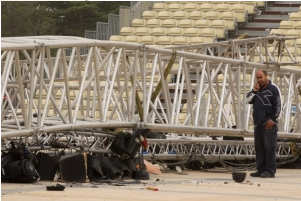
Nanning, China 2015-10-29 - China News reports that during the construction of the stage for an upcoming Jolin Tsai concert the ground supported stage truss system collapsed.  On worker was killed, and 13 other were injured.  On of the injured is in serious condition, while the others only suffered minor injuries.

Truss System Before the Collapse
The incident occurred around 5PM local time at the Guangxi Sports Center Arena.

After the collapse workers assess damage.
Deconstructing a tangled web of steel, aluminum, and stretched cables is a dangerous endeavor - stress in materials can create booby-traps due to spring loading and fractures in components that have not yet fully failed.  Hopefully, the workers doing this are planning their work carefully.

Also note that only three of the workers in the pictures are wearing hardhats.  It is unclear, but likely, that safety shoes are not worn in this construction environment.  Few workers appear to be wearing bright colored clothes, which makes it more difficult to spot staff and avoid collisions.  All of these factors can contribute to further injuries.

This is particularly relevant as this Blogger is scheduled to address the China Stage Design Exhibition in Beijing on November 26th-29th to discuss the development of an Entertainment Safety Initiative similar to the US lead Event Safety Guide developed by the Event Safety Alliance.

Update:  Two more pictures:


Thursday, September 24, 2015

OSHA Safety Violations upheld in death of camerawoman Sarah Jones

2015-10-15 - Sarah Jones, was a 27-year-old camera assistant when she was killed while trying to escape an oncoming freight train during the filming of a scene on February 20, 2014, for the movie “Midnight Rider,” a biopic based on the life of musician Gregg Allman. Eight other workers were injured.

OSHA cited Film Allman LLC in August 2014 for one willful and one serious safety violation for exposing employees to struck-by and fall hazards.

Judge Sharon D. Calhoun of the Occupational Safety and Health Review Commission (OSHRC) upheld those citations on September 15.

“Bad management decisions have real and lasting consequences, and when those decisions involve safety, the consequences can be tragic,” said Kurt Petermeyer, OSHA’s regional administrator for the southeast. “The death of Sarah Jones is particularly disheartening because it was entirely preventable.”

Petermeyer went on to say that Film Allman’s management “blatantly disregarded their obligation to ensure the safety of their crew and cast. They were fully aware that the railroad tracks were live, and that they did not have permission to film there. “

He added that while the OSHRC’s decision cannot correct or reverse the events of February 20, 2014, “we hope that it will serve as a reminder to the film industry that safety has an important, necessary role on every set and in every workplace.”


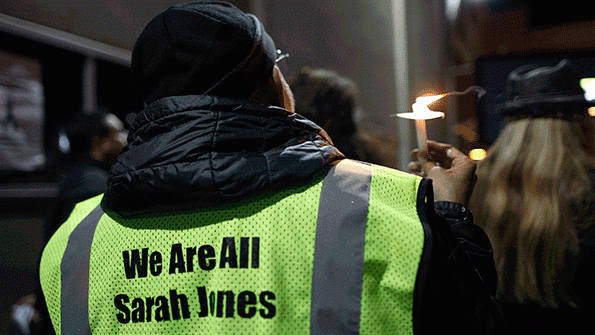
People gather in Los Angeles at the International Cinematographers Guild national offices on March 7, 2014
during a candlelight walk and memorial for Sarah Jones.

The backstory about this tragic incident can be found at:
http://ehstoday.com/safety/director-pleads-guilty-involuntary-manslaughter-case-involving-death-camera-assistant

Tuesday, September 1, 2015

Wednesday, March 12, 2014

Orchestra Pit Cover Collapse During Performance Injures 28

Anaheim, California 2014-03-10 - Students performing an energetic dance routine on the extended forestage at Servite Catholic High School were injured when the stage collapse into the Orchestra Pit below.  The auditorium was originally constructed in the 1980's and the stage extension / pit cover was added in 1996.  Images from the accident scene show what appears to be a modular structure that was built by the school, not a commercially available staging system.

Local Police and Emergency Rescue were called to the scene to extract injured performers and transport them to the hospital as needed.  Some injuries were minor scrapes and bruises, and sprained ankles, while 24 students were transported, some on back-boards with possible neck and back injuries, and a report of broken bones.

Looking into the Orchestra Pit after the Stage Extension Collapsed
(Photo Courtesy of the Anaheim Police Department)

The structure will be inspected to discover the exact nature of the failure.  Although persons interviewed by local papers said that the collapse was unforeseeable (blogger comment: not likely), and later comments (in the follow-up section of this post) show that there was some forewarning (visible sagging) prior to the floor giving-way.

The Anaheim Fire Marshal and Building Inspectors were on scene Sunday investigating what caused the collapse, said Lt. Tim Schmidt of the Anaheim Police Department.  “It looks like, on its face, that too much weight was on the stage than what it was originally built for,” Schmidt said Sunday night.

The high school's platform stage was previously permitted for use, Schmidt said.  Now investigators will be rechecking that permit to see if it included a weight restriction or a limit as to the number of people who could safely be on the stage at one time.

Schmidt said he expected the investigation, which is being led by the Anaheim Fire Department, to take up to two weeks.  He added that Servite has been cooperative in the investigation.  “They want to find out what happened as much as we do.”


Follow-up 2014-03-14:

A news article by the local NBC4 I-team reveals that no permits were ever made for the stage extension addition.  Also from the article we quote:

Carly Yates, a former ballet student and a current NBC4 intern, had danced on the stage for years.
 

She said she and her fellow dancers were always concerned about the safety of the stage.
 

“There was something wrong it,” says Yates.
 

She says dancers would wait below the stage until it was their turn to perform.
 

"When you were underneath the stage in the [make-shift] Green Room [(orchestra pit)], you saw the boards were flimsy," she said.  "They would bend and down as the dancers on top if it danced on it."

Monday, September 9, 2013

BECTU Website is good Safety Resorce for the UK and others

BECTU - Broadcasting Entertainment Cinematograph Theatre Union - a organization that serves many purposes for the technicians in the UK provides numerous links to safety-related documents that can be helpful no matter where you are on the planet.

They have links to the Creative Industries Safety Passport program, Training information, Health & Safety Craft Cards, and an incident reporting form for accidents and near-misses.  Although the incident reporting form is meant for use  by the UK's Theatre Safety Committee, it can be used by anyone trying to organize accident information for their own use or for sharing with others.

Sunday, August 11, 2013

Wind Gust Topples Stage Canopy in Shelby North Carolina

2013-08-10 - Preparations for an evening concert were disrupted at the end of the sound check for one of the bands as a wind gust from an approaching storm blew the overhead lighting and canopy support trusses over.  A band member from The After had just stepped off of the stage when the structure toppled.  The show was set-up at the Cleveland County Fairgrounds near Shelby, North Carolina.

Picture Tweeted by The Afters
The picture from stage left shows a disturbing lack of safety preparation and recovery efforts.

The band’s opening act, The Afters, was doing a sound check around 3:30 p.m. when the wind picked up and the stage started shaking.

“This storm suddenly came in and suddenly I hear 'get off the stage!'” said The Afters’ lead singer Josh Havens, in a cell phone video shot by MercyMe lead singer Bart Millard.  “And we're running, jumping off the stage.”

MercyMe’s stage manager witnessed the collapse.  Joel Bench is used to setting up and taking down stages – just not like this.

“The wind just picked up, the roof lifted a little bit,” said Bench.  “Then it started tilting and just kind of eased down.”

“Luckily we had people watching and eyes on it, and they started screaming and everybody started running and took off safely,” he said.


Reports from the event tell of lightning in the area which should have caused the stage to have been evacuated long before the collapse occurred.  Lightning strike and weather warning applications for smart phones and dedicated lightning strike monitor tools (http://theatresafetyblog.blogspot.com/2010/01/weather-safety-for-outdoor-venues.html) are commonly available and should ALWAYS be monitored, especially if there are visible adverse weather conditions.

John Huntington's ControlGeek site has a thorough run-down on the actual weather conditions:
http://controlgeek.net/blog/2013/8/11/more-on-the-mercymethe-afters-cleveland-county-fairgrounds-stage-roof-collapse-for-mercy-me

Brittany Spangler, administrative assistant for the American Legion World Series, said “The World Series officials are all devastated, but in the end, it was safety first for the artists.  We’re sad, but you can’t really stop Mother Nature.  We weren’t aware that the winds were going to get that high.”  Commentary:  The venue should have had a weather service monitoring the local and regional weather.


Fortunately, no one was injured and the scheduled event that was expecting as many as 10,000 2,500 attendees was cancelled.  Hopefully, the event promoters and staging company have learned from this near-miss.

Friday, July 19, 2013

Violinist Dies After Fall Into Orchestra Lift Machinery Pit

2013-07-16 - Moscow, Russia - A 40 year veteran of the Bolshoi Theatre died Wednesday at a Moscow hospital as a result of injuries sustained from a fall into the machinery pit of the Orchestra Lift.  Violinist Viktor Sedov, 65, was found lying on the pit floor about 2:30PM Tuesday when a theatre employee making a routine fire safety round found Sedov lying unconscious on the pit's concrete floor.  He was taken to the Sklifosovsky Hospital where he passed away the following day.

The accident happened in the New Stage venue, one of four venues in the Bolshoi Theatre of Russia complex.  The Main Stage venue had recently gone through significant architectural modifications, and it is suspected that Sedov entered the unlit sub-stage entry platform behind the orchestra lift and stepped out in the darkness to where he believed the Orchestra Lift Platform was positioned.  In the old configuration of the facility the platform was at the same level as the bottom of the pit.  The lift platform was up at a higher level and he plummeted into the machinery pit.  One report says the fall was about 6 meters (19 feet), but this may be the total depth from the stage, and not the depth from the sub-stage entry platform, however, another news report says that he fell from the stage level. Part of the facility reconstruction involved the addition of many levels of subterranean storage and workspaces, so it may be that the Orchestra Lift pit did extend down 6 meters from the substage platform.

On Wednesday, the Bolshoi's press secretary, Katerina Novikova, said the cause of Sedov's death will be determined by a special commission.  A decision regarding further legal action will be made depending on the outcome of the police inquiry into the incident.


~*~*~*~*~*~*~*~*~
Commentary

In this accident, there are several causal factors to consider:
  • Inadequate illumination of the walking surfaces.
  • Lack of guardrails to protect workers from falls.
  • Lack of interlocks on doors leading to hazardous workspaces.
  • Solo workers in unobserved workspaces.
We can learn from other industries' Best Practices and incorporate those procedures into our daily regimen.  In the sport of SCUBA diving they use the Buddy System - participants NEVER dive by themselves - there is always someone with you nearby that can you rely upon to help you if you need it.  Theatre facilities should have a similar policy.  There are 1000's of scenarios where a single person in a theatre can be injured and not be able to call for help.  If you have a co-worker with you the odds of both person's being incapacitated are significantly reduced.  Simply put:  Don't go into the theatre by yourself!


Monday, July 1, 2013

Cirque du Soleil suffers tragic loss of performer during show accident

MGM Grand, Las Vegas, Nevada - Saturday, June 29, 2013.   In a yet-to-be-explained equipment failure, one of the aerial performers in Cirque du Soleil's KÀ fell about 50 feet from above the show's massive 3-axis moving stage into the forestage pit during the fight scene at the end of a performance.  The pit is nearly 4 stories deep.  Sarah Guyard-Guillot, 31, mother of two, came loose from her safety cable and disappeared into pit unexpectedly.  The show was halted, the audience informed that they could obtain replacement tickets for a future show, and were dismissed.  The show has been suspended indefinitely pending an investigation into the root cause of the accident.  Guyard-Guillot, mother of two young children, was pronounced dead at a hospital late Saturday night.  It is reported that her safety harness was intact with her costume when she was recovered from the accident site.  She was a trained acrobat and aerialist, originally from Paris, France.  She had performed in the industry for about 22 years.
Sarah Guyard-Guillot  1979-2013

This is the first performance-related death that the troupe has experienced in over 30 years of show production.*  Guyard-Guillot was one of the original performer's in the KÀ show when it opened in 2006, and had performed the show since then.

An extremely through and rigorous safety program is entrenched in the companies' culture, so this has been shock to those that work the shows in a tight-knit group.  Cirque's safety managers have been very transparent and informative by sharing their safety culture and knowledge at numerous industry events like the annual USITT convention, LDI convention, and UNSCA's Entertainment Innovation Conference.

The death comes at an unfortunate time for the circus, a reportedly $1 Billion (US) company which employs 5,000 people globally, including 2,000 at its headquarters in Montreal, Canada.  Cirque maintains around 19 touring productions in operation worldwide, yet has recently reduced it's workforce and is trying to reign-in its expenses.

Cirque du Soleil's founder, Guy Laliberté, said in a statement:  "I am heartbroken. I wish to extend my sincerest sympathies to the family. We are all completely devastated with this news.  Sassoon was an artist with the original cast of KÀ since 2006 and has been an integral part of our Cirque du Soleil tight family. We are reminded, with great humility and respect, how extraordinary our artists are each and every night. Our focus now is to support each other as a family. " 

A thorough write-up about this incident can be found at Jim Hutchison's Jim On Light site:
www.jimonlight.com/2013/07/01/tragedy-at-ka-in-las-vegas-sarah-guyard-guillot-falls-to-her-death-during-final-fight-scene

Local news coverage:
www.kctv5.com/story/22726807/spectator-on-cirque-death-i-thought-there-was-a-net

www.lasvegassun.com/blogs/kats-report/2013/jun/30/cirque-suffers-another-accident-artist-falls-ka-mg

~*~*~*~*~*~*~*~
* In 2009, a Cirque performer died in Montreal after sustaining head injuries from falling off a trampoline during training. Oleksandr Zhurov, who was 24, hailed from the Ukraine and was known as Sacha. There also have been several injuries during Cirque performances in the last decade. Actors have been hurt during performances of "Zumanity" in Las Vegas, Nevada; "Corteo" in Portland, Oregon; and "La Nouba" in Orlando, Florida.

The same night as the deadly fall during KÀ, Cirque's newest show, "Michael Jackson: ONE," held its opening night performance at the Mandalay Bay Resort and Casino in Las Vegas. That production experienced its own trouble the previous week.

On Wednesday, June 26, 2013, Cirque reported that an acrobat taking part in one of the final preview performances suffered a mild concussion after slipping through slack rope in the show's "Stranger in Moscow" scene. That performer, who is expected to return to the production, missed a protective pad below the actors and landed hard on the stage.
~#~#~#~#~#~#~#~#~#~#~#~#~
FOLLOW-UP
OSHA FINES CIRQUE DU SOLEIL AND MGM GRAND
FOR PERFORMER'S DEATH AND OTHER CONCERNS

2013-10-29  - Nevada OSHA has finished its investigation into the death of Sarah Guillot-Guyard, the Cirque du Soleil performer who fell 94 feet during the climactic scene of Ka on June 29, 1013 and later died.  OSHA determined that accident happened when the wire rope she was suspended from broke. According to the report, the wire rope “was severed due to the rapid ascent of the performer, ultimately causing the rope to be freed from the sheave/pulley and scraping against a shear point.”  OSHA officials cited Cirque du Soleil with six proposed citations and more than $25,000 in fines and MGM Grand with three citations and a $7,000 fine.  Cirque du Soleil and MGM are appealing the fines.

One of the citations for Cirque du Soleil includes a failure to “protect or prevent Ka employees from striking an overhead grid during the Ka show at the Ka Theater.” Reporting for the Las Vegas Sun, John Katsilometes wrote that “This matches reports from those familiar with the Ka staging and fatal incident that Guillot-Guyard did hit the metal grid over the stage as she ascended high above the Final Battle scene, which jarred the rope connecting her to her harness.” Katsilometes also reported that Cirque du Soleil will be appealing the fine:

    In a statement that also referenced Cirque’s internal review of the incident, [Cirque du Soleil spokeswoman Rene-Claude Menard] said: “Cirque du Soleil completed an exhaustive review of its safety policies and procedures in the wake of the tragic accident involving Sarah. We have redoubled our efforts to ensure the overall diligence and safety of our performers and crew. We have received and reviewed the OSHA citations. We have initiated the appeal process as part of OSHA’s administrative protocol. Safety always has been the top priority for Cirque du Soleil, its performers and crew members.”

On the KTNV website (www.jrn.com/ktnv/news/Cirque-du-Soleil-MGM-Grand-cited-in-KA-performers-death-229744241.html), Krista Hostetler listed the citations OSHA has proposed. They are:

Summary of Cited Violations

Cirque du Soleil:
- NRS 618.375 (1): A General Duty Citation was issued because the employer did not protect or prevent KA employees from striking an overhead grid during the KA show at the KA Theater. $7,000 proposed penalty.

- The first part of the General Duty Citation was issued because the employer did not provide proper training for the KA Battle Spearman Warrior employee involved in the accident in the use of equipment and tasks used in the Ka show, battle scene at the KA Theater.

- The second part was issued because the employer had a Fall Protection Program with construction requirements that do not apply to theater settings because the KA Theater is regulated by Nevada OSHA general industry standards. $7,000 proposed penalty.

- 29 CFR 1910.132: This citation was issued because the employer did not properly assess the workplace for hazards that required personal protective equipment at the KA Theater, including opensided floors, bloodborne pathogens and other potentially infectious materials, pyrotechnic dust cleanup, and not finalizing a hazard assessment for the performers. $7,000 proposed penalty.

- 29 CFR 1910.132: This citation was issued because the employer did not certify that a workplace hazard assessment had been performed and did not include the date the hazard assessments were conducted. $0 proposed penalty, grouped with the proposed citation above.

29 CFR 1904.32: This citation was issued because the employer did not include on the OSHA Form 300 Log of Injury and Illnesses, the object or substance that directly injured or made a person ill, which prevented a trend analysis and kept the employer from recognizing and conducting employee training involving recurring injuries in accordance with Nevada Revised Statute. $3,300 proposed penalty.

Nevada Revised Statute 618.379: This citation was issued because the employer removed equipment from a fatality site on June 29 before Nevada OSHA authorized the dismantling and removal of the equipment (38 feet of wire rope that was attached to the victim at the time of the accident). $935 proposed penalty.

MGM Grand Hotel & Casino:

- NRS 618.375: This General Duty Citation was issued because MGM Grand employees were exposed to hazards due to deficiencies in the Cirque du Soleil Fall Protection Program with construction requirements that do not apply to theater settings because the KA Theater is regulated by Nevada OSHA general industry standards.

- 29 CFR 1910.132: This citation was issued because MGM Grand employees were exposed to hazards due to the deficiencies in Cirque du Soleil hazard assessments for the KA Theater that included opensided floors, bloodborne pathogens and other potentially infectious materials and pyrotechnic dust cleanup. $7,000 proposed penalty.

- 29 CFR 1910.132: This citation was issued because MGM Grand employees were exposed to hazards due to deficiencies in the Cirque du Soleil hazard assessments because Cirque du Soleil did not certify that a workplace hazard assessment had been performed and did not include the date the hazard assessments were conducted. $0 proposed penalty, grouped with the proposed citation above.
 

Tuesday, June 18, 2013

Spring Storm in Thailand Topples Stage and Kills One

June 17, 2013 - Phuket, Thailand.  A poorly built stage canopy and adjacent speaker towers fell-over during high winds at Paphan Hin public park.  One person seeking shelter near the stage was crushed and killed instantly by the weight of the speakers that fell on him.  The stage was erected for a Prison Fair where furniture and other goods fabricated by the prisoners are sold to benefit them.

Witnesses say a 62 year old man that was a motorbike taxi driver, Mohammad Poksakul, sat near the stage and when a 60 kph wind gust pushed the canopy sideways, it forced the 10m tall speaker tower over, which in-turn, fell on to him and killed him.
The victim lies covered-up, stage canopy at right, stage left speaker tower in background.

Toppled Speaker Tower at Stage Left - Note lightweight scaffold framing.
The base does not appear to haven any anchor plates.

View of Stage Right Canopy Supports - Note that they only provide vertical support - no lateral stabilizers, the base was not anchored to the ground.  The orange straps appear to have been guy-lines that tore loose from their attachment points.
Concert season is windy season everywhere.  Be alert to bozos that do not understand how to secure the stage.  Be alert to promoters that don't evacuate the area when storms approach.

Tuesday, May 7, 2013

Fall Into Orchestra Pit Claims Another Life

On March 17th, 2013, the Acting Chief Director of the Perm Opera and Ballet Company backed-up and fell about 3m (~10 feet) into an open Orchestra Pit during a rehearsal of Peer Gynt.  Olga Enns, 33, struck her head and was urgently rushed to the hospital where doctors assessed her injuries and said she here chances of survival were minimal.

Olga Enns - 1980-2013
Olga spent the next two week in a coma, and on April 2, 2013, she passed away.  She is survived by here mother and a sister.  Olga had worked at Perm since 2006 and was integral in the effort to make  the theatre more friendly to visiting performance companies.

---------------------------------------

Let's be more vigilant about safety!
Watch-out for others that are working
around the edges of stages and traps.

Tuesday, April 9, 2013

A Blogger Rants on Fall Protection

Fellow blogger and lighting guru, Jim Hutchison, over at Jim On Light went (appropriately) ballistic over the recent death of another show worker, and he vented via his keyboard about it.  Jim's words are excellent and truly 'Words you can live by'.  Check it out:
www.jimonlight.com/2013/04/09/lets-be-safer-at-least-in-the-entertainment-industry/

206 Reasons to wear your fall protection gear

Saturday, April 6, 2013

Arena Rigger fails to clip-in and falls 100 feet

Friday, April 5, 2013 - San Antonio. Texas.  A high steel rigger fell to his death at the AT&T Center Arena while striking a show at 2:00 AM.  Witnesses said he had detached himself  from the fall safety line while repositioning himself and lost his footing while moving around a beam.  A late load-out can be dangerous as fatigue can play a factor in clarity of thought and situational awareness. 

The rigger was identified as Dean Williams, 44, from Houston, Texas.  He leaves behind a wife and 3  month old daughter.

Accidents like this can be avoided if you wear a dual (twin) lanyard tie-off :
(courtesy of North Safety)

If this is not convenient, then you might consider using a dual retractable fall arrestor like this:
(courtesy of UltraSafe)

Either style works well and  can provide good maneuverability while being tied-off.  Always have a rescue plan when working at height.  Hanging in a fall protection harness for even a short period of times can result in suspension trauma if you cannot relieve the pressure on your thighs from the harness straps.

Climb Safe
Come Home
~~~~~~~~~~~~~~~~~~~~~~~~~~~~~~~~~~~~~~~
Update:  A Memorial Fund has been established for the benefit of Dean's widow and daughter - pitch in what you can!
www.jimonlight.com/2013/04/08/memorial-fund-established-for-dean-williams-rigger-who-fell-at-att-center/

Wednesday, March 27, 2013

Video Display Falls On Family, 1 Killed, 4 Injured

On Friday, March 22, 2013, a family returning home from a spring vacation in Florida had a stop-over in Alabama at the Birmingham-Shuttlesworth International Airport that had tragic consequences:  A Video Display showing Flight Arrivals for the airlines toppled-over without warning and trapped a Mother and four children under it.  One of the children, a 10-year-old boy, did not survive.

Passersby rushed to lift the multi-screen video display off the family, and it's estimated weight of 300-400 pounds required six people to lift it up.  ABC News coverage can be found here:
http://abcnews.go.com/US/large-airport-sign-falls-family-kills-boy/story?id=18797015#.UVLNIzebVrs

Witnesses described the display to be a free-standing assembly that was not anchored to the wall behind it.  It appeared that the structural integrity of the floor, although concrete, may not have been sufficient to support the weight of the front-heavy unit.  Investigators are working to determine if the framework failed, or the floor failed.  The accident occurred only weeks after the airport had completed a $201 million dollar remodeling.

Update 2013-03-27:  The City of Birmingham has stated that the cabinet that contained the video monitors is considered furniture and was not under their jurisdiction to inspect because it was not a structural component of the building.  The cabinet was a freestanding item, and descriptions by witnesses say that it appeared to be attached to the floor with construction adhesive, with no bolts or other fasteners.  The Alabama Department of Transportation and the Federal Aviation Administration (FAA) have also said that the device was not under their jurisdiction.

Update 2013-03-31:  Luke Bresette, 10, was killed by the falling sign, while his 5-year-old brother Tyler suffered a concussion, and his 8-year-old brother Sam had a broken leg and nose. The boys’ mother, Heather Bresette, had broken ankles, a crushed pelvis and was in intensive care in the University of Alabama-Birmingham Hospital after surgery.

The father, Ryan Bresette, and another son and daughter, were at the airport but not injured.
Birmingham, Ala.-based Brasfield & Gorrie and Bloc Global Services Group are the construction management team for the $201.6 million modernization project, which began in June 2012
------------------------------
Although this accident did not occur in a performance venue, it is important to note that many theatres utilize video displays in lobby spaces and other support spaces, including classrooms.  When was the last time anyone checked to see how your TV's, Projectors, and speakers are properly secured?

 TyWrap Wrigging doesn't cut it.

More information about video display mounting can be found here:
www.digitalsignagetoday.com/article/210417/Airport-digital-signage-accident-a-wake-up-call

Saturday, March 16, 2013

LED Screen Falls Injuring Three at Miami Ultra Music Festival

Thursday, March 14, 2013 - Workers setting-up modular LED display screens for the annual Miami Ultra Music Festival were trapped under screen components that fell about 30 feet (10m) from the overhead trusses.  Fortunately, Fire and Rescue teams were on the festival site preparing for the two-weekend event that runs over Spring Break.  They were able to respond immediately and free the trapped workers.  The workers were transported to local hospitals where two were checked and found to have only minor injuries, and one worker remains hospitalized with two broken legs.  The incident occurred just prior to 8:00 PM the night before the festival opens.

The City of Miami had originally passed on requiring special engineering reviews for the festival stages, but the morning after the incident, they rescinded that ruling and city engineers, building inspectors, the Miami Fire Marshal, and OSHA reviewed all six stages to ensure that they were safe.  The event opened on-schedule and over 330,000 people are anticipated to attend.  Reports coming-in the first evening of the festival indicated that more than 15 patrons were transported for medical reasons due to a variety of causes.

A video from a Miami TV station is here: http://miami.cbslocal.com/latest-videos?autoStart=true&topVideoCatNo=default&clipId=8633167

Hopefully, the recently developed Event Safety Guide organized by the Event Safety Alliance will reduce the number of worker and patron injuries over the years to come.  This assumes, of course, that cities and states chose to adopt this as a best practices manual.

Tuesday, September 11, 2012

Actress Injured by Falling Lighting Equipment

Actress Kristin Chenoweth was rushed to a New York hospital after she was injured on the outdoor set of "The Good Wife" that was shooting in Brooklyn, NY on Wednesday afternoon, July 11, 2012.

A source connected to the production of the CBS show said that Kristin was struck by a piece of lighting equipment that was dislodged from a scaffold due to a strong gust of wind.

The 44 year old Tony Award-winning actress immediately fell to the ground and her head impacted the concrete.

A witness said that Chenoweth was hit "square in the head" and appeared to be "knocked out cold. I thought she was dead at first."

A crew member called 911 around 5:07 PM ET to report a woman who had been hit in the head by a scaffold.  The item that struck her was later identified as a ‘Lighting Silk’ (a metal frame with a fabric lighting diffusor media) and the boom stand that supported it.  Paramedics treated Kristin on the set fitting her with a neck brace and putting her onto a stretcher.  She was quickly taken away from the set in an FDNY ambulance and was admitted to a nearby hospital in Manhattan.

 A representative for the New York Fire Department said that Kristin was being treated for "minor injuries" connected to the accident.

Chenoweth later said that she had been hit in the face by the lighting instrument and then hit the back of her head on the curb, which knocked her unconscious.  She said that she had a 5½” skull fracture, possibly cracked or bruised ribs, some additional injuries to her hip, back, and neck.  Two months later she was still requiring some physical therapy and wears a neck brace from time to time.

On August 13th she resigned from the cast of the show. "It is with deep regret to inform everyone that due to my injuries, I am unable to return to 'The Good Wife' at this time," Chenoweth said. "[I’m] Getting better slowly, and thank you, everyone, for your concern.”

The accident not only caused Chenoweth physical injury, but mental as well. The actress described how she struggled forming sentences and remembering words. She told the NY daily News that “I couldn’t really form a sentence after it happened.  I’m the queen of multi-tasking.  I’m not so good at that right now.   I’ll be like, ‘Mom, are you talking on the thing that you push ... the phone?’ ”

“That’s been interesting, but that’s getting better. I’m grateful.  It could have been much worse.”

The actress has been involved in other performance-related accidents, too.
  • She injured her neck during the pre-Broadway engagement of "Wicked" in 2003.
  • She fell off an elevated section of the stage during a rehearsal of the Broadway revival “The Apple Tree” in 2006.
  • She injured her back on the set of “Glee” when she tumbled down a set of concrete stairs in 2011.

Friday, August 24, 2012

Underwater Theatre Incident Recalled 32 Years Later

There is a really interesting post at the Manufacturing.net web site about an underwater theatre that flipped on-end back in 1970.  Blogger Karl Stephen recalls the incident and discusses what could have been a much more serious outcome for all involved.  Fortunately, no lawsuits, injuries, or other damages ensued.  The article can be read here: 


Friday, July 13, 2012

Keeping it all together

GRC (Not the Nutrition Guys) is a term commonly used to abbreviate Governance, Risk Management, and Compliance in the safety industry.  It is supposed to be an organizational cohesion that coordinates the efforts of everyone in a business so that guidance (Governance) is uniformly applied to all the sub-groups, and the subgroups share information and resources openly.

School Districts and Universities typically show significant separations between Risk Management (aka insurance claims management), Facility Safety (building and equipment maintenance), Public Safety (security), and personnel safety (actually training staff and students).

Interdepartmental separations occur, too.  Why is it the automotive shop student is given protective eye wear, while the theatre shop student has to provide his own?  The disparities are numerous and sometimes frustrating.  It affects the supply of safety information, safety goods, safety training, and maintenance.  When properly implemented, it answers the question of "Who's going to pay for this?"

For the governing administrators to do their jobs effectively, it is critical that they understand the wide variety of environments under their care.  In the theatre, this means that we have to pull-back the curtain and expose ourselves to the scrutiny of other non-theatre people.  This is hard.  We spend our entire careers trying to create magic and not let anyone outside of the theatre process know how it really works.  This is the exception.  When it comes to safety - everyone has to know and understand.

Don't stand there and tell everybody that your theatre is safe.  It's not.  This blogger sees brand new theatres that are constructed unsafely all of the time, and few new facilities come with any significant amount of operational safety training - everybody just brings their old bad habits with them and go on with little or no thought as to how they might make cultural changes to their work process.

In the 70's, the phone company ran a series of advertisements that said: "To communicate is the beginning of understanding."  The theatre plant is a perfect example of how important this is.  Maintenance workers need to access equipment and understand what is 'special' theatre equipment and know when they can work on it, and what is 'off limits' so that only specially qualified personnel are brought in to service it.  Good examples might be:
  • Dimmer Racks:  The air filters need to be cleaned regularly.  This may require that the power to the dimmer rack be disconnected because there may be live electrical parts within.  Chasing-off the cleaning crew and then not having the filters serviced may cause the dimmers to overheat and malfunction, or even catch fire.  At a minimum, it will shorten the life of the equipment.  This applies to the air filters for the workspaces around the theatre, too.  I've seen clogged air filters and air grilles in follow spotlight rooms, on stages, in dimmer rooms, and on dimmer racks - all preventable if the theatre staff would engage with the maintenance staff.
  • Stage Rigging:  Equipment must be inspected regularly by qualified personnel.  Most janitors and building maintenance crews are NOT trained or experienced enough to perform this task.  The maintenance of the stage rigging falls into this category.  The oil field rigging, construction rigging, or ship rigging backgrounds that some maintenance workers might have may be of some use, but without a knowledge of theatrical systems and how they are used, the resulting 'fixes' may be dangerous, incompatible with the theatrical operational needs, or aesthetically undesirable.
  • Fire Curtain, Smoke Vent, and Fire Doors:  Inspections and maintenance present challenges similar to the Stage Rigging.  Corrections that are not compatible with Fire Codes, Theatre Operations, and the Audience's enjoyment of the presentations must be prevented through the use of knowledgeable people.  Hire a consultant of you need one - this is where your Risk Management Department and or your Safety Office may be able to assist in securing the necessary funding.
Finding a balance with safety equipment provision policies, cost deferrals, and training budgets can only be achieved if the various participants can speak openly about the needs of their buildings and operations.  It also requires that the administrators truly understand and acknowledge just how dangerous a theatre plant is.  They care about bad brakes on buses, broken playground equipment, football helmets, and toxic fumes in the chemistry lab - why should your performing arts venue be any different?

Blogger Norman Marks on the Sustainable Business Forum site has a series of articles that help to explain GRC:  http://sustainablebusinessforum.com/node/59561

Monday, June 18, 2012

Stage Canopy Collapse in Toronto Claims One Life

Saturday, June 16, 2012 - Toronto, Canada - Workers erecting the stage for a Radiohead concert scattered as the framework above the stage came crashing down, pining and killing one worker.  The weather was calm and wind did not appear to be a factor.  Arial shots of the aftermath show a scaffold style framework that did not involve portable concert trussing.  The incident occurred at around 4:00PM before the concert and any audience had been allowed into the venue.  The concert was cancelled.


According to Ian McClellend with the cities' EMS department, one man was extricated from under the wreckage and pronounced dead at the scene;  another was transported to the hospital with head injuries; and two more were assessed with minor injuries and released on the scene.

The Canadian Ministry of Labour will be investigating to see what the root cause of the structure collapse was.

More information can be found at:
http://edition.cnn.com/2012/06/16/world/americas/canada-stage-collapse/index.html

Thursday, April 26, 2012

Actor accidentally really hangs himself.

The celebration of Easter frequently has re-enactments of significant events in the life if Christ.  In this case, an Brazilian actor, Tiago Klimeck, 27, was recreating the suicide of Judas Iscariot as he hangs himself as described in the Bible in the book of Matthew.  This is part of a production of the play "The Passion of the Christ."  The event was presented on Good Friday in the southern city of Itarare, Brazil.

The actor just before the accident.
Klemick was wearing a fall protection harness and allegedly knew how to arrange the equipment under his robe costume so that the rope around his neck would not cause him any harm.  He had borrowed the harness from the local Fire Department on previous occasions, so they did not review the donning of the equipment with him.  Witness say he was hanging nearly four minutes before anyone became concerned.

Luiz Carlos Rosner owns a sandwich cart next to the city square where the play was taking place. He described the anxiety after cast members realized Klimeck was unconscious.  "One of the actors came over to me, desperate, explaining there was someone unconscious hanging from the rope and that he wanted to cut it," Rosner told TV Record. "I was a little worried about giving him a knife in the middle of the crowd."

He was taken down and rushed to the hospital where he remained in a medically induced coma in a medically induced coma for 16 days due to extensive brain injuries from a prolonged lack of oxygen.  He passed away in he Hospital Santa Casa de Misericordia, in the neighboring city of Itapeva.

The harness, along with the rope used in the play, are now being analyzed at the Criminal Institute of Sorocaba.

-----------------------------------------
No matter how confident performers and technicians are in setting-up stunt work, it is vital that pre-show rehearsals review the effect, the equipment, and the adjustments of the components to ensure performer safety.  It is also important to have a quick way to check if performers are in trouble.  In this situation, a discrete hand signal that would only be possible if the performer is conscious might have provided just enough warning to  a spotter that the effect had been compromised.  Ideally, the harness and rope system would have been reviewed to ensure that the relative tensions were proper.  Presumably, there was someone there to lower the actor to the ground after the scene, and this person should have had eye-contact and/or intercom communications with spotters, too. The search for a knife to cut the actor down indicates that there was no easy way to lower the performer to safety.

NO stunt is worth your life.  Plan, check, certify, evaluate, think of all the ways the stunt might go wrong, re-evaluate, check again, test it, and re-test it.

Monday, April 23, 2012

2012 Summer Event Season Post First Death


April 18, 2012 - Jerusalem, Israel.  A twenty year old female IDF medical corps officer, Second Lieutenant Hila Betzaleli, died from injuries sustained when the over-stage canopy for an outdoor event collapsed onto her.  Seven others were injured, too.  The incident happened as the Color Guard soldiers were rehearsing for the National Fallen Soldiers and Victims of Terrorism Remembrance Day ceremony on Mount Herzl.  According to reports, it was very windy at the time of the collapse, and a truss laden with lights fell when a cable failed to stabilize the structure.  The structure was about 10 meters tall.  An initial investigation revealed that a cable supporting the lighting fixture truss was torn apart and as a result, the fixtures collapsed and dragged a concrete cube that weighs a few tons.

Emergency services began treating the wounded shortly after the collapse and there are fears that some people may be trapped under the debris. A spokesman for Magen David Adom said that it was the sound and lighting system that collapsed onto the stage during rehearsal.

Eight of the people involved in the erection of the stage were arrested and held pending further hearings.  Four were later released, and the remainder were released under house arrest pending further investigation.  The four detained were being held on charges of negligent manslaughter. 
The four suspects, including the owner of the company that built the lighting rig, Elad Lavie, the company engineer, Oren Varshavky, the security consultant Yitzhak Zuker, and the director of the ceremony, Alex Sela, were released to seven days house arrest. They cannot contact anyone for 30 days, as the investigation is continuing. All the suspects must also pay financial guarantees.

Design Group, the company that erected the lighting fixtures said in response that it adhered to the instructions of engineers and supervisors and did not veer from safety instructions.

"The installation was not built today and has been erected for more than 10 days," the company said.

"It has been checked by safety engineers, passed two examinations and received the necessary permits. Design Group was responsible of following the instructions given by the engineers." 

Elad Lavie’s lawyer, Kobi Kamar, said Lavie still stands by his claim that the company received approval for the structure. Kamar denied that the suspects are playing a game by shifting the blame around and implicating each other.

According to Israel Army Radio, the suspects stand accused of forging documents and paying bribes to secure the Mount Herzl job and others.

Jerusalem District Police Department  Commander Manny Yitzhaki said that police were investigating every aspect of the incident. “We will investigate the facts one by one to understand how this happened and who is responsible,” he said.

Despite the tragic event, the authorities have decided that the ceremonies at Mount Herzl will go ahead as scheduled.

Sigalit Bezaleli, Hila’s mother, has been invited light a torch at the ceremony with Knesset Speaker Rueven Rivlin, a family representative announced on Monday. “The family welcomes the decision to have the ceremony continue as planned – this is what Hila would have wanted,” the family said in a statement.

Family friend, Bar Sitton, noted that Har Herzl was like a “second home” to Bezaleli, whose mother Sigalit has worked for 16 years in the administration of the site.  He added that it was tragically symbolic for Sigalit to be honored at the very place where Hila lost her life and where she is buried.  Sitton said that Sigalit Bezaleli is dedicating her torch to halting the “Israeli culture of carelessness.”


Follow-up: 2014-04-30 - Six Charged with Criminal Negligence and Involuntary Manslaughter after Israeli courts consider the facts.  Charges were brought against five people and a staging company associated with the April 18, 2012 collapse of a stage structure that killed an IDF officer and injured seven other military personnel.

On April 30, 2014 Jerusalem District Court noted that all those charged in the incident would have the opportunity — which could also be waived — to meet with prosecutors in the case for a hearing on their involvement in the incident.

The five individuals charged, according to reports, included Elad Lavi, Doron Lavi, Taimuraz (Tomer) Laonidzeh, Yitzhak Zucker, and Oren Varshavsky.  The staging company owned and run by the Lavis — Itzuv Bama — was named as a sixth party charged in the accident

The named individuals include the founders and CEO and COO of the implicated staging company (Elad and Doron Lavi) along with its director of operations (Laonidzeh). Zucker and Varshavsky were, respectively, the safety consultant and engineer working on the project.