Showing posts with label Safety. Show all posts

Tuesday, August 23, 2011

Safety Standards Protect Workers — Improve Productivity


The American National Standards Institute, Inc. (ANSI) publishes safety standards for the workplace.  These standards are key to ensuring worker safety, protecting the environment, and improving productivity.

You can find standards for ladder safety, construction, clothing, equipment, workplace surfaces, signage, occupational health, fire safety, handling of chemicals and gases, labeling and safeguarding standards for equipment, noise, and vibration, and more at www.webstore.ansi.org/safety_standards.  Download individual copies or explore multi-user site licenses.  If you are part of a school or university system, they may already have a site license that you can benefit from.
Searches are available for a wide range of safety standards from these organizations:
  • American Ladder Institute (ALI)
  • American Society of Safety Engineers (ASSE)
  • American Society of Testing and Materials (ASTM)
  • National Eletrical Equuipment Manufacturer's Association (NEMA)
  • National Fire Protection Association (NFPA)
  • International Standards Organization (ISO)
  • International Safety Equipment Association (ISEA)
  • American Industrial Hygiene Association (AIHA); and many others.

Friday, August 19, 2011

NFPA Announces New Editions of Codes and Standards

Theatres are complex buildings, and they don't usually don't come with an Instruction Manual. You need to know what you can do, and what you can't do. And it usually helps if you can quote the authorities 'Chapter and Verse'.  This way people understand that it's not you that's being a pain in the butt, but that there really is a law, rule, or standard that defines the proper way to handle situations around the venue.

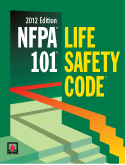
The 2012 NFPA 101 Life Safety Code has been made available for purchase on the NFPA web site:
http://www.nfpa.org/catalog/product.asp?pid=10112&title=2012-NFPA-101-Life-Safety-Code&category_name=&target_pid=10112&source_pid=10109&link_type=edition_change

This edition has changes that relate to egress paths, so they have used that theme on the cover design.


The 2012 NFPA 204 Standard for Smoke an Heat Venting (that smoke hatches / vents over the stage for the theatre folks) has also been updated and information can be found here:
http://www.nfpa.org/catalog/product.asp?pid=20412&title=2012-NFPA-204-Smoke-and-Heat-Venting&category_name=&target_pid=20412&source_pid=20412&link_type=edition_change

This describes the means of operations, quantity required, and recommended inspection procedures and scheduling.

If you have a Fire Curtain (many theatres) or Fire Doors (almost all buildings), then you need to fully understand the requirements for inspecting and testing these critical devices.  The 2010 NFPA 80 Standard for Fire Doors and Other Opening Protectives is the key to this part of your facility management.

This talks about door props, latches, crash bars, automatic closers, painting doors, and identifying Fire Doors.

Also of interest to many is the 2011 NFPA 70 National Electric Code which is everything you need to know, and them some, about electrical issues.  There are sections about the wire and cable we are permitted to use in the theatre environment, special requirements for dressing room lights and power receptacles, and many important items.  Product information can be found here:
http://www.nfpa.org/catalog/product.asp?pid=7011SB&title=Code-70-2011-National-Electrical-Code-NEC-Softbound&category_name=&target_pid=7011SB&source_pid=7008SB&link_type=edition_change

The companion book for those working on electrical equipment (almost all of us, whether we should or not) is the 2012 NFPA 70E Standard for Electrical Safety in the Workplace.  This addresses Lock-Out-Tag-Out (LOTO) procedures, ArcFlash, working 'HOT', and many other life-threatening activities when working with electricity.
http://www.nfpa.org/catalog/product.asp?pid=70E12&title=2012-NFPA-70E-Standard-for-Electrical-Safety-in-the-Workplace&category_name=&target_pid=70E12&source_pid=70E09&link_type=edition_change

Many of the NFPA publications have companion Handbooks that are available that break-down the codes and standards into manageable concepts with great graphics and explanations describing both proper and improper conditions.

Put these books in your budget.  Each one usually has a 3 to 5 year update cycle, so setting aside the funding for each of these should be a simple task.  If you need justification for the expenditures, then ask the powers that be how you are supposed to do your job without the actual books that define the Laws you must obey and the Standards to which you should adhere.

Warning:  Reading these books may induce drowsiness. Do not drive or operate heavy machinery while reading them.

Monday, April 18, 2011

UK Training Opportunities for Health & Safety in the Theatre

RB Health & Safety Solutions, a UK based service company is now offering two courses focused especially on the unique needs of the theatre worker.

The first course is an all day session that addresses First Aid in the theatre environment.  It will cover topics from the regulatory and medical aspects so you will know what you can do, what you must do, and what you shouldn't do.  From burns and ban-aids, to resuscitation, shock, and transport of the injured, they will get you certified for 3 years.

More info at: www.rbhealthandsafety.co.uk/firstaidfortheatres.html

Their other training is only 3 hours, and it covers AEDs (Automatic Defibrillator Devices) so you can zap heart attack victims the right way and get their ticker beating again.
More info at: www.rbhealthandsafety.co.uk/aedfortheatres.html

Both of these courses can be invaluable for those working Front of House or Back of House.  Injuries and Heart Attacks can happen to Staff, Performers, and Guests at any time, so be prepared to come to their aid.  As a part of the theatre you need to be able to help those that have been injured.  Everything form a twisted-ankle to an electric shock can happen, not to mention serious falls, and injuries of all sort from tools.

For those of you that aren't in the UK, look-up your local Red Cross or Health and Safety training providers to get similar courses.

www.RedCross.org                www.AmericanHeart.org

Wednesday, August 11, 2010

Talk of the Nation: Risk Management

'Risk Management' is a popular term these days.  Lots of things to be discussed that affect us all from BP's Oil Spill to accusations about cars that accelerate unexpectedly, to airplane and train crashes.  It may be the big disasters that make the news and turn the spotlight on both the culprits and victims, but it can be small disasters, or near-misses, that you see every day in your theatre that can make you take pause and realize, "maybe it's time we re-think how we do this before someone gets hurt."

Safety and Risk Assessment are like any good 12-step program:  The first thing you have to do is recognize you have a problem.  Risk Assessment is just as it sounds:  you take apart a policy, procedure, or piece of equipment and look at both the whole and the pieces to determine what can be improved.  There are no sacred cows.  Pick it apart, think about "what could possibly go wrong?" (famous last words), and look to see what can be done to make the procedure safer, maybe more efficient, and possibly easier to perform.  This can be applied to any aspect of show production from crowd control, to rigging, to load-in / strike, to cable management, and a myriad of other tasks.  Everything we do has some sort of procedure we perform, and there is almost always room for improvement.

Things to consider are:
  • Are the correct Tools (this means any physical object or software used to perform the task) available to the workers? ("Never try to do a Jeweler's job with Blacksmith's tools.")
  • What PPE is needed? (OSHA regulations and NIOSH are great resources for this.)
  • Are there enough (or too many) people involved?
  • What is the best order to complete the work?
  • Is there enough time to do the job safely?
  • Who's really in-charge?
Each step of the way you have to question the ultimate goal of the task, and the financial reality of the project.  "Biting off more than you can chew" is a recipe for disaster, so break-down tasks into manageable portions.

There is an excellent discussion about this subject on NPR's Talk of the Nation news show:
http://www.npr.org/templates/story/story.php?storyId=129086937
Host Tony Cox interviews former astronaut James Bagian (Chief Patient Safety Officer, Veterans Health Administration), William Reilly (Co-chairman, BP Deepwater Horizon Oil Spill and Offshore Drilling Commission), and Beverly Saur (Consultant in Strategic Risk Communication; Author, "The Rhetoric of Risk: Technical Documentation in Hazardous Environments") in this show and they all bring a high level of understanding of the issues.  There are both an MP3 podcast and a written transcript of the show available.

Tuesday, August 10, 2010

Getting Safety Wrong

"Safety" can be one of those words that can stop a conversation dead in its tracks even before it's started.  Greatly misunderstood, sometimes feared, frequently misguided.  Perceptions about how safety affects the performing arts and those that work in the field can be strange, and strained.  Even mentioning 'safety' to some can put them in a defensive mode that is difficult to deal with.  Why is this?

It takes more than just 'good people skills', tact, and being a master debater to get the message across to those that aren't inclined to listen.  It requires an understanding of your opponent's state of mind.  If you see what is holding them back from enjoining the conversation, then you may be more successful when you broach the subject.

Kathryn Shulz, author of the Slate Blog, The Wrong Stuff:  What it means to make mistakes, has a fairly clear understanding of this phenomena and explains it well both through interviews on her blog, and in a book called Being Wrong: Adventures in the Margin of Error. (Ecco Books, 2010, http://beingwrongbook.com/synopsis).  There is a great interview by the KERA host of Think (http://www.kera.org/audio/think.php), Krys Boyd, that can be downloaded as an MP3 file at the PBS podcast site: http://podcastdownload.npr.org/anon.npr-podcasts/podcast/77/510036/129111964/KERA_129111964.mp3

Take a listen, maybe even read the book, and you can be better prepared to address the S-word with peers and administrators above you.  Understanding how to best dissuade concerns about the subject of safety can really help to open-up the conversation so that its comfortable to all and can be discussed as needed.

If you can't talk about it, then you can't do anything to make improvements.
Engage in the Safety Conversation