Showing posts with label Planning. Show all posts

Thursday, September 24, 2015

OSHA Safety Violations upheld in death of camerawoman Sarah Jones

2015-10-15 - Sarah Jones, was a 27-year-old camera assistant when she was killed while trying to escape an oncoming freight train during the filming of a scene on February 20, 2014, for the movie “Midnight Rider,” a biopic based on the life of musician Gregg Allman. Eight other workers were injured.

OSHA cited Film Allman LLC in August 2014 for one willful and one serious safety violation for exposing employees to struck-by and fall hazards.

Judge Sharon D. Calhoun of the Occupational Safety and Health Review Commission (OSHRC) upheld those citations on September 15.

“Bad management decisions have real and lasting consequences, and when those decisions involve safety, the consequences can be tragic,” said Kurt Petermeyer, OSHA’s regional administrator for the southeast. “The death of Sarah Jones is particularly disheartening because it was entirely preventable.”

Petermeyer went on to say that Film Allman’s management “blatantly disregarded their obligation to ensure the safety of their crew and cast. They were fully aware that the railroad tracks were live, and that they did not have permission to film there. “

He added that while the OSHRC’s decision cannot correct or reverse the events of February 20, 2014, “we hope that it will serve as a reminder to the film industry that safety has an important, necessary role on every set and in every workplace.”
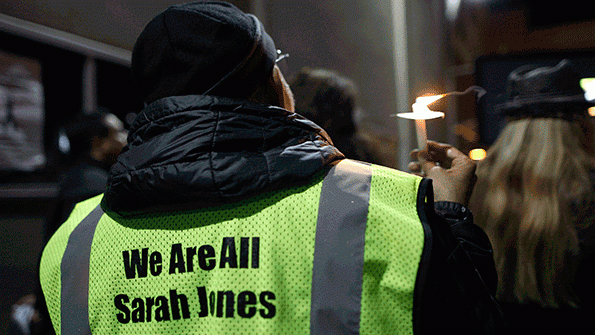


People gather in Los Angeles at the International Cinematographers Guild national offices on March 7, 2014
during a candlelight walk and memorial for Sarah Jones.

The backstory about this tragic incident can be found at:
http://ehstoday.com/safety/director-pleads-guilty-involuntary-manslaughter-case-involving-death-camera-assistant

Friday, September 6, 2013

OSHA Hammers Away AGAIN About Ladder Safety

Falls from ladders continues to be a leading cause of injuries and deaths, so OSHA has teamed-up with the Center for Disease Control (CDC), National Institute for Occupational Safety and Health (NIOSH), the American Ladder Institute, the Electronic Library of Construction Occupational Safety & Health (elCOSH), and The Center for Construction Research and Training to bring you more training materials.

Visit the Campaign to Prevent Falls in Construction at:
http://stopconstructionfalls.com

Previous discussions about Ladder Safety can be found at:
http://theatresafetyblog.blogspot.com/2013/04/osha-campaigns-for-ladder-safety.html

Industrial Safety and Health (ISHN) magazine has a good article on fall prevention:
ISHN September 2013 - PPE - Serious About Preventing Falls

The following flash video provides testimony from accident victims, family members of those that didn't make it home, and provides good examples and advice about how to select and use ladders.


The OSHA web site is full of downloadable fliers, posters, training guides, and information, too: https://www.osha.gov/stopfalls/


Working in the theatre is just like working on a construction site, so treat it with respect.

Wednesday, September 21, 2011

Performers need some limits and restraints, too.

This video of a 1982 U2 concert at Gateshead clearly shows a performer that has completely disregarded his own safety (and possibly the safety of others had he fallen).  The artist climbs the support structure starting around 2:30 in the video.

Were any laws broken here?  Maybe not, as it was the artists' own initiative to do this, however, promoters, venue owners, stage managers, and staging rental companies must be on the alert for this type of unexpected and unplanned behavior so that proper precautions are taken to thwart it or see that it is done with the proper safety protocols in-place.

Wednesday, August 24, 2011

Event Safety Guides - Freebies

The UK Health and Safety Executive (HSE) publishes The Event Safety Guide.  First authored in 1993, it has been updated and reformatted for easier reading in the Second Edition.  Also Known as "The Purple Guide".  Available here:
www.hse.gov.uk/pubns/priced/hsg195.pdf

Overview

Revised to align with recent law changes and event industry best practice. Provides 'tried and tested' advice on which to organize health and safety at music events, although many chapters may also apply to other gatherings sharing similar characteristics. Intended to enable organizers, local authorities, emergency services and HSE to work together to improve safety. As such, this guidance was devised in consultation with an event industry working group. In addition to broader safety headlines, such as venue and site design, fire procedures and major incident planning, the guidance also scopes pertinent circumstantial issues. Accordingly, specifics like transport, barriers, electrics, refreshments, merchandising, amusements, attractions, sanitation, noise, vibration and many other relevant subjects are also considered.

This supersedes the 'Guide to health, safety and welfare at pop concerts and similar events.'
---------------------
Safe Use and Operation of Temporary Demountable Fabric Structures is a guide book put together by MUTA and is available here:


---------------------

HSE Managing Crowds Safely (web page): www.hse.gov.uk/pubns/indg142.htm
Event Safety Solutions Blog:  http://eventsafetysolutions.wordpress.com/
The Special Event Guru Blog:  http://specialeventguru.blogspot.com
IAVM Trained Crowd Manager Course (NOT Free, but worth every penny!):

Friday, August 19, 2011

NFPA Announces New Editions of Codes and Standards

Theatres are complex buildings, and they don't usually don't come with an Instruction Manual. You need to know what you can do, and what you can't do. And it usually helps if you can quote the authorities 'Chapter and Verse'.  This way people understand that it's not you that's being a pain in the butt, but that there really is a law, rule, or standard that defines the proper way to handle situations around the venue.

The 2012 NFPA 101 Life Safety Code has been made available for purchase on the NFPA web site:
http://www.nfpa.org/catalog/product.asp?pid=10112&title=2012-NFPA-101-Life-Safety-Code&category_name=&target_pid=10112&source_pid=10109&link_type=edition_change

This edition has changes that relate to egress paths, so they have used that theme on the cover design.


The 2012 NFPA 204 Standard for Smoke an Heat Venting (that smoke hatches / vents over the stage for the theatre folks) has also been updated and information can be found here:
http://www.nfpa.org/catalog/product.asp?pid=20412&title=2012-NFPA-204-Smoke-and-Heat-Venting&category_name=&target_pid=20412&source_pid=20412&link_type=edition_change

This describes the means of operations, quantity required, and recommended inspection procedures and scheduling.

If you have a Fire Curtain (many theatres) or Fire Doors (almost all buildings), then you need to fully understand the requirements for inspecting and testing these critical devices.  The 2010 NFPA 80 Standard for Fire Doors and Other Opening Protectives is the key to this part of your facility management.

This talks about door props, latches, crash bars, automatic closers, painting doors, and identifying Fire Doors.

Also of interest to many is the 2011 NFPA 70 National Electric Code which is everything you need to know, and them some, about electrical issues.  There are sections about the wire and cable we are permitted to use in the theatre environment, special requirements for dressing room lights and power receptacles, and many important items.  Product information can be found here:
http://www.nfpa.org/catalog/product.asp?pid=7011SB&title=Code-70-2011-National-Electrical-Code-NEC-Softbound&category_name=&target_pid=7011SB&source_pid=7008SB&link_type=edition_change

The companion book for those working on electrical equipment (almost all of us, whether we should or not) is the 2012 NFPA 70E Standard for Electrical Safety in the Workplace.  This addresses Lock-Out-Tag-Out (LOTO) procedures, ArcFlash, working 'HOT', and many other life-threatening activities when working with electricity.
http://www.nfpa.org/catalog/product.asp?pid=70E12&title=2012-NFPA-70E-Standard-for-Electrical-Safety-in-the-Workplace&category_name=&target_pid=70E12&source_pid=70E09&link_type=edition_change

Many of the NFPA publications have companion Handbooks that are available that break-down the codes and standards into manageable concepts with great graphics and explanations describing both proper and improper conditions.

Put these books in your budget.  Each one usually has a 3 to 5 year update cycle, so setting aside the funding for each of these should be a simple task.  If you need justification for the expenditures, then ask the powers that be how you are supposed to do your job without the actual books that define the Laws you must obey and the Standards to which you should adhere.

Warning:  Reading these books may induce drowsiness. Do not drive or operate heavy machinery while reading them.

Sunday, July 25, 2010

20 Killed, 342 Injured as Crowd Panics at German Music Festival

Saturday, July 24, 2010 - Duisburg, Germany.  As approximately 1,400,000 (yeah, you read that right: 1.4 MILLION) people tried to attend the Love Parade techno-music festival, the crowd surged into a narrow tunnel leading into the show grounds.  Panic ensued and fans were crushed to death as they approached a security checkpoint to the event that had been closed.

Emergency responders trying to clean-up the mess.Picture courtesy of The Wall Street Journal

City officials were being criticized almost immediately because they had restricted entry to only ONE path that created a choke point.  People were still moving forward even though the entrance at the other end of the tunnel had been closed.  This lead to a mass panic and chaos as fans were unsure where to go in the claustrophobic environment.  The stampede started around 5 p.m. local time, shortly after police closed the tunnel because the festival grounds were too full.  Police told those in the tunnel over loudspeakers to turn around and walk out from the direction they came.

Crowd crush as patrons try to exit.  Picture courtesy of Yahoo!

German police union leader Rainer Wendt said in an interview on the Bild newspaper's web site that he warned Love Parade organizers more than a year ago that Duisburg was "too narrow, too small to handle this mass of people."

Ariel view of festival grounds.  Picture courtesy of Yahoo!

More pictures of the aftermath here:
http://online.wsj.com/article/SB10001424052748704719104575389122383665304.html#project%3DSLIDESHOW08%26s%3DSB10001424052748703958904575387401397668776%26articleTabs%3Dslideshow

The Wall Street Times news article here:
http://online.wsj.com/article/SB10001424052748704719104575389122383665304.html#project%3DSLIDESHOW08%26s%3DSB10001424052748703958904575387401397668776%26articleTabs%3Darticle

Yahoo! News groups article here:  http://news.yahoo.com/s/ap/eu_germany_love_parade_deaths

To learn more about effective event planning and crow control issues ther are some great resources.  The International Association of Assembly Managers (IAAM) (http://www.iaam.org/) regularly discusses this topic as a key component of event planning and security.

A company that focuses on this issue is Crowd Management Strategies (http://www.crowdsafe.com/) an their web site has a wealth of information and [sometimes gruesome] statistics.

Picture courtesy of Yahoo!