Showing posts with label Electrical. Show all posts

Tuesday, July 30, 2013

Blow This! Littelfuse Publishes Electrical Safety Handbook

Littlefuse, a company long known in the electrical and electronics industries for fast-acting circuit protection devices, has published a 76 page Electrical Safety Hazards Handbook that is free to download as a PDF.


This isn't a simple Do This, Don't Do That pamphlet.  This extensive guide explains the history, physics, body physiology, relevant safety codes, hazard analysis, and offers suggestions about how to minimize exposure to a variety of workplace conditions.  It also includes a chapter on Arc-Flash safety.

Numerous Annex Chapters are provided that cover key Electrical Terminology, Arc-Flash calculations and tables, an example Hot Work Permit for those thinking about risking their lives tinkering with energized circuits and equipment, Electrical Safety Resources (with live links), and much more.

The booklet concludes with an Electrical Safety Quiz and an answer guide for checking your knowledge.

Download your copy here:
www.littelfuse.com/data/en/Arc-Flash_Literature/LittelfuseArc-FlashSafetyHandbook-PF339.pdf

Friday, July 5, 2013

Fire Mars 4th of July at Milwaukee's 100 Year Old Miramar Theatre

An early morning electrical fire in the basement of a theatre turned nightclub was detected by an alert employee while cleaning-up about 2:00AM Thursday, July 4th.  A faulty power receptacle is thought to have been the starting point of the fire which caused more smoke damage than anything else.

“We had an electrical fire in our office basement that basically didn’t burn like flames of fire, but it had heat and just lots of smoke, and we had the whole place filled up with smoke,” said owner William Stace.  Fortunately, no one was injured.  The facility will be closed for business until further notice.  According to Stace's employee, Aaron Ohlsson, the venue is critical to the Milwaukee music scene, and several live music acts that were scheduled for the weekend were looking for other places to perform.

The Miramar Theatre owner, Stace, said that although he was frustrated by the timing, he was glad that the damage was minimal.  Smoke damage clean-up is estimated at around $6,300.  Stace said that due to the 4-day holiday, his insurance agent was unavailable, and that cleaning crews could not start to abate the smoke damage until Monday at the earliest.  Getting the place aired-out was the main priority.  The acrid smell of smoke lingers in the theatre, and soot is everywhere.  In retrospect, he says getting a few days to calm-down and rest will be OK.

Further news are available at:
www.wisn.com/fire-breaks-out-in-east-side-theater/-/9374034/20838884/-/e2oixs/-/index.html
and
www.fox6now.com/2013/07/04/100-year-old-miramar-theatre-suffers-fire-damage

Information about the venue can be found at:  www.themiramartheatre.com

Side notes:
  • Look carefully in the videos and you can see numerous code violations, so the fire trucks may return unless these issues are resolved.
  • The comment about the whole place "filling up with smoke" is worthy of consideration.  Remember that it was the rapid build-up of smoke at both The Station Night Club and the Kiss Nightclub in Brazil that resulted in numerous deaths.

Friday, May 3, 2013

LOTO also means - Test Before You Touch

As a part of Electrical Safety Month, the Electrical Safety Foundation International (ESFi) has published a safety flyer addressing the need to test an electrical device BEFORE you stick your fingers or tools in to work on it.  Just because you THINK it's OFF, doesn't necessarily MEAN it's OFF.  To mix a metaphor and paraphrase our favorite Star Trek character:
      Measure Twice - Live Long and Prosper!


Get the Test Before You Touch safety flyer here for reprinting and distribution to your crew:  http://esfi.org/index.cfm/pk/download/id/10818/pid/10272

Or you can order the pamphlets for a nominal charge at:  http://esfi.org/index.cfm/pid/10693

There is a free Test Before You Touch safety video that can be watched online or downloaded at:
http://esfi.org/index.cfm/pid/10847 and scroll down to: ESFI "Never Assume" Safety Series

Or you can purchase the "Never Assume" DVD here:  http://esfi.org/index.cfm/pid/10683


Thursday, May 2, 2013

Wednesday, May 1, 2013

May is Electrical Safety Month

Let's place a little extra emphasis on electrical safety this month.  With the end of the school year for many, and the beginning of the summer festival season for others, may is a good time to get your house in order.

Electrical hazards can appear in many work spaces around the are theatre plant (yes, it is a factory, we make a product, we produce goods, and a few bads).  Some of the most common electrical hazards I see around theatres involve power outlets, extension cords, and the interface between the cables and the item they are connected to (i.e. - failed cable grips).

Be sure to use Lock-Out / Tag-Out (LOTO) procedures so the equipment behind the cover plate is dead before you go poking around with a screw driver.  All it takes is one slip and you can come in contact with live parts!  It is better the circuit be dead than you!

Broken connectors present a very serious hazard because they can lead to miss-alignment of the power pins / blades, which can result in the live parts shifting and coming in contact with the cover plate.  This electrifies the cover plate (if it is metal) and may trip a circuit breaker.  The unseen danger may be that the plate and/or connector are not properly grounded.  If they are not grounded, you might be the easiest path to ground that the electricity seeks-out.

Broken or missing cover plates present a similar danger.  This allows small items like fingers and screw drivers to to come in contact with live circuits.  Where larger openings are present, larger items like music stands, microphone stands, and chair legs can fall-over and come in contact with the live wiring.


In the example at the left, the receptacle is missing the cover plate AND was a ungrounded connector.

Some facilities favor stainless steel covers for their look and durability, some use plastic (typically Nylon, but other formulations are available).  The Nylon cover plates are particularly durable in that the Nylon material flexes a bit without breaking, where other plastics tend to be more brittle and shatter when stressed.

It's not just the power receptacles on the wall that need to be audited - remember to check floor pockets, receptacles inside cabinets, and on ceilings, too.

Friday, July 27, 2012

ZZzzzaaap! Whose Fault is that?

The 2011 NFPA 70 (aka The National Electric Code) introduced new requirements for many items. Among the new items is the clear and concise labeling of electrical panels, meter housings, and disconnects to show the available fault-current.  See NEC Article 110.24 for more information (www.nfpa.org/catalog/product.asp?pid=7011SB).  These requirements are in addition to the Arc-Flash labeling requirements in 2012 NFPA 70E - Electrical Safety in the Workplace.


To achieve proper labeling, DuraLabel has developed an ANSI Z535 compliant product group that addresses this requirement, and they have guide books to educate you further about it, too.
Go to: www.duralabel.com/free-gifts/free-fault-current-labeling-guide.php to get your free Available Fault-Current Labeling Guide.

Wednesday, May 16, 2012

Getting a Grip

ISO Symbol for 'Gloves Required'
We take many parts of our lives for granted, and we don’t typically realize how important they are until one of them gets injured or goes missing.  When it comes to body parts, our hands tend to fall in that category.  How would you cope if one or both of your hands were missing or out of commission?  Providing proper PPE (Personal Protective Equipment) to guard against injuries can help, however, the selection of PPE for hands can be vast and varied.  Here are a few aspects of glove selection that should be considered.

Physical Injuries to your hands can come in several different ways. Physical trauma can get ugly fast, and be quite painful.
  • Crushing can happen when heavy loads of forces compress the hand. Mild impacts can cause bruising of the skin and underlying muscles.  More severe forces can break the skin by forcing the flesh from between the incoming object and the underlying bones.  Wearing gloves with hard-shell knuckle guards and/or rubber bumpers across the backs of the hand and fingers can be beneficial.  Brightly colored gloves can be helpful here because they make your hands more visible to both yourself and others.  Wearing black gloves when loading counterweights on a dark the fly gallery is a good way to get your pinkies smashed!
  • Abrasion is caused when your skin is rubbed tangent to the skin surface.  Continued mild scuffing can build callouses, where continued rubbing can cause blisters to form.  More abrasive surfaces can tear-away chunks that you would rather stayed attached.  ANSI / IESA 105-2011 Abrasion Resistance is rated on a scale of 1 to 5, with 1 being the least, and 5 being the best.  For gloves tested to the European EN 388 standard, the scale is 1-4.
  • Impalement or Punctures can come from many different types of sources like wood splinters, needles, screw and nail tips (think about that the next time you reach around something to grasp it without looking to see what’s there first . . .), and sharp ends of wires, glass shards, or sheared metal.  ANSI / IESA 105-2011 Puncture Resistance is rated on a scale of 1 to 5, with 1 being the least, and 5 being the best.   For gloves tested to the European EN 388 standard, the scale is 1-4.
  • Cutting occurs when there is a sharp edge like a saw blade, knife, freshly sheared metal, or an unpolished glass edge.  ANSI / IESA 105-2011 Cut Resistance is rated on a scale of 1 to 5, with 1 being the least, and 5 being the best.  For gloves tested to the European EN 388 standard, the scale is also 1-5.
Thermal Injuries can happen when the surface temperature of an object is beyond the ability for skin to dissipate the energy differential.
  • Extreme Cold can be caused by handling dry ice (frozen carbon dioxide) can result in freeze burns.  Grabbing a cold handle on a truck door after it has been sitting in sub-zero weather can do this, too.
  • Extreme Heat is most often encountered with hot lighting equipment which can burn you and/or raise blisters that will take a while to heal. The nozzle ends of heat guns used for accelerated paint stripping / drying or activating heat-shrinkable tubing can also be hazardous, as can soldiering irons.  Welding can expose your skin to both high intensity UV rays which can result in sunburn-like skin irritation, as well as the more common burns from molten metal spatter.  Synthetic glove materials (rubbers and plastics) can melt when exposed to extreme heat, so using cloth or leather type products typically are a better choice if you don’t like the feel of molten plastic on your skin.
There are additional ANSI / IESA ratings for Heat Degradation Resistance (melting), Conductive Heat Resistance, and Conductive Cold Resistance.

Chemical Exposure creates two additional categories of ANSI / IESA ratings:
  • Chemical Permeation is when the glove may be porous or absorbent to the chemicals you are using and do not create a protective shield between you and the exposure chemical.  Open weave fabrics (natural or synthetic) may be comfortable to wear because they breathe well, but fluids can flow right through them.  Leather may offer a bit of protection as most fluids don’t soak through them rapidly, but they will saturate and allow undesirable chemicals to come in contact with your skin.
  • Chemical Degradation is when the gloves disintegrate or otherwise decompose due to a chemical reaction with the chemicals they are exposed to. It is ALWAYS a good idea to dip test the glove (without a hand inside it) you are considering using to see how it reacts BEFORE you put on the glove and use it.
Melted Gloves - That could be your skin!
If a glove has a leak or gets torn, then the chemicals can get inside the glove and be forced tightly against your skin.  This is where the tear, puncture, and cut resistance can become very important.   Know before you go!

If you have questions about the compatibility between a glove material and a chemical, then look at the Chemrest Chemical Resistant Glove site at: www.chemrest.com   They have an interactive tool that shows you the best type of glove materials for use with many common chemicals.

Vibration Exposure can happen when you are using an orbital sander, reciprocating saw (hand-held jig-saw), or hammer-drill. These types of protective gloves have special vibration energy damping pads built into the palms of the glove to minimize the mechanical energy transferred to your hands. Prolonged exposure to excessive vibration can cause nerve numbness (tingling sensation or ‘dullness’) and even permanent nerve damage.

Electrical Contact can be deadly, so the electrical insulation factor is an important consideration when working around live electrical items.  Of course working ‘hot’ requires special permits, so unless you are a fully qualified electrical worker, please make sure that you power-off and/or unplug equipment before you attempt even the most basic of repairs.

Gloves with Grippy Dots
Traction - Getting a Grip can be important for many tasks around the workplace, so having gloves with a rubberized or tacky palm and fingers can actually reduce your end-of the day fatigue.  These gloves give you a little extra traction so that you are less likely to be fumble-fingers and drop things (particularly on your feet!).  This can speed the loading and unloading of trucks, too.

Snagability - Not Getting Caught-Up in Things can be a real safety concern.   It is commonly recommended that you should not wear gloves when you are working drills, power saws, planners, and other equipment that might draw your hands into the machine or tool should they get a bit too close. In these cases, it may be better to lose a bit’o flesh than to be sucked into the machine and loose much more.

Keeping the Bugs Out should always be a check list item.  When you leave your gloves laying around the shop or in the bottom of a tool box it is always possible that spiders and mites can set-up house inside them (they like small dark places), so the next time you pull the gloves out to use them, you are instigating a home invasion for those pests and they’ll fight back by biting you.  Keep your gloves someplace clean, dry, and bug-free.  After the sweat dries, store them in a large ziplock bag.

Fingers: Count-em’ 1 to 10!

PPE – Pick the right tool for the job.

(This post first published in TheatreFace Online Blogs)

Monday, May 14, 2012

Grounding Versus Bonding - Free Webinar

Grounding Versus Bonding of electrical systems, sensitive electronic, and communications equipment is the most important and least understood activity in the electrical, data process, and communications industry.


Webinar is at: Thursday, May 24, 2012 at 2:30PM US Eastern Time (UCT -5 hours)

In this 60-minute FREE webinar, Mike Holt of Mike Holt Enterprises, Inc. will explain the purpose of grounding and bonding as related to the most current requirements set forth in the 2011 NEC (NFPA 70). Full color graphics and practical examples of typical electrical installations will help attendees learn the concepts necessary to safely design, install, and inspect electrical systems rated 600V or less.

This workshop is brought to you by EC&M magazine (http://ecmweb.com) and Fluke test equipment (www.fluke.com).

Registration for this event is at:
https://event.on24.com/eventRegistration/EventLobbyServlet?target=registration.jsp&eventid=458297

Friday, May 11, 2012

Weather Resources and Electrical Safety Dominate PLASA Protocol

The spring 2012 issue of PLASA's Protocol magazine has an article about weather observing tools written by John Huntington.  The article "Weather Resources for Show Crews" discusses a very important issue in light of the numerous recent weather-related show accidents over the past few years.  John is an avid weather-watcher and is well-versed in meteorology and how it can affect outdoor shows.

Other article of interest include Keith Bohn's “Tips for a Safe Outdoor Concert Season.”  The article discusses the planning and management of of outdoor event structures and the considerations for weather-related loading.  A nice tie-in to John Huntington's article.

Electrical safety is addressed by Richard Cadena in his Shadow, Light, and Truth column.  His article “Grounding and Bonding Portable Generators and Stages" should be read by all that are involved in show production lest you become a victim of another person's mistakes.  In a related article, he offers-up a brain-teaser about using three-phase power generators in a single-phase configuration.  Just how much power can it really deliver?

All this can be found at: http://na.plasa.org/publications/protocol.html

Saturday, March 31, 2012

Outlets, inlets, receptacles, plugs, jacks, whatever you call them, they oughta be correctly mounted

Alex, I'll go for $1,000 for "Places you shouldn't stick your finger.  Ever."


Note the missing cover plate and the uninsulated wiring sticking out.
Should not have an ungrounded outlet in a commercial building - or any building for that matter.


Note the extension box pulled off the wall.


Note the box and ground conductor completely missing.

Monday, March 19, 2012

Electrical Room Fire at Golden State Theatre

2012-03-17 - Monterey, California.  A fire was reported to the Monterey Fire Department at around 12:17AM Saturday morning after four people tried to control the flames with a hand-held fire extinguisher.  Damage to the building was minimal and contained to the electrical room.  Most of the damage was smoke spreading to other parts of the venue.

A total of 16 fire crew members dealt with the incident, responding with four engines, a ladder truck, and a chief officer.  Upon arrival, firefighters detected smoke on the inside of the building, set up for fire attack, ventilation and forcible-entry operations, and then entered the room, where they found the fire still in progress.

"[It] Turns-out a plastic water pipe from a sink in another part of the building melted, leaked water into the electrical room and helped put out the fire before we got there," Roth said. "That certainly helped contain the fire to that single room, which was fortunate. If a building that large goes up, the whole block could go up.

The root cause of the fire is still under investigation.

Photo Credit:  Warren Dewey

The 1600 seat theatre underwent a renovations several years ago and is used for cinematic presentations, live shows, church services, and events featuring a large Wurlitzer Organ.

More information about the venue and pictures can be found at:

Tuesday, January 3, 2012

Electrical Safety in the Theatre


Electricity can pose a serious hazard in the workplace, however, it is unlikely that we’ll be doing much without it in the foreseeable future.  Lighting, sound, rigging, projection, and tools all require it.  A 12-year study by the National Instituteof Occupational Safety and Health (NIOSH) identified 244 workplace deaths thatwere the direct result of an electrical accident.  Misuse or neglect of electrical equipment puts employees at risk of electrical shock, electrocution, fires, and explosions.  Making your crew / staff / guests / employees aware of the risks and teaching them to following basic safety principles will help reduce the chance of electrical-related accidents at your venue.

Basic Electrical Safety Principles

It is important for employers to be aware of the risks associated with electrical equipment. When planning or performing work on or near electrical equipment or machinery, the safety tips that follow will reduce the risk of an accident:
  • Plan ahead; consider possible problems that may occur and how to prevent them.
  • Use the right tools for the job including procedures, drawings, and other documents.
  • Identify all potential hazards in the work space, including the risk of electrical shock.
  • Test every circuit and every conductor; every time, to ensure that they are powered-down before service.
  • Train workers to ensure that they have the skills and experience required to perform work around electrical equipment.
  • De-energize all electrical equipment and conductors before beginning work.
  • Treat electrical equipment and conductors as energized until lockout / tagout (LOTO) and grounding procedures have been implemented.
  • Wear protective clothing, including hard hats, insulated clothing, and gloves.
  • Only use insulated tools.
  • Determine approach boundaries and comply with suggested minimum clearances for power lines or exposed conductors.
Electrical Safety Regulations and Standards

The Occupational Safety and Health Administration (OSHA) has a number of regulations relating to workplace electrical safety. Some important regulations include 29 CFR 1910: Subpart Electrical:
 The following National Fire Protection Association (NFPA) standards cover electrical safety:
Checklist of Workplace Electrical Safety Practices
  • Require employees to use Personal Protective Equipment (PPE) when working on or near electrical equipment.  Depending upon the Arc Flash Hazard present, this may involve donning special clothing, gloves, hoods, and face shields.
  • Inform employees as to the location of potential electrical safety hazards.  Inform them before they enter the work area AND mark the specific hazards with signage, barrier tape, etc.
  • Establish an effective lockout / tagout (LOTO) procedure for working on electrical circuits and equipment.
  • Use safe work practices to prevent shock or other injuries.  De-energize live equipment, discharge capacitors, use lockout / tagout (LOTO) procedures, wear the appropriate level of PPE, and never work alone.
  • Only permit trained or approved personnel to perform maintenance or work on electrical equipment.  Thinking you know what you are doing is not the same as being trained and certified.  Have a second person check you work afterwards to ensure that wiring connections are the proper polarity (Hot, Neutral, Ground), and that covers are re-installed after work as is completed.
  • Ensure that all portable electrical tools are grounded or insulated properly.  Use Portable Ground Fault Circuit Interrupters (GFCI) if the power source is not already protected.  Inspect all cords and devices to ensure that cord strain reliefs are properly clamped to the cable casing.
  • Install and cover electrical boxes and fittings in accordance with the National Electrical Code (NFPA 70) and other regulations.  When removing covers, make sure that screws are not lost (use magnetic holders to retain loose parts where practical).  When working at height, secure covers with safety lanyards before removing the final attachment fasteners.
  • Have someone who is trained and certified in the National Electrical Code (NFPA 70) inspect the electrical system regularly.  This includes cleaning-out the dust and dirt from inside Dimmer Cabinets, Floor Pockets, and Circuit Breaker Panels; Replacing / Repairing broken switches & receptacles; Repairing / Replacing broken or overheated lamp holders; and checking the wiring lugs in feeder panels with an infrared thermometer to ensure that they are tight and not overheating.
  • Train appropriate individuals in the use of fire protection equipment and emergency response procedures.  Know the difference between a Safety Program and an Emergency Preparedness Plan.  A Safety Program, if well implemented, may save you from ever needing to implement your Emergency Preparedness Plan.
  • Develop procedures to replace and dispose of damaged or defective electrical cords, circuits, or other electrical equipment.  Implement a ‘Tag and Bag’ process to identify and mark equipment that must be repaired or replaced.  Do not store defective equipment where it may be accessible to the casual user so that it is not inadvertently utilized.  Assigning Inventory Numbers to equipment can help to log and track items in the repair process, and also may help you to track repair expenses.
More Information:
ESFi web site:  http://esfi.org/
Electrical Construction and Maintenance Magazine:  http://ecmweb.com/
Mike Holt web site:  www.MikeHolt.com

Monday, December 26, 2011

1 Plus 1 Plus 1 = Hey, that's not such a good idea!


We've all done it. If you look around right now you'll probably see one, too. Plugging one extension cord into another extension cord may seem like a minor issue, but each time you plug stuff together you add a little more resistance into the power line. More resistance means more heat generated and more voltage drop at the far end of the cord. If the device(s) you are powering don't get the voltage they want, they may demand more current, and when they do that, then the heating in the cord goes UP and the voltage goes DOWN. Kind of a vicious cycle.

Relocatable Power Tap (Plug Strip)
It's not just Extension Cords, either, it's Relocatable Power Taps, too. A what!? Yeah, its a fancy term for a "Plug Strip" that UL uses.  Jim Hutchison's Blog JimOnLight has a great article about using RPT's safely, so go there to read that, and keep reading here for more Extension Cord Safety Do's and Don'ts.

So don't just think about the fully portable types like at left, you also have to consider the rack- mounted ones like this:
Rack-Mounted Relocatable Power Tap (Plug Strip)

Also note that a Relocatable Power Tap is intended only for indoor use as a temporary extension of a grounding alternating-current branch circuit for general use.

Do
• Do inspect an extension cord for physical damage before use.
• Do check the wattage or current rating on the appliance or tool that the extension cord will be used with; do not use an extension cord that has a lower rating.
• Do make sure all equipment and extension cords bear the mark of an independent testing laboratory such as UL, ETL, CE, TUV, etc.
• Do make sure the plug on an extension cord is fully inserted in the outlet.
• Do replace an outlet (receptacle) if a plug is too loose and can easily fall or be pulled-out.
• Do match up the plug and extension cord on a polarized cord (one hole on the plug is larger than the other).
• Do keep extension cords away from water.
• Do use GFCI (Ground Fault Circuit Interrupter) protection when using extension cords in wet or damp environments or in areas considered construction sites like the scene shop and stage.
• Do keep extension cords away from children and animals.
• Do pull on the plug, not the cord when removing an extension cord from the outlet.
• Do store extension cords indoors (UV light damages the plastic casings).
• Do unplug extension cords when not in use.
• Do keep slack in flexible extension cords to prevent tension on electrical terminals.
• Do use cable pathways to cover cables passing through walk areas.
• Do use high temperature cord sets for stage lighting circuits.
• Do put safety covers on the unused receptacle outlets on extension cords.

Don’t
• Don’t use an extension cord marked for indoor use outdoors.
• Don’t plug one extension cord into another.
• Don’t overload cords with more than the proper electrical load.
• Don’t run extension cords through doorways, holes in ceilings, walls, or floors.
• Don’t move, bend, or modify any of the metal parts of the extension cord plug.
• Don’t plug a three-prong into a two-hole extension cord.
• Don’t force a plug into an outlet.
• Don’t use an extension cord when it is wet.
• Don’t overheat an extension cord.
• Don’t cover an extension cord with anything.
• Don’t drive over an extension cord - especially with hard wheel devices like Fork Lifts.
• Don’t drag an extension cord.
• Don’t attach extension cords to the wall with nails or staples.
• Don’t run extension cords under rugs or carpets or in high traffic areas.

Other Resources:
Extension Cord Facts:  www.generalcable.com/NR/rdonlyres/AEFA0995-ADF0-4AA8-96F4-E3CB20FF72AA/0/Pg92_Extension_Cord_Facts.pdf
Underwriters Laboratory: www.ul.com/global/eng/pages/offerings/perspectives/consumer/productsafety/cords/
Wikipedia:
Power Strip: http://en.wikipedia.org/wiki/Power_strip
Extension Cord: http://en.wikipedia.org/wiki/Extension_cord

Friday, August 19, 2011

NFPA Announces New Editions of Codes and Standards

Theatres are complex buildings, and they don't usually don't come with an Instruction Manual. You need to know what you can do, and what you can't do. And it usually helps if you can quote the authorities 'Chapter and Verse'.  This way people understand that it's not you that's being a pain in the butt, but that there really is a law, rule, or standard that defines the proper way to handle situations around the venue.

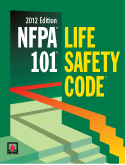
The 2012 NFPA 101 Life Safety Code has been made available for purchase on the NFPA web site:
http://www.nfpa.org/catalog/product.asp?pid=10112&title=2012-NFPA-101-Life-Safety-Code&category_name=&target_pid=10112&source_pid=10109&link_type=edition_change

This edition has changes that relate to egress paths, so they have used that theme on the cover design.


The 2012 NFPA 204 Standard for Smoke an Heat Venting (that smoke hatches / vents over the stage for the theatre folks) has also been updated and information can be found here:
http://www.nfpa.org/catalog/product.asp?pid=20412&title=2012-NFPA-204-Smoke-and-Heat-Venting&category_name=&target_pid=20412&source_pid=20412&link_type=edition_change

This describes the means of operations, quantity required, and recommended inspection procedures and scheduling.

If you have a Fire Curtain (many theatres) or Fire Doors (almost all buildings), then you need to fully understand the requirements for inspecting and testing these critical devices.  The 2010 NFPA 80 Standard for Fire Doors and Other Opening Protectives is the key to this part of your facility management.

This talks about door props, latches, crash bars, automatic closers, painting doors, and identifying Fire Doors.

Also of interest to many is the 2011 NFPA 70 National Electric Code which is everything you need to know, and them some, about electrical issues.  There are sections about the wire and cable we are permitted to use in the theatre environment, special requirements for dressing room lights and power receptacles, and many important items.  Product information can be found here:
http://www.nfpa.org/catalog/product.asp?pid=7011SB&title=Code-70-2011-National-Electrical-Code-NEC-Softbound&category_name=&target_pid=7011SB&source_pid=7008SB&link_type=edition_change

The companion book for those working on electrical equipment (almost all of us, whether we should or not) is the 2012 NFPA 70E Standard for Electrical Safety in the Workplace.  This addresses Lock-Out-Tag-Out (LOTO) procedures, ArcFlash, working 'HOT', and many other life-threatening activities when working with electricity.
http://www.nfpa.org/catalog/product.asp?pid=70E12&title=2012-NFPA-70E-Standard-for-Electrical-Safety-in-the-Workplace&category_name=&target_pid=70E12&source_pid=70E09&link_type=edition_change

Many of the NFPA publications have companion Handbooks that are available that break-down the codes and standards into manageable concepts with great graphics and explanations describing both proper and improper conditions.

Put these books in your budget.  Each one usually has a 3 to 5 year update cycle, so setting aside the funding for each of these should be a simple task.  If you need justification for the expenditures, then ask the powers that be how you are supposed to do your job without the actual books that define the Laws you must obey and the Standards to which you should adhere.

Warning:  Reading these books may induce drowsiness. Do not drive or operate heavy machinery while reading them.

Monday, August 15, 2011

Indiana State Fair Stage Collapse - Post Mortem Questions

The picture is getting a bit clearer now that the news has buzzed this into notoriety.  One resource has posted a time-line of events (http://media2.wane.com/_local/site/PDFs/News/State%20Fair%20Incident%20Time%20Line.pdf) that shows the level of emergency planing that didn't happen. This brings to light the pre- and post-emergency actions by the promoter and emergency crews.

The weather issue has been discussed extensively, however, the electrical power issue has not.  The stage canopy collapsed at 8:49 PM, yet the timeline shows that the power wasn't cut to the stage for almost another half hour.  There were hundreds of people climbing in, under, and on that aluminum structure and the power was still HOT!  Truly, someone was asleep at the switch.  Fortunately, no one was electrocuted.  Crushed, yes, but electrocuted, no.

How come the power wasn't killed BEFORE the canopy blew down?  At the time the storm was identified to contain rain, hail, lightning, and wind (most summer storms contain these four elements, so this isn't 'unexpected' or 'freakish'), the lighting and sound power should have been disconnected, and the winch power left on-line until the canopy was safely brought down to the stage level.  This should have happened waaay earlier than the timeline shows.

NEWS FLASH:  Water and Electricity and Aluminum structures are not a good mix.  Add people to that and you have a recipe for further disaster.


Event Planning:  When you are doing outdoor shows there should always be someone at the power source so that power can be shut-off in the event of an emergency.  The power source and disconnect location should be located outside of the crash radius of the structure so that the workers there can operate the controls / disconnects and so the falling structure can't bury the one thing you must get to if an incident like this occurs.

Saturday, June 12, 2010

Free Arc-Flash Training Seminars

Burnt to a crisp.  Not Good.  Bad JuJu.  Learn how to recognize Electrical Hazards and work safely around them. NFPA 70E Safety in the Electrical Workplace requires personnel training for anyone that works on electrical power.  Arc Flash events occur very rapidly and if you are caught in the plasma blast you can be seriously injured, burnt, or killed.  Learn about the proper Personal Protective Equipment (PPE) needed to do the job.  Think this doesn't apply to you?  Think again.  Dimmer Racks / Panels and Motor Control Centers (MCC) for Orchestra Lifts and Automated Stage Rigging Winches can have very large Voltage and Amperage power services, as do Road Show Disconnect Panels.

Example of an Arc Flash Warning Label
Note: Each label is custom made to match the requirements of the device to which it is attached.
If you don't see a label similar to this on your equipment, find-out why it isn't there.

Free is good.  Find-out more at: AVO Training Institute:  http://www.electricalpowerengineering.com/avo-arc-flash-hazard-analysis-seminar.php

Other info:
Mike Holt:  http://www.mikeholt.com/mojonewsarchive/NEC-HTML/HTML/What-is-Arc-Flash~20040512.php
Arc Flash Information Resource Center: http://www.arcflash.me/index.php
Occupational Health & Safety magazine:  http://ohsonline.com/articles/2009/08/03/arc-flash-training-ppe.aspx
Arc Flash Labeling Handbook: http://www.duralabel.com/ppc/free-arc-flash-book-g.php
Easy Power Support Resources: http://www.easypower.com/arc_flash/arc_flash_resource_center.php