Tuesday, February 1, 2011

"Well, here's another nice mess you've gotten me into!" - Ollie

StageCo has been sued in Texas state court by Christie Lites for damages sustained when a 90-foot lighting tower erected by StageCo collapsed prior to a nationally televised motocross event at the historic Fort Worth Stockyards in June, 2009.
Christie Lites, Plaintiff in the lawsuit styled Cause No. 096 246397 10; Christie Lites Dallas, Inc. d/b/a Christie Lites v. StageCo U.S., Inc.; In the 96th Judicial District Court in and for Tarrant County, Texas alleges that StageCo was negligent in the design and construction of the tower. A specialized lighting array and equipment owned by Christie Lites, elevated atop the tower was totally destroyed.

Christie Lites CEO Huntly Christie commented that it was extremely fortunate that the collapse of the tower occurred just days prior to the scheduled event, with only physical damage to the lighting array, grandstands, and general admission area.  Had the tower collapsed during the event it might have caused severe injury, and possible loss of life, to spectators and field personnel.  The tower collapse was initiated by wind gusts that blew as a storm passed through the area.  Engineering analysis of the structure, tie-downs, and other safety precautions have not been made public.

Christie Lites has an outstanding safety record in the industry.  Prior to this incident it has never had to take legal action against a fellow industry vendor.  Attempts to resolve this matter amicably have been frustrated since the filing of the lawsuit.

Tom Bilsen, Stageco Operations Manager states: “Stageco takes its responsibilities very seriously, we are fully insured, so all parties will be appropriately protected and reimbursed.  “Following this unfortunate incident we initiated our own investigation; there are multiple parties and multiple factors under consideration such as unpredicted wind gusts, and most importantly, there were no injuries. This law suit relates to the collapse of one of eight towers days before the event which took place as planned.  We anticipate the judges will need time to resolve this complex matter.”

Christie Lites is seeking actual damages in excess of $500,000, and to ensure that this type of incident does not jeopardize public safety for future events, $1,000,000 in punitive damages.  Actual damages likely include the actual cost and the lost revenue cost of the destroyed lighting equipment, and the extensive overtime labor required to clean-up the wreckage, ship-in new equipment, and set-up for the show a second time under a very compressed time-table.  There was no mention at this time of the costs or law suits by other show support vendors like those supplying the viewing stands, seating, or other nearby damaged structures.  The disassembly of a toppled structure is very hazardous, as well, and requires special precautions against additional worker injuries during the salvage and clean-up operations.

Inquiries or witnesses to the event should be directed to Scott Douglas Cunningham, The Cunningham Law Firm, 7500 San Felipe, Suite 1010, Houston, Texas; (713) 273-8950, counsel for Christie Lites.

The past few years have had numerous show tents, towers, and other venue structures that have been toppled by high winds and inadequate anchorage.  It should be no surprise that towers, canopies, and tents must be well secured against high winds.  Failure to provide adequate anchorage and structural integrity for temporary structures has resulted in numerous deaths, injuries, and significant property damage.

It is imperative that promoters, staging companies, and other industry professionals take note of the risks involved with outdoor events when it comes to the unpredictability of natural forces.  It is essential that someone be stationed where they can scan the horizon for threatening weather activity, have continuous access to weather radar reports, and have the authority to call a show and evacuate an event site should inclement conditions arise.  Event evacuation plans must have time-tables that estimate the amount of time required for an orderly egress from the venue, as you don't want patrons caught out in the open on the way to transportation or more robust shelters.
Physical threats to the public and staff alike include:
  • Hail ( a 4" ball of ice can do a lot of damage!  This blogger was witness to the 1995 MayFest Hail Storm in Fort Worth where hundreds of people could not get to safe shelter and were pelted by enormous ice balls - see: http://en.wikipedia.org/wiki/1995_Mayfest_Storm)
  • Wind (can blow people over and blow chairs, tables and other loose items into people)
  • Lightning (can knock-out power and emergency power, and electrocute people)
  • Rain (can provide a path for power to electrify nearby items, cause flooding of pathways and egress routes, and result in canopy collapses, cars and people being carried away in rushing water)
  • Dust (kicked-up by wind, can temporarily blind and cause panic due to reduced visibility)
An any of these weather threats can instigate crowd mentality panic and rushing for exits, which, in turn, can cause people to push, shove, and possibly crush someone that has fallen into the path of the surging crowd.  Proper Emergency Crowd Control Planning is a must for outdoor events.

Related Posts:
http://theatresafetyblog.blogspot.com/2010/07/wind-gust-uplifts-festival-tent-six.html
http://theatresafetyblog.blogspot.com/2010/01/weather-safety-for-outdoor-venues.html
http://theatresafetyblog.blogspot.com/2009/08/1-dead-and-75-injured-at-canadian-music.html
http://theatresafetyblog.blogspot.com/2009/07/another-stage-tower-collapse.html

Monday, January 31, 2011

Las Vegas Review-Journal investigates unresolved death of stagehand

We all know that it takes time for incident reports to be processed and published, however, this has come to a frustrating end for the mother of stagehand and UNLV student Vicente Rodriguez after he died on May 20, 2009.  Rodriguez was killed when he fell about 40 feet from the attic structure of the Hollywood Theatre in the MGM Grand Hotel in Las Vegas.

Due to state regulations and a mis-handled investigation, the worker's family probably will not receive any compensation, or even apologetic acknowledgement, for the preventable death.  In a very revealing video interview and well-researched article by Las Vegas Review-Journal writer Joan Whitely, it becomes painfully obvious that the deck is stacked against workers in Nevada when it comes to safety and the enforcement of safety regulations.  The article and video can be found here:
http://www.lvrj.com/news/osha-not-reviewing-death-of-stagehand-114707049.html?

The article also includes a link to a a well-presented graphic that depicts the scenario that lead to the fatal fall.  The graphic can be downloaded as a PDF.  Take this opportunity to share this information with your staff, students, and co-workers so that they might all learn how this tragedy occurred and don't place ourselves or others in this type of situation.

Fall protection gear only works if the users have been properly trained in the application of the equipment.


Thursday, December 30, 2010

107th Anniversary of the Iroquois Theatre Fire

As we start the new year let's take a moment to look around our facilities with a fresh set of eye's.  It never ceases to amaze me at the number of obvious fire hazards I see when visiting theatres, gymatoriums, cafetoriums, and other assembly spaces.

It sometimes seems like we haven't learned anything since that fateful day in Chicago where over 600 people lost their lives.  These are the common fire code violations I frequently see that also fueled the Iroquois Theatre tragedy:
Learn not to burn.  Keep your Fire and Smoke Protective Systems working properly and accessible.

Here is a blog entry from Lori Green at Ingersol-Rand Security Technologies, the manufacturers of Von-Duprin Door hardware.  They make one of the few crash-bar exit systems that don't make a lot of noise - Great for Theatres!  http://idighardware.com/2010/12/iroquois-theater-fire/

Friday, December 24, 2010

Make Angles Fly - Not 'Make Angels'

Photo courtesy of Abel Aluart
'Tis one of the the seasons for churches to attempt high profile productions, and a few schools, too.  If it involves flying people, angels, Santa Claus, Peter Pan, or anybody else, then it is REALLY DANGEROUS.  Hire professionals to do the work so that everybody makes it home for Christmas.  The November-December issue of Church Production magazine has a really great article about Hall Associates Flying Effects (http://www.flyingfx.com/) installing a computer-controlled system for three-dimensional flying of actors.  This article by Jim Kumorek discusses many important points about this type of very specialized rigging.  You can find it here:  http://www.churchproduction.com/go.php/article/on_a_wing_and_a_prayer_and_a_wire?p=1

Remember: Your frequent flier miles won't do you any good if you're being shipped in a box.

Thursday, December 23, 2010

Spidey goes splat.

December 20, 2010:  Actor / stunt double Christopher Tierney was said to be in serious condition with cracked ribs at Bellevue Hospital Center on Tuesday after falling about 18 to 30 feet (depending upon the report your read)  from a platform into a pit.  The accident happened during a Monday evening performance of SpiderMan: Turn Off The Dark at the Foxwoods Theater in Times Square, New York.

The production has also been plagued with other technical issues that has delayed it opening and, at $65 million and counting, is the most expensive Broadway show in history.  This was the fourth injury on the special-effects-laden show, and the most severe.  Earlier, two stuntmen / dancers had injured themselves in a “slingshot” type stunt, one breaking both his wrists, and another suffering a foot injury.  During the first preview performance of the show an actress suffered a concussion when she was struck in the head with a rope.

The performer's Fall Restraint Lanyard can be clearly seen moments before the incident.
The incident occurred near the end of the show when the bridge set piece comes down and MJ (Mary Jane) is lowered on a rope from the edge of the bridge into a pit that is out of sight from the audience's view.  As she decends on a rope, he was to lean over the edge and look down followed by a black-out.  Unfortunately, the fall restraint lanyard failed and the performer lunged over over the side of the elevated platform.  Soon after the audience saw SpiderMan take the unexpected plunge, the stage manager's voice was heard over the PA, and informed the audience that there was going to be a pause in the show.  The theatre stayed dark for a minute or two, and then they called the show and brought the house lights back up.

Here you can see the loose lanyard trailing behind the performer as he goes over edge. 
Coming from the pit where the actor fell, a voice, which was believed to be lead actress Jennifer Damiano's, was heard screaming.  As audience members left the theatre, at least one ambulance and fire truck were seen.

Actors' Equity Association, the labor union representing American actors and stage managers in the theatre, released its third statement December 21 that stated:  "Actors' Equity Association worked today with the Department of Labor, OSHA and the production to determine that the cause of the accident at last night's performance of Spiderman was, in fact, human error.  Further protocols are now being implemented, including redundancies recommended by Equity, the DOL and OSHA, to address this situation as well as other elements of the production.  [Actors'] Equity [Association] continues to vigilantly monitor the production for the safety of its members."

State lawmakers and safety advocates met with crew and cast members of the troubled Broadway musical "Spider-Man: Turn Off the Dark," which will resume its performances Thursday night.
The meeting addressed the need for better theater oversight following the hospitalization of an actor who fell during a recent performance.  "This is a workplace and they are entitled to a safe workplace," said New York Assemblyman Rory Lancman, who chairs a state subcommittee on workplace safety. "Clearly there were shortcomings."  "While we appreciate that 'Spider-Man' is pushing the envelope . . . workplace safety is not something that can be achieved by trial and error."  Lancman said earlier that the show could proceed if it met advisory recommendations.

Lancman said those concerns include providing sufficient rehearsal for understudies performing aerial or tethered sequences. All performers involved in aerial work must also attend seminars or those sequences may be removed from the show, according to a written statement.  There must also be sufficient crew and stage management to run the show safely, Lancman added.  Also, the tether attached to the Spider-Man double will be shortened so the actor is not as close to the end of the platform.

The company canceled its Wednesday matinee and evening performances to review the new safety measures recommended by the Occupational Safety and Health Administration and the New York State Department of Labor, said company spokesman Rick Miramontez.

State Sen. Eric Adams told reporters Thursday that he is introducing a bill that would create a task force charged with examining safety regulations in New York theaters.

Update: 2011-03-10

US Department of Labor's OSHA cites Spider-Man Broadway musical production company following injuries to cast members
NEW YORK – The U.S. Department of Labor's Occupational Safety and Health Administration has issued 8 Legged Productions LLC, the production company for the Broadway stage production of "Spider-Man Turn Off the Dark," three serious violations of workplace safety standards following four separate incidents late last year that resulted in injuries to cast members of the musical.

OSHA began its investigation of the incidents that took place at the Foxwoods Theater, located at 214 West 43rd St. in Manhattan, after receiving a referral from the New York State Department of Labor. The incidents resulting in employee injury happened on Sept. 25, Oct. 19, Nov. 28 and Dec. 20, 2010.
From the investigation, OSHA alleges that employees were exposed to the hazards of falls or being struck during flying routines because of improperly adjusted or unsecured safety harnesses. An additional fall hazard stemmed from unguarded open-side floors that lacked fall protection. Finally, the company failed to shield employees from being struck by moving overhead rigging components.
These conditions resulted in the issuance of the three serious citations, with a total of $12,600 in proposed fines. OSHA issues a serious citation when there is substantial probability that death or serious physical harm could result from a hazard about which the employer knew or should have known.

The employer, 8 Legged Productions LLC, has 15 business days from receipt of its citations and proposed penalties to meet with the OSHA area director or contest the findings before the independent Occupational Safety and Health Review Commission. The inspection was conducted by OSHA's Manhattan Area Office; telephone 212-620-3200. To report workplace incidents, fatalities or situations posing imminent danger to workers, call OSHA's toll-free hotline at 800-321-OSHA (6742).

Under the Occupational Safety and Health Act of 1970, employers are responsible for providing safe and healthful workplaces for their employees. OSHA's role is to ensure these conditions for America's working men and women by setting and enforcing standards, and providing training, education and assistance. For more information, visit http://www.osha.gov/.

Wednesday, December 22, 2010

Hemp House Rigging - The 'old fashioned way'

Dawn Wilfong, 24, works the fly rail and hauls a piece of coiled rope during a performance of “A Christmas Carol.”  (c) 2010 Photo by Thomas Slusser (For The Virginian-Pilot)

Check out this great story about one of the few remaining active rope rigging houses.  http://hamptonroads.com/2010/12/behind-scenes-wells-theatre-rare-find

This wooden pin-rail is in a theatre built in Texas in the 1920's.

One of the most common scenarios this blogger sees is equipment like this that has never been serviced in 50-70+ years.  The Loft Blocks are sometimes made of dry-rotted wood or sand-cast pigiron, either of which could fail under load without notice.  The ropes need constant review and regular replacement, too, as they weaken with age and abrasion.  As you can see in the second picture, the facility operators in this building don't understand the concept of counterweighting the batten loads, so everything is stage-heavy.  The battens are dead-hauled (bull-dogged) up, and if the tie-off fails or the fly crew looses their grip, then the batten and load will will come crashing to the stage.

Other potential problems are retro-fitted belaying pins:   I've found rebar, conduit, gas pipe, broom handles, steel spikes, and other odd items used in place of the correct items.  Some hemp-house facilities are 'hand-me-down' theatres that started-out as the High School Auditorium, then was the Middle School, and is now part of the Elementary School facility.  Not only is the equipment MORE DANGEROUS, but it is located where young children not familiar with the hazard potential can pull-out the belaying pins and/or untie the rope lines.

It is extremely important that the operators and staff fully understand how the fly system works and what safety precautions must be taken when loading and operating the system.

Wednesday, December 15, 2010

OSHA Cranes and Derricks Standard as iPhone App

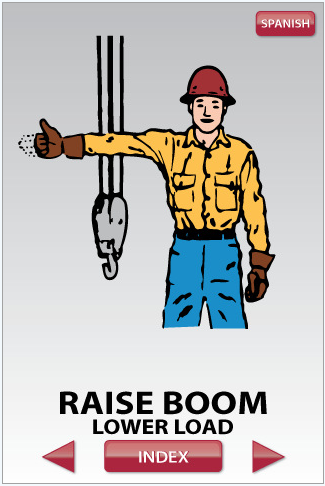
December 14 - The Specialized Carriers & Rigging Association (SC&RA - http://www.scranet.org/) now offers a free mobile phone application for instantly accessing all necessary crane hand signals. The new application is available in the iTunes App Store (http://itunes.apple.com/us/app/crane-operator-hand-signals/id403502739?mt=8) and Blackberry App World (http://appworld.blackberry.com/webstore/content/18294?lang=en).

Every signal included is compliant with the new OSHA Cranes and Derricks Standard, Appendix A to Subpart CC of Part 1926-Standard Hand Signals. Each signal is shown graphically so that operators can quickly and easily reference the appropriate signal for each command. All signals are available in English and Spanish.

This new app is intended for use before entering the workplace. SC&RA does not encourage the use of smartphones on jobsites.  The Specialized Carriers & Rigging Association (SC&RA) is an international trade association of more than 1,300 members from 43 nations. Members are involved in specialized transportation, machinery moving and erecting, industrial maintenance, millwrighting, crane and rigging operations, manufacturing and rental.

The U.S. Department of Labor‘s Occupational Safety and Health Administration (OSHA) released a historic new standard, addressing the use of cranes and derricks in construction and replacing a decades old standard. The significant number of fatalities associated with the use of cranes and derricks in construction and the considerable technological advances in equipment since the publication of the old rule, issued in 1971, led the Labor Department to undertake this rulemaking.
 
The final rule was published on August 9, 2010 by the Federal Register and became effective 90 days later.  The rule can be found at http://www.osha.gov/FedReg_osha_pdf/FED20100809.pdf.

A copy of the regulatory text is available at: http://www.osha.gov/doc/cranesreg.pdf