Monday, October 17, 2011

Falling Down on the Job


[Today’s Theatre Safety Blog post is presented by Guest Blogger and author Jenn Zuko Boughn.  She runs the Daily Cross Swords blog at http://bonzuko.com and wrote the book Stage Combat – Fisticuffs, Stunts and Swordplay for Theatre and Film.  Jenn is an instructor at Metro State College in Denver, Colorado, and her student-run stage combat club can be found on YouTube.  Further information on the subject can be found at http://en.wikipedia.org/wiki/Category:Theatrical_combat]

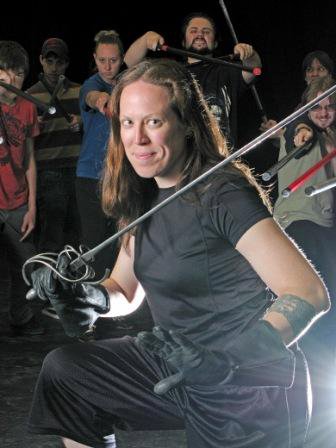
As a stage combat instructor (and performer); I always say that knowing how to fall properly is probably the most important movement skill one can learn.  The main reason for this is that it’s something that shows up in plays way more often than actual fight scenes do, and therefore is very often not accommodated for by the hiring of a fight choreographer or specialist.  Yet, an actor can be seriously injured if she merely hurls herself to the ground repeatedly without knowing what she’s doing.


When I teach advanced stage combat, I use different language when we learn basic skills for live theatre (stage falls), martial arts (break falls, rolls) and skills that are more for film, i.e. stunt work (being thrown, air break falls, falls from a height).  These three categories of how to fall down are vastly different in execution and are meant for very different things.

Live Theatre techniques are built for the world of the stage.  This means that actors, not stunt people or people who have training, are doing the falling.  They’re doing the falling in real time, on a hard stage floor, and with no special effects or safety equipment to speak of (barring knee pads and the like under a costume).  Most actors are not tumblers or martial artists with years of training, and even if they are, it’s unlikely they’ll be able to translate their falling skills from padded mats to a hard stage seamlessly.  Alongside the safety aspect of falling on a hard surface, there is the need for the fall to be theatrical—that is, an audience needs to be able to follow the physical move, not be yanked out of suspension of disbelief in concern for the actor, and most importantly the fall must be in line with the character’s arc. It’s not merely a cool move, it’s part of the story unfolding.

In live theatre falls an actor (again, not an expert) needs to be able to execute the move with all the above, multiple times.  A standard run for community or professional local theatre is around a month for rehearsal, and a month or two of performances.  An actor must be taught techniques that will allow them to perform these falls multiple times, often in short time frame, without injury.

Martial Arts techniques can be useful to a certain degree when it comes to staged combat for stage or film, especially as a style choice, but in general, martial arts falls aren’t a great idea for the stage.  Break falls and rolls are ways to cushion the blow of falling without undue injury when engaged in actual self defense.  The issues that arise from translating this to stage are threefold:
1)      Actual combat situations are much too fast and small for a live audience to be able to follow.
2)      Break falls and rolls on a hard floor will cause minor injury — even if done perfectly by someone with many years of training.  When done ‘adequately’ by someone who just learned how, they can result in devastating injuries.
3)      Rolling makes the character look particularly skilled in a unique way.  It’s rare that one actually plays a ninja on stage that would have these moves naturally occur within the course of the character’s story arc.  In other words, the martial arts version of falls, including rolling, can help anyone save themselves from in a variety of calamities from stage combat mistakes to slipping on the ice, but it can and will cause injury to the non-master, and is not nearly as theatrically useful.

Stunt work is different than stage combat falling in that the moves are inherently very dangerous, many not even possible to do on a regular hard stage.  This includes any falls that catch air, or come from tumbling mechanics, anything that must land from a height (even just a table), or anything that can’t be done without elaborate safety equipment in place, such as crash pads.
Stunt-type falling is typically done by a stunt person, not the actor, and is not done in real time, but rather in small bits, with many takes to ensure the best reaction makes it into the film.  Stunt work may be done repeatedly for the multiple takes, but not repeatedly in the same way over time that live theatre requires.  Wires, pads, and other equipment are available to help with the safety of the stunt person.  These things don’t violate an audience’s suspension of disbelief because they can be hidden off-camera, edited out, or otherwise concealed.

The only time that stunt-style falling can be appropriate for live theatre is if the stage itself is built for such things.  For example, the Spider-Man or Indiana Jones stunt shows seen at amusement parks are made with crash pads, wires, sprung floors, stunt people as actors, and other efforts to make the live show that is centered around the stunts.  In this case, the very visible equipment is part of the audience’s expectations, in that the show itself is not as much an immersive story but a display of skill.
This type of show is a different experience than what one would see in most live theatre, and in fact some current Broadway spectacle-musicals, such as Tarzan and Spiderman: Turn off the Dark tend to come under critical scrutiny because it’s apparent to an audience that the equipment is pervasive and clunky (which takes the audience out of the action), or the actors are in constant danger (which in effect does the same thing).

If an audience member is distracted by either too much equipment function showing, or by a true concern for the actors’ safety, there is no longer a suspension of disbelief, and therefore the audience is not engaged in an effective theatrical experience.

For falls on stage that not only work theatrically but are also safe, a trained fight choreographer must be used in the early rehearsal process, to embed the physical moves in the play in such a way that the actors may do their work without fear, and the audience may enjoy the piece without concern for their safety.

Monday, September 26, 2011

Nailed It! Will someone please dial 911?


Just because you have one doesn't mean that you know how to use it.  OSHA and NIOSH have teamed-up to publish a Nail Gun Safety Guide.

“Nail gun injuries are responsible for approximately 37,000 emergency room visits annually. In some cases, workers have died from their injuries,” said OSHA Administrator Dr. David Michaels. “This document will help construction employers make necessary changes to improve nail gun safety and protect their workers from preventable injuries and death.”

While nail guns are easy to operate and can increase productivity, they also can cause internal and external bodily injuries, according to OSHA. These injuries occur as a result of unintended nail discharge; nails that bounce off a hard surface or miss the work piece and become airborne; and disabling the gun’s safety features, among other causes.

The guidance outlines six steps to prevent nail gun injuries:
  1. Select the proper product: Use full sequential trigger nail guns.
  2. Provide training and keep a log of approved users.
  3. Establish written Nail Gun work procedures.
  4. Provide PPE and see that it is properly worn.
  5. Encourage reporting and discussion of injuries and close calls.
  6. Provide first aid and medical treatment.
 Download the guide here: www.osha.gov/Publications/NailgunFinal_508_02_optimized.pdf

Play nice.  Share your tools.  Share your knowledge.
Be careful where you point that thing.

Wednesday, September 21, 2011

Performers need some limits and restraints, too.

This video of a 1982 U2 concert at Gateshead clearly shows a performer that has completely disregarded his own safety (and possibly the safety of others had he fallen).  The artist climbs the support structure starting around 2:30 in the video.

Were any laws broken here?  Maybe not, as it was the artists' own initiative to do this, however, promoters, venue owners, stage managers, and staging rental companies must be on the alert for this type of unexpected and unplanned behavior so that proper precautions are taken to thwart it or see that it is done with the proper safety protocols in-place.

Monday, September 19, 2011

Where Are We Headed with Outdoor Concert Regulations?

PLSN published a Guest Editorial by this blogger in the September 2011 Issue of Projection, Lights and Staging News.  In it I discuss the potential for a coming storm of concert legislation that may affect the entertainment industry.  Check it out at:
http://www.plsn.com/current-issue/87-guest-editorial/7967-where-are-we-headed-with-outdoor-concert-regulations.html

Sunday, September 18, 2011

I think I'll go strapless on the catwalk today

Your nemesis - Expanded Metal Grating.
And his side-kick - Bar Grate.

Wurk Pads from the front.
 Working on the Gridiron Deck, Loading Gallery, or Beam Catwalk is not usually all that glamorous, but you can make a fashion statement that is functional and comfortable.  Who knows, maybe you will turn a few heads while wearing these Wurk Pads?  For some unknown reason, masochists must design these work surfaces, as someone that works upon them would never let this happen.  Theatre crews spend way too much time on their knees, and anything you can do to relieve some of that suffering is a good thing.
Wurk Pads - the secret revealed.

The key design element is that they use heavy duty clips that grab your pant legs and won't let go (well, unless you tell them to).  So, wa-la!  Nothing sneaking around behind the crook of your knees to bind-up and get all sweaty.  Sweet!  No sweat.

This can come in handy if you have big feet, too, as some over-the shoe knee pads just won't open-up far enough to slip over your work boots.  I suppose that if you had to work for a stretch on your hiney, you could clip one to each cheek and give them some relief, too.

Knee pads aren't just for crawling around on the steel, either:  the stage and shop floor can harbor small screws, nails, tacks, and other pebble-sized objects that can render your brain useless should you set your full weight down on them via your knee-cap, so put these in your PPE kit - and don't kowtow to anyone without them.

More info at:  http://simplifiedsafety.com/store/wurk-pad-clip-on-strapless-knee-pads.html

Friday, September 16, 2011

Rigging Schools set-up for December 2011 & January 2012

Columbus-McKinnon Entertainment Technology division (CMET) has scheduled more schools for rigging training.

Rigging Seminar (December 5th - 6th, 2011)
The Rigging Seminar will be presented by Eric Rouse, an ETCP Certified Rigger and ETCP Recognized Trainer. The head of the Scenic Technology program at Penn State University, Eric has been working in the industry for 20 years. He has designed fl ying systems and performed installations throughout the USA and in Japan.
  • This two-day rigging seminar is an intensive exploration of rigging terminology, equipment, and concepts.
  • Day one begins with basic rigging concepts and then progresses to more advanced principles. Topics will include truss rigging, fall protection, math concepts, and rigging formulas.
  • Day two will cover deadhangs, bridles, and the math used to determine sling length, tension, and vertical and horizontal forces on the building structure.
  • Taking this course is an excellent refresher if you are preparing for an industrial certification exam. Those individuals who are already certified will receive 12 renewal credits.
For additional information, please contact Dave Carmack at CM:

Phone: (276) 475-3124 extension 287 • Email: david.carmack@cmworks.com
----------------------------------------------------

Tomcat trusses has also announced their school for February 2012 to be held in beautiful Midland, Texas.  In 2008 in response to the changing needs of the industry and thanks to the input of a team of industry experts, TOMCAT launched a new and improved curriculum. These changes allowed participants to receive both beginning AND advanced training in their area of specialization:  Hoist or Rigging.  Participants can earn 32 renewal credits at each of these ETCP recognized workshops that provide a unique, hands-on learning experience with industry experts. Tomcat invites you to review the Hoist and Truss workshop section as well as the Rigging and Truss Workshop section to learn more about this unique training.

Tomcat Workshops include: All instruction and materials, lodging, lunches, dinners, snacks, transportation for dinner outings.

More information can be found at: http://tomcatglobal.com/workshop.html • Phone: (432) 694-7070  • Email: sales@tomcatusa.com

Thursday, September 8, 2011

PLASA Launches Safety in Entertainment Website

EW YORK - PLASA announces the launch of the Entertainment Industry Safety Initiative website, now live at www.safetyinentertainment.org. The site is designed to raise awareness of safety in the live event production industry among companies and individuals by providing information and resources regarding safe work practices, record keeping, accident reporting, and more. The site currently focuses on codes and regulations in the United States, but will be expanded to cover other countries in the future.

The website was created by PLASA after meeting with representatives from across the industry, including a variety of trade and professional associations, employers, venues, and labor unions last March at USITT. At the meeting, there was unanimous agreement among the attendees that there is a need and a desire for a central location where information can be easily found to help facilitate safety programs and to promote the general health and safety of the industry. Development of the website is ongoing, and contributions and suggestions from the industry are encouraged.  The site currently only focuses on the US resources, but it will be expanded to encompass resources from many countries.
 
The site includes news, information, and standards from the Occupational Safety and Health Administration (OSHA); references to relevant standards from ANSI (many created by PLASA's Technical Standards Program), NFPA, NEC, and NIOSH; OSHA technical resources, record keeping and reporting tools, sample forms, publications, and information about illness and injury prevention. Much of the information has been gathered and consolidated from participants in the inaugural meeting.
 
Eddie Raymond, Chairman of PLASA North America, said, "Employers have a responsibility to protect the lives and safety of their workers. We want to help make it easier to find information and tools that employers can use to facilitate their safety programs and compliance with OSHA."
 
Lori Rubinstein, Executive Director, North America, commented, "We had a tremendous response at our first meeting. Many of the participants have assisted in collecting these resources and making them available to the entire industry. Our hope is that this website will help make the industry a safer place to work."
 
For more information, please visit www.safetyinentertainment.org.