Thursday, June 23, 2011

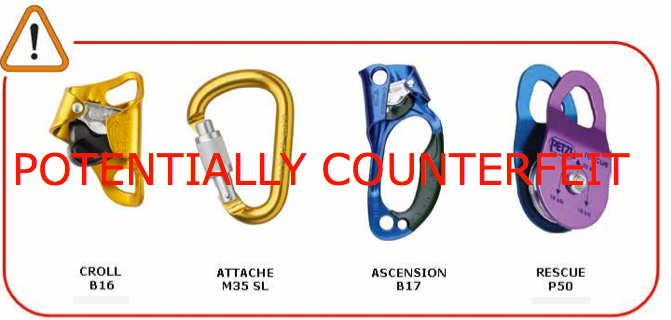
Petzl releases warning about counterfit PPE climbing products found


February 2011 - Recognized as a world leader in climbing and rescue hardware, Petzl has come forward to warn buyers about counterfit products they have discovered in the marketplace.  The products are visually identical to the true Petzl products, however they fail prematurely when loaded.  If you have purchased similar devices recently, then you should follow the manufacturer's instructions regarding inspection and assessment of the devices to ensure that what you have is an authentic Petzl product.

More information can be found at:
http://www.petzl.com/en/outdoor/news-1/2011/02/12/warning-regarding-presence-counterfeit-versions-petzl-products

Hats off to Petzl for being proactive with equipment safety.  It is an exceptional company that will publish warnings, recall notices, and keep their customers informed without someone telling them to do so.

If you vist their web site, be sure to check-out the wallpaper section - AMAZING PHOTOS!

Wednesday, June 1, 2011

National CPR & AED Awareness Week - June 1-7, 2011

In 2008, Congress designated the first week of June for observation of National CPR / AED Awareness Week, with the goal of encouraging all states, cities and towns to establish organized programs which provide CPR (Cardio Pulmonary Resuscitation) and AED (Automated External Defibrillators) training to the public.

People are being offered opportunities to learn how to save a life threatened by Sudden Cardiac Arrest (SCA).  The American Heart Association recommends that laypersons should learn “Hands Only” or continuous chest compression CPR.  Learn to save a life.  You would want someone to do the same for you.

People are also urged to learn how to use Automated External Defibrillators (AEDs), which are safety devices that are becoming more available in public locations so that they can be used immediately if someone collapses in SCA.  AEDs can restore a normal heartbeat, as long as they are used quickly and effectively.

American Heart Association - http://www.americanheart.org/

International Federation of Red Cross & Red Crescent Societies - http://www.ifrc.org/

Hands Only CPR - http://www.handsonlycpr.org/


National Safety Council - http://www.nsc.org

Many facilities have also recognized the need for Automated External Defibulators, or AED's.  These can save live of both staff and patrons in your performing arts facility.  You should have one in the lobby and backstage between the shop(s) and the stage.  Units should be in plain sight and readily accessible.  Employ clear signage to assist locating the units.  Photoluminescent signage is recommended.

Backstage, stress, falls, and/or electrical shock can be common causes of SCA, while in the front of house, it may be due to the sudden excitement in the show, patrons over-exerting themselves climbing stairs, or rushing to get to the show on-time.  Whatever the cause, having personnel and equipment available immediately is key to a good outcome.

Call for Help.  Don't forget that hardline (wired) phones are always best to call for emergency services, as cellular phones don't automatically track-back to the facility address.  Also remember to clearly post the facility address adjacent to the telephone.

How are you going to pay for an AED?  Local, state, and federal governments sometimes makes funding available for AEDs in the form of grants. Though finding these grants for your AED program can require an investment of both time of energy, the effort may be worthwhile.

Government funding: For federal funding options look at the Catalog of Federal Domestic Assistance at http://www.cfda.gov/

Private Funding: For funding from private organizations look at the Foundation Center at http://www.foundationcenter.org/

Other helpful information can be found at the
Proposal Development:  A written proposal is almost always required to apply for a grant. For assistance in writing an effective proposal, you can find excellent instructions and examples at http://www.minerandassociates.com/

A grant project can take weeks or months to complete. If your needs are more immediate, look toward civic groups such as your local PTA, Lions Clubs, Moose Lodges, Elks Clubs, Kiwanis, Rotary Clubs, and Masonic Temples. If your project is aimed at the well-being of children, a local Optimist Club could be a source.

Of course, it can't hurt to look to your own theatres' patrons and supporters for financial help.  Having an AED on-site can save their lives, too!

Other Grant Resources:
Sudden Cardiac Arrest Foundation - www.sca-aware.org/finding-funding
Zoll Medical Devices - www.zoll.com/medical-products/automated-external-defibrillators/aed-grant-information
AED Grant.Com - http://www.aedgrant.com/
Friday, May 20, 2011

Blow me. No, OSHA says don't blow me.


LOTO, or Lock-Out-Tag-Out, is a system where you secure equipment so that it cannot release energy that might harm someone.  Many people think that it's just for electrical devices, but that is only one application for LOTO.  Pneumatic, steam, spring, hydraulic and even gravitational movement are equally important.  Second to electricity, pneumatic, or air pressure, is probably one of the most common forms of energy to be managed by an LOTO program.  Compressed air systems are frequently used for dusting-off items in the shop, operating staplers, nailers, rotary tools like grinders and impact drivers (wrenches), pressurizing air painting equipment, and operating platform lifts and air casters.

When you need to service the equipment or delivery lines it is important that all of the pressure is bled from the system so that tools can't misfire, clamps or brakes can't change state, and hoses don't accidentally spray a blast of air into your face / eyes or discharge in close proximity to your skin.

To achieve this, there is a special safety valve called a Pneumatic Isolation Valve, or PIV.  It isolates the supply air stream from the delivery system, and it allows all back-pressure in the delivery system to be relieved safely - and it has a means to lock the valve so it can't be tampered with.

Bimba Manufacturing (www.bimba.com) has a great video that explains how one of these work:

Thursday, May 19, 2011

Be well hung


The PLASA International Rigging Conference, first held in 2010, has announced it's schedule for the Fall 2011 event in London, England.  Last year's event was the first of its kind, and provided a unique specialist forum that will brought together rigging companies, riggers, venue operators, tour and event production managers from around the globe. They focused specifically on rigging and working at height for temporary installations.
As the entertainment technology industry is going through a process of standardisation, there is a need for the international community to come together and discuss key issues, share knowledge and dispel myths. The expertise on offer at this conference will allow you to do that, with presentations from top industry individuals from the global rigging community.

With a balanced programme of presentations, panel discussions, Q&A sessions, and live demonstrations, the 2-day conference is designed to give you clarity on a wide range of current issues and will allow you the opportunity to air your questions and concerns with industry experts and your peers from around the globe.

A new event this year will be a one-day Rigger's Forum on September 11, just before the main conference.  This has been arranged to allow many that cannot attent the main conference to benefit from the great gathering of experts.
Registration and Conferencde Information can be found at:
http://www.plasariggingconference.com/
The PLASA Show will cun concurrently with the Rigging Conference from September 12 through 14, 2011 

Friday, May 13, 2011

OSHA Initiates Summer Safety Program for Heat Related Illnesses

Secretary of Labor Hilda L. Solis announced that OSHA is launching this national outreach initiative to educate workers and their employers about the hazards of working outdoors in the heat, as well as steps they can take to prevent heat-related illnesses.

“If you’re working outdoors, you’re at risk for heat-related illnesses that can cause serious medical problems and even death,” said Solis. “But heat illness can be prevented. This Labor Department campaign will reach across the country with a very simple message – water, rest and shade."

Information about identifying the warning signs of Heat Stroke, Dehydration, and Heat Stress can be found at http://www.osha.gov/SLTC/heatillness/index.html

With the summer concert and festival season upon us, don't forget to take precautions against Snakes, Bugs, Plants, Heat, and Weather.

Wednesday, April 27, 2011

Arbor Day is Time to Check Your Arbors

Your Counterweight Arbors are stressed-out.  Make them feel better by giving them a thorough check-up.  Doctor's Orders.

Things to check:

Top Plate Connections:
  • Make sure that all the screws, nuts, and bolts, are tight.
  • Check the Hauling Line rope to see that is secure and not worn.
  • Check the Lift Line Terminations to see that they are all secure.
Not Good Example . . .

 Check to see that Spreader Plates are accessible and Weight Locking Rings are in-use.
Not buried like this . . .
Check to see that the rods nuts are tight:

Tight nuts are good to keep your rod in place.
And check to see of the lower rope connection is properly tied-off:
Note the thimble to keep the rope from abrading on the lower arbor eye.

Keep a good eye on your arbors and watch for loose parts!  If something gives-way it could be deadly!

Every Day is Arbor Day in the Theatre


Monday, April 18, 2011

UK Training Opportunities for Health & Safety in the Theatre

RB Health & Safety Solutions, a UK based service company is now offering two courses focused especially on the unique needs of the theatre worker.

The first course is an all day session that addresses First Aid in the theatre environment.  It will cover topics from the regulatory and medical aspects so you will know what you can do, what you must do, and what you shouldn't do.  From burns and ban-aids, to resuscitation, shock, and transport of the injured, they will get you certified for 3 years.

More info at: www.rbhealthandsafety.co.uk/firstaidfortheatres.html

Their other training is only 3 hours, and it covers AEDs (Automatic Defibrillator Devices) so you can zap heart attack victims the right way and get their ticker beating again.
More info at: www.rbhealthandsafety.co.uk/aedfortheatres.html

Both of these courses can be invaluable for those working Front of House or Back of House.  Injuries and Heart Attacks can happen to Staff, Performers, and Guests at any time, so be prepared to come to their aid.  As a part of the theatre you need to be able to help those that have been injured.  Everything form a twisted-ankle to an electric shock can happen, not to mention serious falls, and injuries of all sort from tools.

For those of you that aren't in the UK, look-up your local Red Cross or Health and Safety training providers to get similar courses.

www.RedCross.org                www.AmericanHeart.org